QUESTION IMAGE
Question
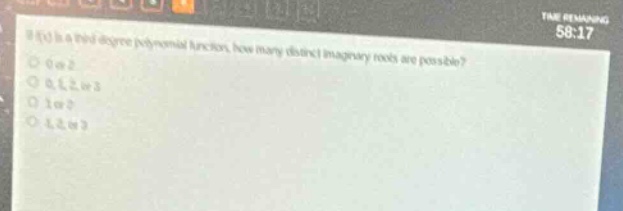
if \\(f(x)\\) is a third degree polynomial function, how many distinct imaginary roots are possible?
- 0 or 2
- 0, 1, 2, or 3
- 1 or 3
- 1, 2, or 3
⚡ Using what you learned: Understanding Polynomial Functions
Step 1: Analyze the degree of the polynomial
A third-degree polynomial function has exactly \(3\) complex roots (including real and imaginary roots), counted with multiplicity, according to the Fundamental Theorem of Algebra.
Step 2: Apply the Complex Conjugate Root Theorem
For polynomial functions with real coefficients, imaginary roots must always occur in conjugate pairs.
- If \(a + bi\) is a root, then its conjugate \(a - bi\) must also be a root.
- This means the number of imaginary roots must always be an even number (such as \(0\) or \(2\)).
Step 3: Determine the possible number of imaginary roots
Since the total number of roots is \(3\):
- If there are \(0\) imaginary roots, there are \(3\) real roots.
- If there are \(2\) imaginary roots, there is \(1\) real root.
- It is impossible to have \(1\) or \(3\) imaginary roots because they must occur in pairs.
Thus, the possible number of distinct imaginary roots is \(0\) or \(2\).

Snap & solve any problem in the app
Get step-by-step solutions on Sovi AI
Photo-based solutions with guided steps
Explore more problems and detailed explanations
0 or 2