QUESTION IMAGE
Question
thinking
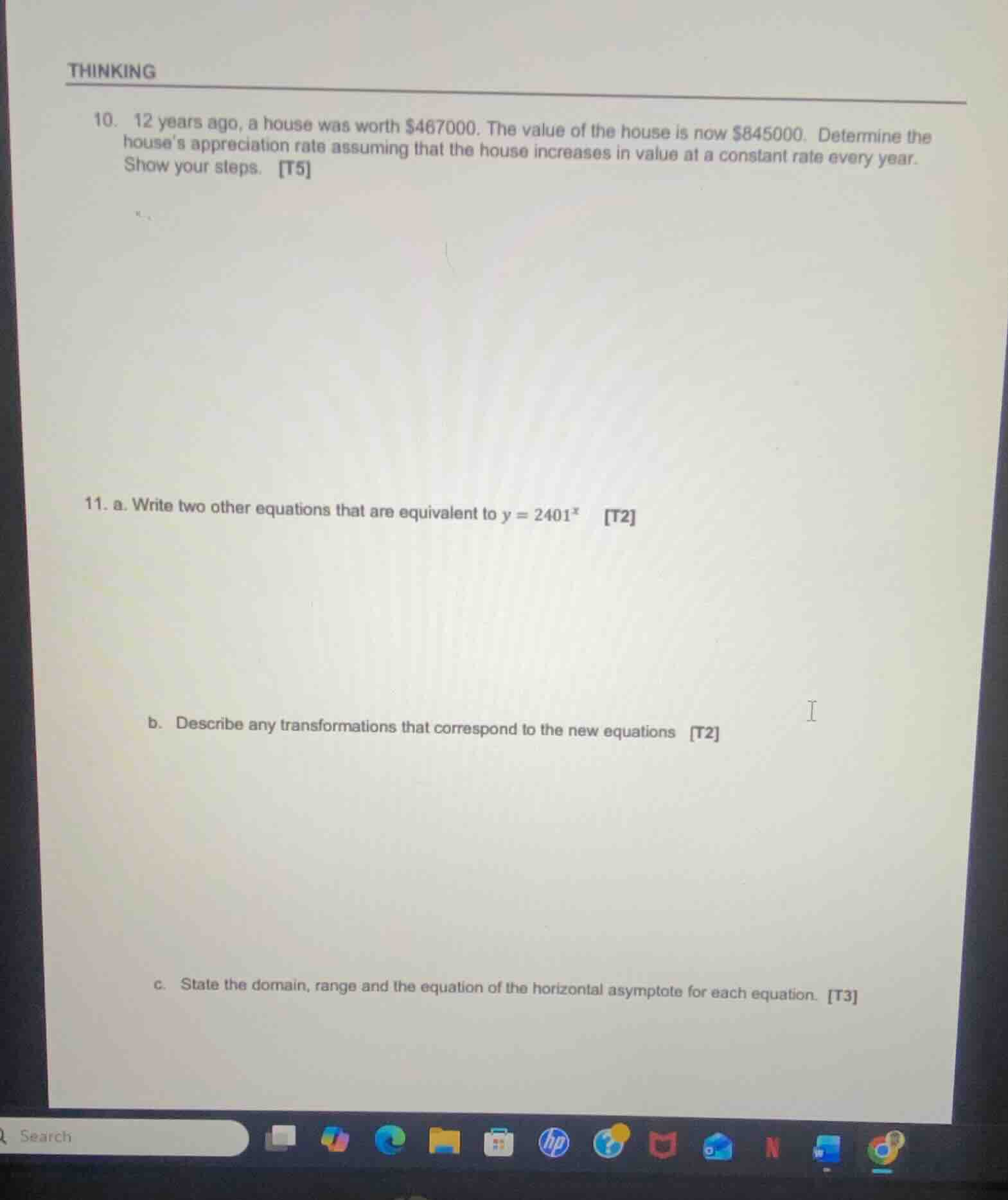
- 12 years ago, a house was worth $467000. the value of the house is now $845000. determine the houses appreciation rate assuming that the house increases in value at a constant rate every year. show your steps. t5
- a. write two other equations that are equivalent to \\(y = 2401^x\\) t2
b. describe any transformations that correspond to the new equations t2
c. state the domain, range and the equation of the horizontal asymptote for each equation. t3
<pre_analysis>
{
"quality": "clear",
"question_count": 4,
"skills_matched": [
"step_cot",
"explain_then_answer",
"quick"
],
"needs_drawing": false,
"concepts_used": [],
"new_concepts": [
"Exponential Appreciation",
"Equivalent Exponential Equations"
],
"current_concepts": [
"Exponential Growth and Decay",
"Exponent Rules",
"Function Transformations"
]
}
</pre_analysis>
<reasoning>
Solve for the appreciation rate in Question 10
\[
\]
Find equivalent equations for Question 11a
\[
\]
Describe transformations for Question 11b
\[
\]
State domain, range, and asymptote for Question 11c
\[
\]
</reasoning>
<answer>
Question 10
The house's appreciation rate is approximately \(5.06\%\) per year.
Question 11
a.
Two equivalent equations are:
- \(y = 7^{4x}\)
- \(y = 49^{2x}\)
b.
- For \(y = 7^{4x}\), the graph is horizontally compressed by a factor of \(\frac{1}{4}\) compared to the parent function \(y = 7^x\).
- For \(y = 49^{2x}\), the graph is horizontally compressed by a factor of \(\frac{1}{2}\) compared to the parent function \(y = 49^x\).
c.
For all three equivalent equations (\(y = 2401^x\), \(y = 7^{4x}\), and \(y = 49^{2x}\)):
- Domain: \((-\infty, \infty)\)
- Range: \((0, \infty)\)
- Horizontal Asymptote: \(y = 0\)
</answer>
<post_analysis>
{
"subject": "Mathematics",
"question_type": "Multi-part",
"knowledge_point": [
"Mathematics",
"Algebra",
"Exponential Functions"
]
}
</post_analysis>
Snap & solve any problem in the app
Get step-by-step solutions on Sovi AI
Photo-based solutions with guided steps
Explore more problems and detailed explanations
<pre_analysis>
{
"quality": "clear",
"question_count": 4,
"skills_matched": [
"step_cot",
"explain_then_answer",
"quick"
],
"needs_drawing": false,
"concepts_used": [],
"new_concepts": [
"Exponential Appreciation",
"Equivalent Exponential Equations"
],
"current_concepts": [
"Exponential Growth and Decay",
"Exponent Rules",
"Function Transformations"
]
}
</pre_analysis>
<reasoning>
Solve for the appreciation rate in Question 10
\[
\]
Find equivalent equations for Question 11a
\[
\]
Describe transformations for Question 11b
\[
\]
State domain, range, and asymptote for Question 11c
\[
\]
</reasoning>
<answer>
Question 10
The house's appreciation rate is approximately \(5.06\%\) per year.
Question 11
a.
Two equivalent equations are:
- \(y = 7^{4x}\)
- \(y = 49^{2x}\)
b.
- For \(y = 7^{4x}\), the graph is horizontally compressed by a factor of \(\frac{1}{4}\) compared to the parent function \(y = 7^x\).
- For \(y = 49^{2x}\), the graph is horizontally compressed by a factor of \(\frac{1}{2}\) compared to the parent function \(y = 49^x\).
c.
For all three equivalent equations (\(y = 2401^x\), \(y = 7^{4x}\), and \(y = 49^{2x}\)):
- Domain: \((-\infty, \infty)\)
- Range: \((0, \infty)\)
- Horizontal Asymptote: \(y = 0\)
</answer>
<post_analysis>
{
"subject": "Mathematics",
"question_type": "Multi-part",
"knowledge_point": [
"Mathematics",
"Algebra",
"Exponential Functions"
]
}
</post_analysis>