QUESTION IMAGE
Question
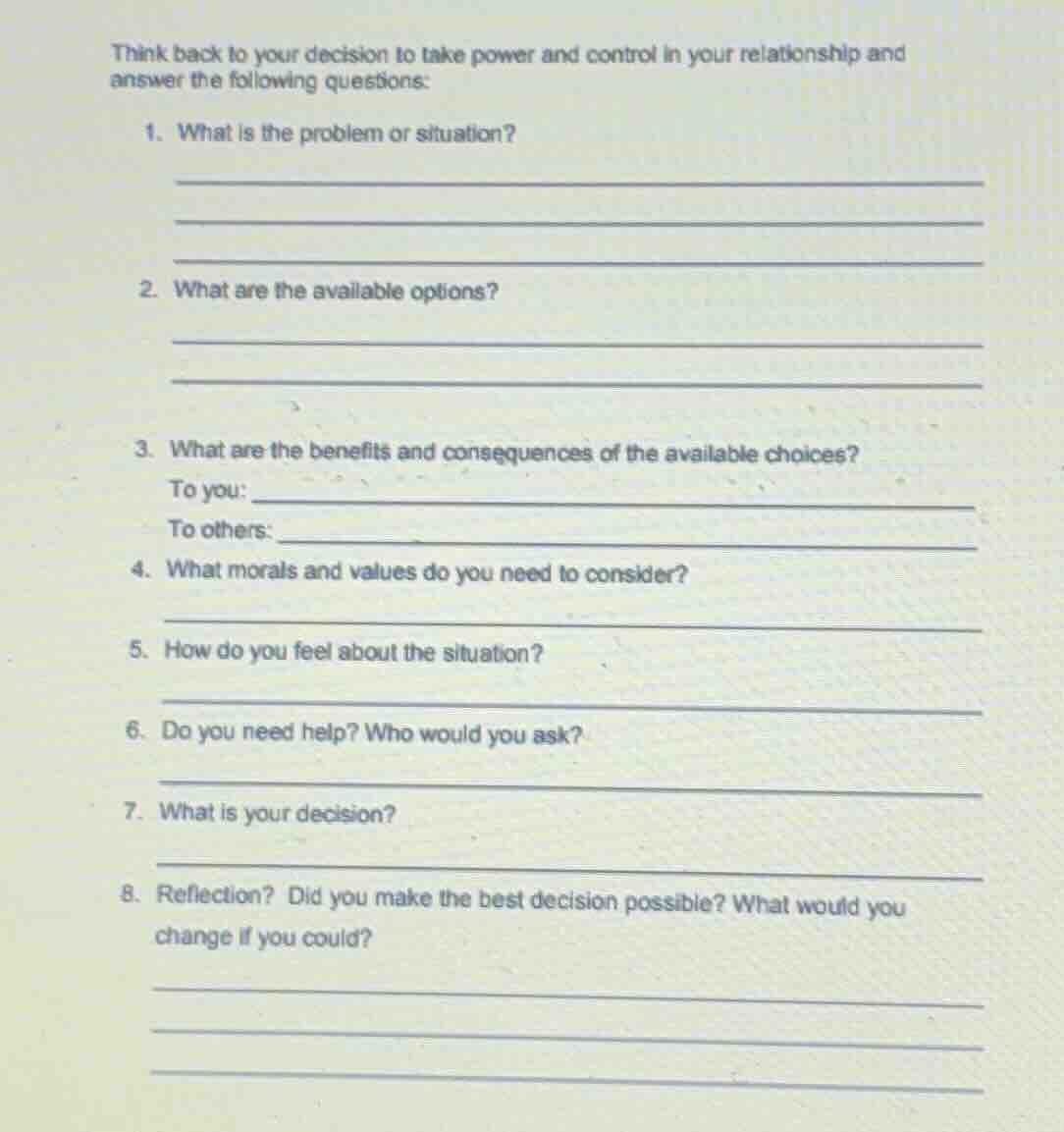
think back to your decision to take power and control in your relationship and answer the following questions:
- what is the problem or situation?
- what are the available options?
- what are the benefits and consequences of the available choices?
to you:
to others:
- what morals and values do you need to consider?
- how do you feel about the situation?
- do you need help? who would you ask?
- what is your decision?
- reflection? did you make the best decision possible? what would you change if you could?
Analyze the prompt context
The worksheet asks the student to reflect on a specific past choice: "Think back to your decision to take power and control in your relationship and answer the following questions." This context relates directly to behavioral therapy, relationship dynamics, and interventions addressing coercive control or power imbalances. We will guide the student through a structured, therapeutic decision-making framework to analyze this situation constructively.
Identify the problem or situation
Using the Coercive Control Intervention and Decision-Making Process knowledge points, we define the core issue. Taking "power and control" in a relationship creates an unhealthy, non-egalitarian dynamic. The situation involves a conflict or insecurity where one partner attempted to dominate or dictate terms rather than communicating as equals.
Outline available options
Using the Decision-Making Process knowledge point, we evaluate alternative paths.
- Option A (The past choice): Asserting dominance, monitoring, or controlling the partner's actions to manage personal anxiety or conflict.
- Option B (The healthy alternative): Engaging in open, respectful communication, setting mutual boundaries, and practicing active listening.
- Option C: Seeking external support (therapy, counseling) to address underlying insecurities.
Evaluate benefits and consequences
Using the Decision-Making Process knowledge point:
- To you:
- Benefits of control: Temporary, superficial sense of security or relief from anxiety.
- Consequences of control: Increased isolation, guilt, hyper-vigilance, and eventual breakdown of trust.
- To others (the partner):
- Benefits of control: None.
- Consequences of control: Loss of autonomy, anxiety, fear, resentment, and emotional distress.
Consider morals, values, and emotions
Using the Relationship Communication knowledge point, healthy relationships require mutual respect, equality, trust, and honesty. Controlling behaviors violate these core values. Emotionally, the situation often stems from fear, insecurity, or anger, but results in shame, frustration, or sadness for both parties.
Determine help, decisions, and reflection
Using the Coercive Control Intervention knowledge point, addressing power struggles requires professional guidance (such as a behavioral therapist, counselor, or support group) and a conscious decision to practice equality. Reflection shows that controlling decisions are never sustainable or healthy; a constructive change involves shifting toward collaborative problem-solving and emotional self-regulation.

Snap & solve any problem in the app
Get step-by-step solutions on Sovi AI
Photo-based solutions with guided steps
Explore more problems and detailed explanations
Question 1
What is the problem or situation?
<blank>The situation involves attempting to assert dominance, power, or control over a partner during a relationship conflict or period of insecurity, rather than treating them as an equal partner.</blank>
Question 2
What are the available options?
<blank>The options include: (1) Continuing to use controlling behaviors to manage the situation, (2) Stepping back to practice open, respectful communication and active listening, or (3) Seeking professional guidance to address the root causes of the need for control.</blank>
Question 3
What are the benefits and consequences of the available choices?
To you: <blank>Benefits: A temporary, false sense of security or immediate compliance. Consequences: Long-term guilt, anxiety, loss of genuine connection, and the eventual destruction of trust.</blank>
To others: <blank>Benefits: None. Consequences: Emotional distress, loss of personal autonomy, fear, and deep resentment.</blank>
Question 4
What morals and values do you need to consider?
<blank>The core values to consider are mutual respect, equality, trust, personal autonomy, and empathy for your partner's feelings and rights.</blank>
Question 5
How do you feel about the situation?
<blank>The situation typically provokes feelings of anxiety, fear of losing the relationship, or anger initially, followed by regret, sadness, and shame upon reflection.</blank>
Question 6
Do you need help? Who would you ask?
<blank>Yes, professional help is highly beneficial. I would ask a licensed relationship counselor, a behavioral therapist, or join a specialized support group focused on healthy relationship dynamics.</blank>
Question 7
What is your decision?
<blank>My decision is to actively relinquish controlling behaviors, commit to relationship equality, and practice healthy, non-coercive communication strategies.</blank>
Question 8
Reflection? Did you make the best decision possible? What would you change if you could?
<blank>No, choosing power and control was not the best decision because it damaged the relationship and hurt my partner. If I could change it, I would address my insecurities directly through self-reflection and communicate my feelings honestly without trying to manipulate the outcome.</blank>