QUESTION IMAGE
Question
text-dependent questions
directions: for the following questions, choose the best answer or respond in complete sentences.
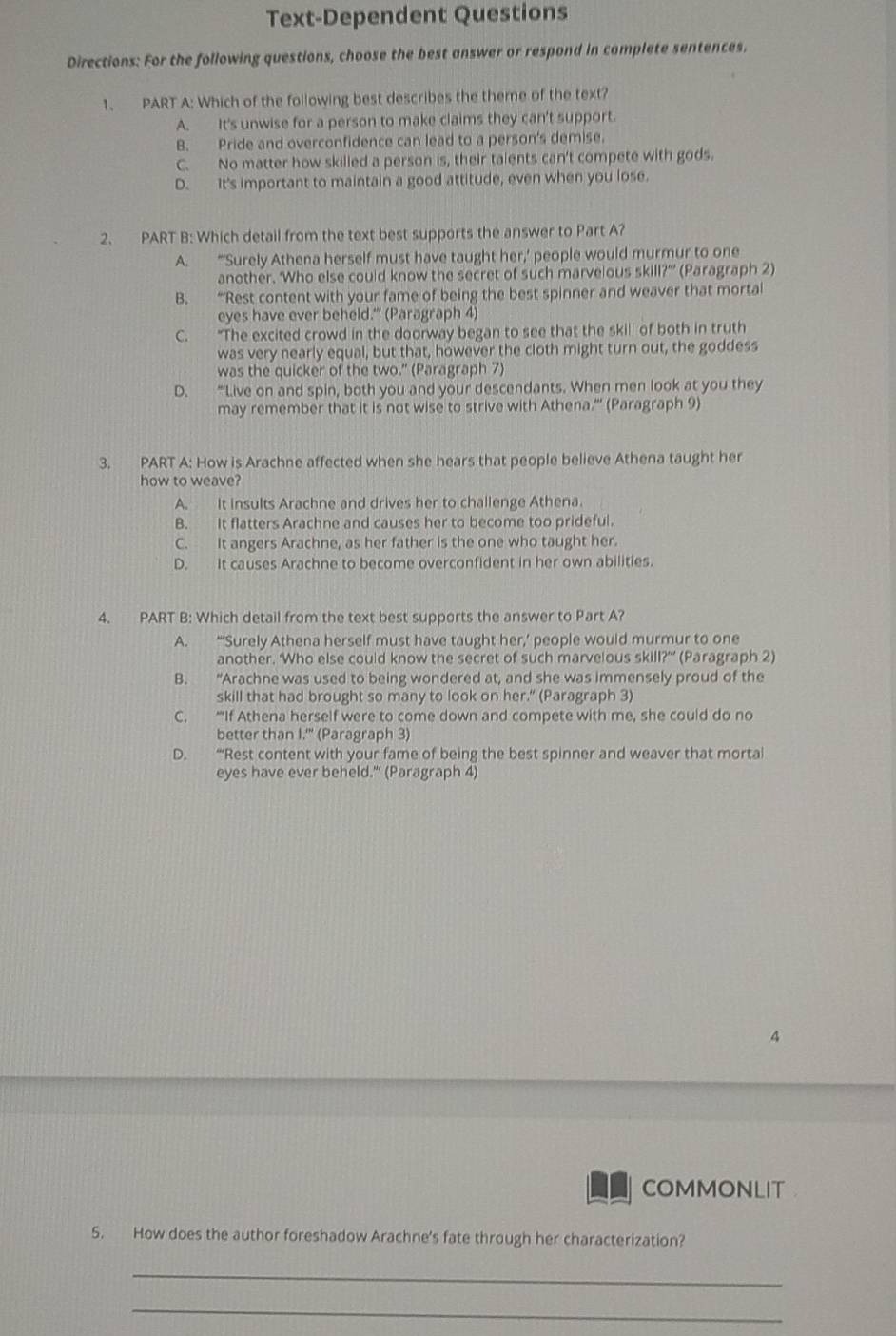
- part a: which of the following best describes the theme of the text?
a. its unwise for a person to make claims they cant support.
b. pride and overconfidence can lead to a persons demise.
c. no matter how skilled a person is, their talents cant compete with gods.
d. its important to maintain a good attitude, even when you lose.
- part b: which detail from the text best supports the answer to part a?
a. \surely athena herself must have taught her, people would murmur to one another. who else could know the secret of such marvelous skill?\ (paragraph 2)
b.
est content with your fame of being the best spinner and weaver that mortal eyes have ever beheld.\ (paragraph 4)
c. \the excited crowd in the doorway began to see that the skill of both in truth was very nearly equal, but that, however the cloth might turn out, the goddess was the quicker of the two.\ (paragraph 7)
d. \live on and spin, both you and your descendants. when men look at you they may remember that it is not wise to strive with athena.\ (paragraph 9)
- part a: how is arachne affected when she hears that people believe athena taught her how to weave?
a. it insults arachne and drives her to challenge athena.
b. it flatters arachne and causes her to become too prideful.
c. it angers arachne, as her father is the one who taught her.
d. it causes arachne to become overconfident in her own abilities.
- part b: which detail from the text best supports the answer to part a?
a. \surely athena herself must have taught her, people would murmur to one another. who else could know the secret of such marvelous skill?\ (paragraph 2)
b. \arachne was used to being wondered at, and she was immensely proud of the skill that had brought so many to look on her.\ (paragraph 3)
c. \if athena herself were to come down and compete with me, she could do no better than i.\ (paragraph 3)
d.
est content with your fame of being the best spinner and weaver that mortal eyes have ever beheld.\ (paragraph 4)
- how does the author foreshadow arachnes fate through her characterization?
🆕 New Concept Discovered: Theme and Supporting Evidence
Connecting central messages to specific textual details.
Step 1: Analyze Question 1 (Theme of the story)
The story of Arachne is a classic Greek myth about a highly skilled mortal weaver who boasts that her skill is greater than that of the goddess Athena. This hubris (excessive pride) leads her to challenge a deity, resulting in her ultimate downfall when she is transformed into a spider.
- Option A focuses on making unsupported claims, but Arachne actually is incredibly skilled.
- Option B directly addresses how her extreme pride and overconfidence lead to her ruin (demise).
- Option C is too broad and misses the moral lesson about pride.
- Option D focuses on sportsmanship, which does not fit the tragic nature of the myth.
Therefore, the best description of the theme is B.
Step 2: Analyze Question 2 (Evidence for the theme)
We need to find the quote that best supports the theme that pride and overconfidence lead to a person's demise (Option B in Part A).
- Option D ("Live on and spin, both you and your descendants. When men look at you they may remember that it is not wise to strive with Athena.") shows the final consequence of Arachne's pride—her transformation into a spider as a warning to other mortals not to challenge the gods. This directly supports her demise due to her pride.
Therefore, the best supporting detail is D.
Step 3: Analyze Question 3 (Arachne's reaction to rumors)
We need to determine how Arachne is affected when she hears that people believe Athena taught her how to weave.
- In the myth, Arachne is highly insulted by the suggestion that her skill is not entirely her own, which drives her to angrily deny it and challenge Athena to a weaving contest to prove her independent superiority.
Therefore, the correct option is A.
Step 4: Analyze Question 4 (Evidence for Arachne's reaction)
We need to find the quote that best supports the answer to Part A (that she is insulted and driven to challenge Athena).
- Option C ("If Athena herself were to come down and compete with me, she could do no better than I.") directly shows her defensive reaction to the rumors, where she actively issues a challenge to the goddess to prove her own supreme talent.
Therefore, the best supporting detail is C.
Step 5: Analyze Question 5 (Foreshadowing through characterization)
To answer how the author foreshadows Arachne's fate through her characterization, we look at her dominant personality traits:
- Her Hubris and Pride: Arachne is characterized as incredibly proud, boastful, and dismissive of the gods. In Greek mythology, mortals who exhibit extreme pride (hubris) and compare themselves to gods are invariably punished.
- Foreshadowing: By characterizing Arachne as someone who refuses to give credit to the gods and actively insults Athena, the author sets up an inevitable confrontation. Her stubborn refusal to back down, even when warned, signals to the reader that her arrogance will lead directly to her tragic punishment.
---

Snap & solve any problem in the app
Get step-by-step solutions on Sovi AI
Photo-based solutions with guided steps
Explore more problems and detailed explanations
1. Part A
B — Pride and overconfidence can lead to a person's demise.
2. Part B
D — "Live on and spin, both you and your descendants. When men look at you they may remember that it is not wise to strive with Athena." (Paragraph 9)
3. Part A
A — It insults Arachne and drives her to challenge Athena.
4. Part B
C — "If Athena herself were to come down and compete with me, she could do no better than I." (Paragraph 3)
5. Written Response
The author foreshadows Arachne's tragic fate by characterizing her with extreme pride, arrogance, and hubris. By showing that Arachne is so consumed by her own weaving skills that she openly denies any divine influence and boasts that she is superior to the goddess Athena, the author sets up a classic mythological conflict. In Greek myths, mortals who challenge the gods are always punished. Therefore, her boastful attitude and refusal to show humility immediately signal to the reader that her overconfidence will lead directly to her downfall.