QUESTION IMAGE
Question
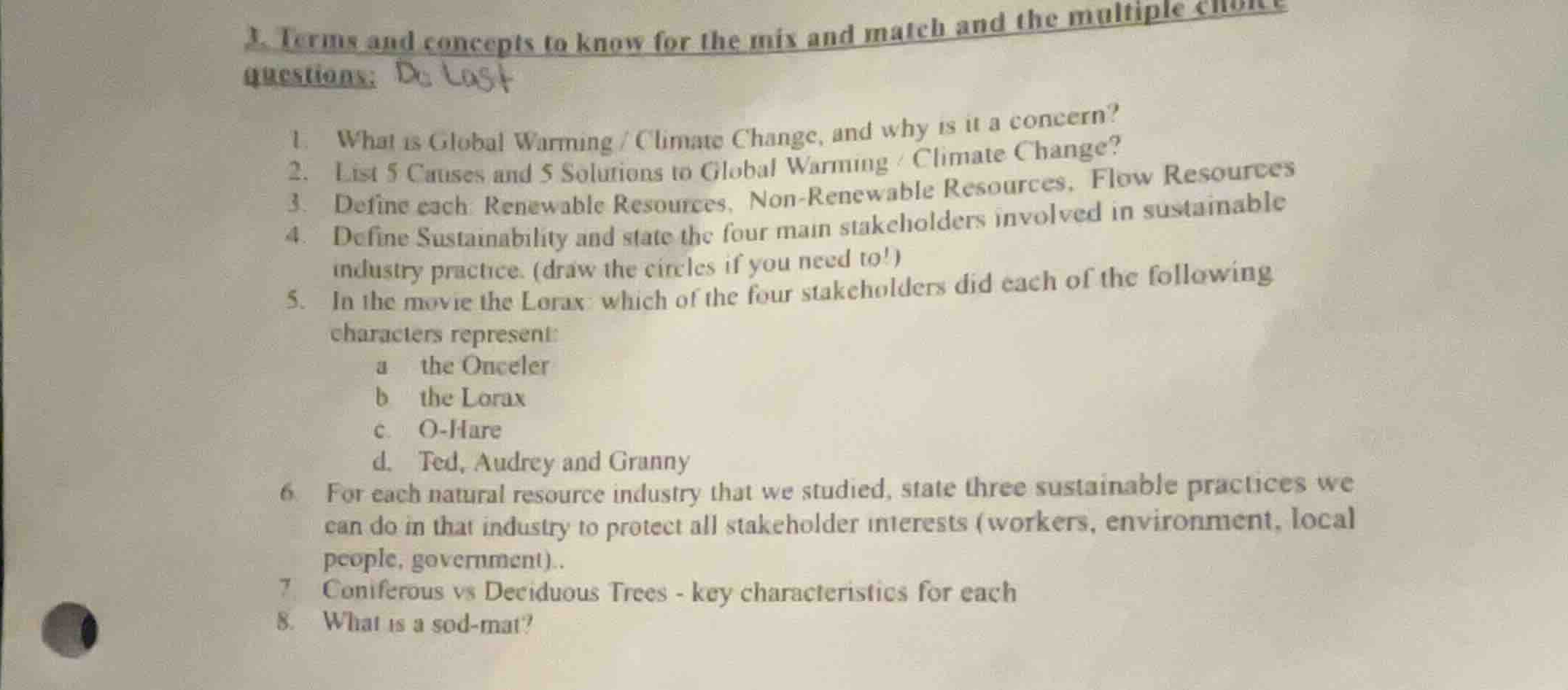
- terms and concepts to know for the mix and match and the multiple choice questions: do last
- what is global warming / climate change, and why is it a concern?
- list 5 causes and 5 solutions to global warming / climate change?
- define each: renewable resources, non-renewable resources, flow resources
- define sustainability and state the four main stakeholders involved in sustainable industry practice. (draw the circles if you need to!)
- in the movie the lorax: which of the four stakeholders did each of the following characters represent:
a. the onceler
b. the lorax
c. o-hare
d. ted, audrey and granny
- for each natural resource industry that we studied, state three sustainable practices we can do in that industry to protect all stakeholder interests (workers, environment, local people, government).
- coniferous vs deciduous trees - key characteristics for each
- what is a sod-mat?
Define climate change and its impacts
Climate change refers to long-term shifts in global temperatures and weather patterns, primarily driven by human activities like burning fossil fuels. It is a major concern because it leads to rising sea levels, extreme weather events, habitat loss, and threats to food and water security.
Identify causes and solutions of global warming
Five major causes include fossil fuel combustion, deforestation, industrial processes, agricultural emissions (methane), and waste landfills. Five key solutions are transitioning to renewable energy, improving energy efficiency, reforestation, adopting sustainable agriculture, and implementing carbon capture technologies.
Classify types of natural resources
Resources are classified by their replenishment rates:
- Renewable Resources: Replenish naturally at a rate equal to or faster than consumption (e.g., solar, wind).
- Non-Renewable Resources: Exist in finite amounts and deplete with use (e.g., coal, oil).
- Flow Resources: Constantly in motion and must be used where and when they occur (e.g., running water, wind).
Explain sustainability and its stakeholders
Sustainability means meeting current needs without compromising the ability of future generations to meet theirs. The four main stakeholders in sustainable industry practices are:
- Industry/Businesses (seeking profit and production)
- Workers/Employees (seeking fair wages and safety)
- Local Communities/Indigenous Peoples (seeking health and cultural preservation)
- Government/Environment (seeking regulation and ecological protection)
Analyze Lorax characters as stakeholders
In the context of environmental stakeholders:
- The Once-ler: Represents Industry/Business (focused on production and profit).
- The Lorax: Represents the Environment/Nature (advocating for ecological preservation).
- O-Hare: Represents exploitative commercial interests/monopolies capitalizing on environmental degradation.
- Ted, Audrey, and Granny: Represent the Public/Local Community (seeking a healthy, livable environment).
Propose sustainable resource practices
For key resource industries (such as Forestry, Mining, and Fishing):
- Forestry: Selective logging instead of clear-cutting, mandatory replanting (reforestation), and protecting old-growth habitats.
- Mining: Minimizing tailing pond leaks, reclaiming mined land post-extraction, and reducing water consumption.
- Fishing: Enforcing catch quotas, banning destructive gear (like bottom trawling), and establishing marine protected areas.
Compare tree classifications
- Coniferous Trees: Softwoods, needle-like leaves, evergreen (retain needles year-round), and bear cones (e.g., pine, spruce).
- Deciduous Trees: Hardwoods, broad leaves, shed leaves annually in autumn, and typically bear flowers/fruit (e.g., maple, oak).
Define a sod-mat
A sod-mat (or turf mat) is a dense, interconnected layer of soil, grass roots, and decomposing organic matter. It helps bind the topsoil together, preventing erosion and…

Snap & solve any problem in the app
Get step-by-step solutions on Sovi AI
Photo-based solutions with guided steps
Explore more problems and detailed explanations
Question 1
Global Warming/Climate Change is the long-term rise in Earth's average temperature due to greenhouse gas accumulation. It is a concern because it causes rising sea levels, severe weather, habitat destruction, and agricultural disruption.
Question 2
- 5 Causes: Burning fossil fuels, deforestation, industrial emissions, intensive agriculture (methane), and waste decomposition in landfills.
- 5 Solutions: Transitioning to solar/wind energy, reforestation, increasing energy efficiency, promoting public transit, and adopting sustainable farming.
Question 3
- Renewable Resources: Resources that regenerate naturally on a human timescale (e.g., timber, fish).
- Non-Renewable Resources: Finite resources that cannot be replaced once depleted (e.g., coal, oil, minerals).
- Flow Resources: Resources that must be used when and where they occur because they are constantly in motion (e.g., wind, solar radiation, running water).
Question 4
- Sustainability: Meeting present needs without compromising the ability of future generations to meet their own needs.
- Four Main Stakeholders:
- Industry/Owners (Profit & Production)
- Workers (Jobs & Safety)
- Local Communities (Health & Culture)
- Government/Environment (Regulations & Conservation)
Question 5
- a. The Once-ler: Industry / Business Owners
- b. The Lorax: The Environment / Nature
- c. O-Hare: Exploitative Commercial Interests / Monopolistic Business
- d. Ted, Audrey, and Granny: Local Community / Consumers
Question 6
- Forestry: Selective harvesting, mandatory replanting, and protecting biodiversity corridors.
- Fishing: Enforcing strict catch quotas, using selective nets to reduce bycatch, and respecting seasonal closures.
- Mining: Reclaiming and restoring land after mining, recycling wastewater, and transitioning to electric mining vehicles.
Question 7
- Coniferous Trees: Have needles, produce cones, are typically evergreen, and are classified as softwoods (e.g., pine, spruce).
- Deciduous Trees: Have broad leaves, shed their leaves in autumn, and are classified as hardwoods (e.g., maple, birch).
Question 8
A sod-mat is a thick, tightly woven layer of grass roots, soil, and organic matter that holds the topsoil together, preventing soil erosion and helping retain moisture.