QUESTION IMAGE
Question
task 2: multichoice questions
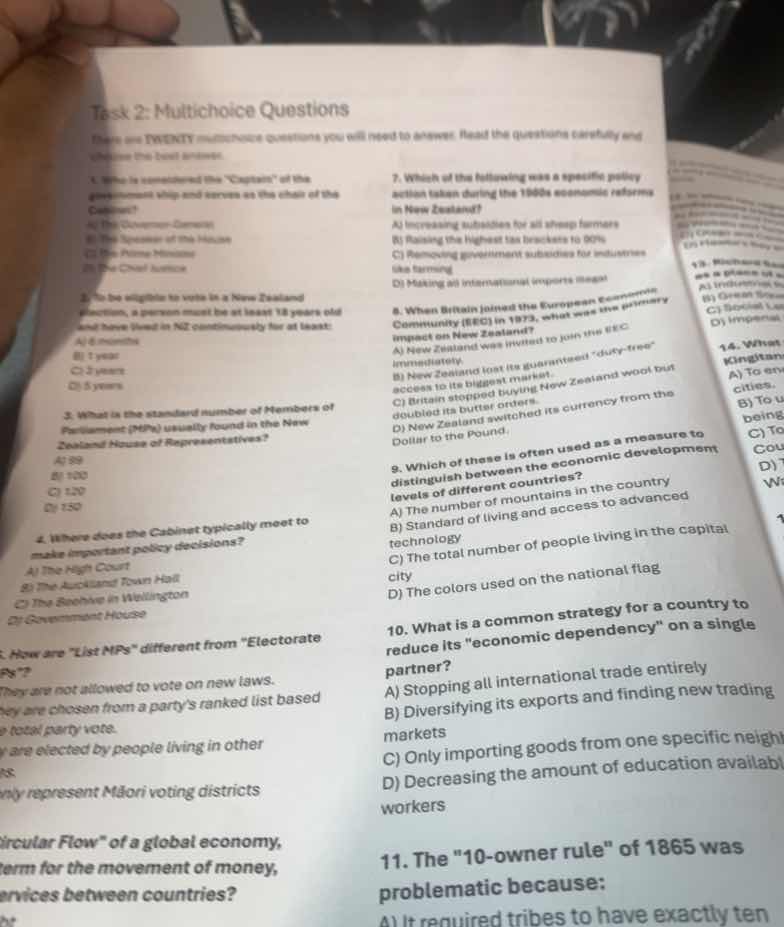
there are twenty multichoice questions you will need to answer. read the questions carefully and choose the best answer.
- who is considered the \captain\ of the government ship and serves as the chair of the cabinet?
a) the governor-general
b) the speaker of the house
c) the prime minister
d) the chief justice
- to be eligible to vote in a new zealand election, a person must be at least 18 years old and have lived in nz continuously for at least:
a) 6 months
b) 1 year
c) 2 years
d) 5 years
- what is the standard number of members of parliament (mps) usually found in the new zealand house of representatives?
a) 99
b) 100
c) 120
d) 150
- where does the cabinet typically meet to make important policy decisions?
a) the high court
b) the auckland town hall
c) the beehive in wellington
d) government house
- how are \list mps\ different from \electorate mps\?
a) they are not allowed to vote on new laws.
b) they are chosen from a partys ranked list based on total party vote.
c) they are elected by people living in other districts.
d) they only represent māori voting districts.
- in the \circular flow\ of a global economy, what is the term for the movement of money, goods, and services between countries?
- which of the following was a specific policy action taken during the 1980s economic reforms in new zealand?
a) increasing subsidies for all sheep farmers
b) raising the highest tax brackets to 90%
c) removing government subsidies for industries like farming
d) making all international imports illegal
- when britain joined the european economic community (eec) in 1973, what was the primary impact on new zealand?
a) new zealand was invited to join the eec immediately.
b) new zealand lost its guaranteed \duty-free\ access to its biggest market.
c) britain stopped buying new zealand wool but doubled its butter orders.
d) new zealand switched its currency from the dollar to the pound.
- which of these is often used as a measure to distinguish between the economic development levels of different countries?
a) the number of mountains in the country
b) standard of living and access to advanced technology
c) the total number of people living in the capital city
d) the colors used on the national flag
- what is a common strategy for a country to reduce its \economic dependency\ on a single partner?
a) stopping all international trade entirely
b) diversifying its exports and finding new trading markets
c) only importing goods from one specific neighbor
d) decreasing the amount of education available to workers
- the \10-owner rule\ of 1865 was problematic because:
Analyze Executive Branch roles
The first question asks who is considered the "Captain" of the government ship and serves as the chair of the Cabinet. In the Executive Branch of the New Zealand Government, the Prime Minister acts as the head of government and chairs Cabinet meetings. Therefore, the correct option is (C).
Determine voting eligibility requirements
The second question asks about the residency requirement for voting eligibility in New Zealand. To register to vote, a person must be at least 18 years old, a New Zealand citizen or permanent resident, and have lived in New Zealand continuously for at least 1 year at some point in their life. Therefore, the correct option is (B).
Identify standard Parliament size
The third question asks for the standard number of Members of Parliament (MPs) in the New Zealand House of Representatives. Under the MMP Voting System, the standard number of seats is 120, though overhang seats can occasionally alter this total. Therefore, the correct option is (C).
Locate Cabinet meeting venue
The fourth question asks where the Cabinet typically meets to make policy decisions. The Cabinet meets in the executive wing of the New Zealand Parliament Buildings, commonly known as the Beehive, located in Wellington. Therefore, the correct option is (C).
Compare List and Electorate MPs
The fifth question asks how "List MPs" differ from "Electorate MPs". Under the MMP Voting System, Electorate MPs are directly elected by voters in geographic electorates, whereas List MPs are chosen from a political party's ranked list based on the party's overall share of the party vote. Therefore, the correct option is (B).
Analyze 1980s economic reforms
The seventh question asks about a specific policy action taken during the 1980s economic reforms in New Zealand, a period widely known as Rogernomics. A core pillar of these reforms was deregulation and the removal of government subsidies for industries, particularly farming, to expose the economy to international market forces. Therefore, the correct option is (C).
Assess impact of Britain joining the EEC
The eighth question asks about the primary impact on New Zealand when Britain joined the European Economic Community (EEC) in 1973. Historically, Britain was New Zealand's primary export market. Upon joining the EEC, Britain had to adopt common external tariffs, meaning New Zealand lost its preferential, guaranteed duty-free access to its largest market. Therefore, the correct option is (B).
Identify economic development measures
The ninth question asks which measure is used to distinguish between the economic development levels of different countries. Standard of living (oft…

Snap & solve any problem in the app
Get step-by-step solutions on Sovi AI
Photo-based solutions with guided steps
Explore more problems and detailed explanations
Question 1
- (A) The Governor-General
- (B) The Speaker of the House
- (C) The Prime Minister (Correct answer)
- (D) The Chief Justice
Question 2
- (A) 6 months
- (B) 1 year (Correct answer)
- (C) 2 years
- (D) 5 years
Question 3
- (A) 99
- (B) 100
- (C) 120 (Correct answer)
- (D) 150
Question 4
- (A) The High Court
- (B) The Auckland Town Hall
- (C) The Beehive in Wellington (Correct answer)
- (D) Government House
Question 5
- (A) They are not allowed to vote on new laws.
- (B) They are chosen from a party's ranked list based on total party vote. (Correct answer)
- (C) They are elected by people living in other districts.
- (D) They only represent Māori voting districts.
Question 7
- (A) Increasing subsidies for all sheep farmers
- (B) Raising the highest tax brackets to 90%
- (C) Removing government subsidies for industries like farming (Correct answer)
- (D) Making all international imports illegal
Question 8
- (A) New Zealand was invited to join the EEC immediately.
- (B) New Zealand lost its guaranteed "duty-free" access to its biggest market. (Correct answer)
- (C) Britain stopped buying New Zealand wool but doubled its butter orders.
- (D) New Zealand switched its currency from the Dollar to the Pound.
Question 9
- (A) The number of mountains in the country
- (B) Standard of living and access to advanced technology (Correct answer)
- (C) The total number of people living in the capital city
- (D) The colors used on the national flag
Question 10
- (A) Stopping all international trade entirely
- (B) Diversifying its exports and finding new trading markets (Correct answer)
- (C) Only importing goods from one specific neighbor
- (D) Decreasing the amount of education available to workers
Question 11
- (A) It required tribes to have exactly ten owners listed on the certificate of title, which ignored collective ownership. (Correct answer)