QUESTION IMAGE
Question
tangent lines
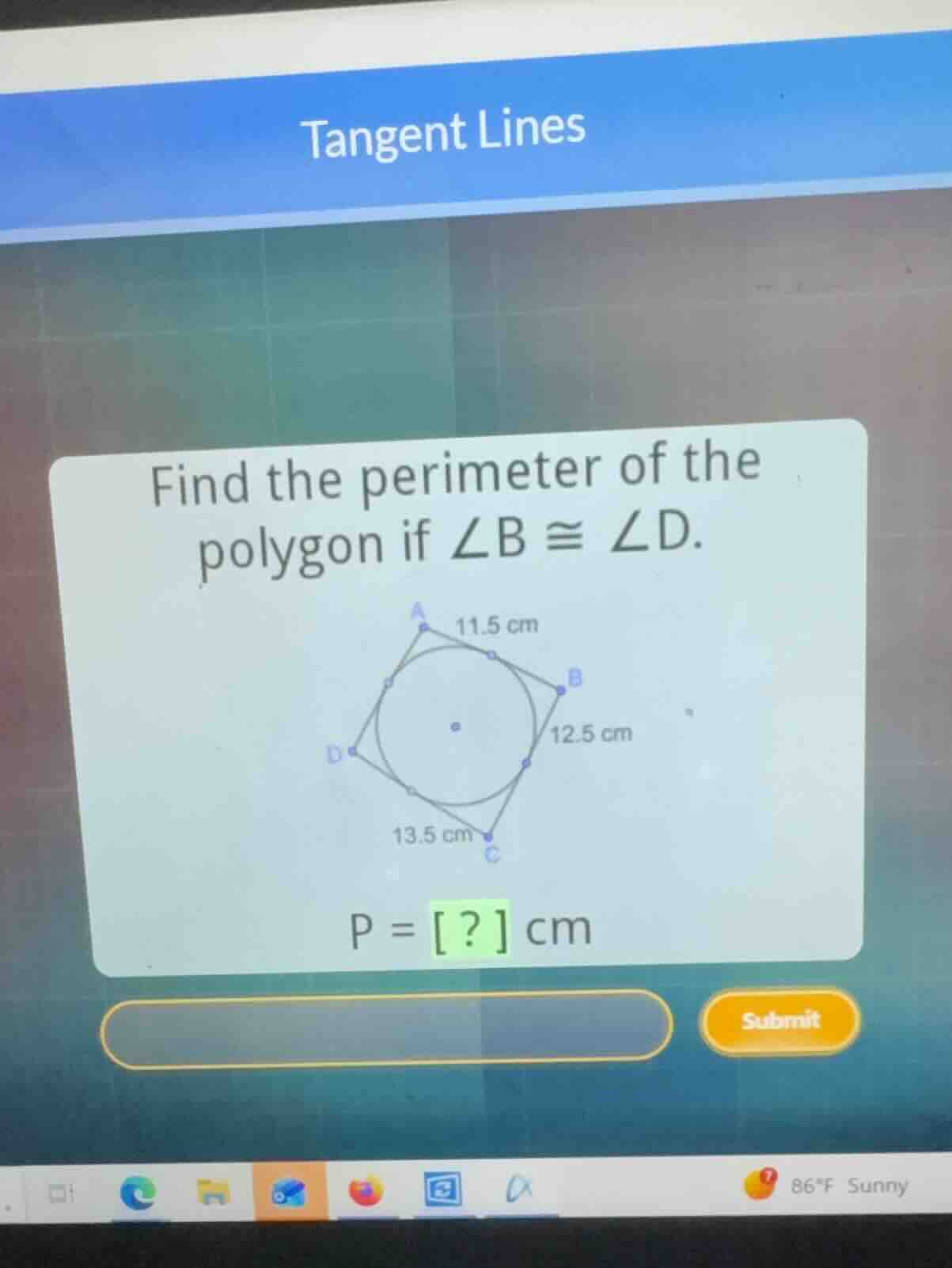
find the perimeter of the polygon if \\(\angle b \cong \angle d\\).
\\(p = ?\text{ cm}\\)
Identify properties of tangent segments
Let the points of tangency on sides \(AB\), \(BC\), \(CD\), and \(DA\) be \(P\), \(Q\), \(R\), and \(S\) respectively.
By the Tangent Segments Theorem, tangent segments from an external point to a circle are equal in length:
Use the given angle congruence
We are given that \(\angle B \cong \angle D\).
Let the center of the circle be \(O\). The segments \(OB\) and \(OD\) bisect \(\angle B\) and \(\angle D\) respectively.
Since \(\angle B \cong \angle D\), their halves are also congruent:
In the right triangles \(\triangle OBQ\) and \(\triangle ODR\) (where \(\angle OQB = \angle ORD = 90^\circ\) and \(OQ = OR = r\), the radius of the circle):
Since the angles are equal, their cotangents are equal, which implies:
Consequently, we have:
Set up equations with given side lengths
Let \(BP = BQ = DR = DS = x\).
We are given the lengths of three sides of the quadrilateral \(ABCD\):
Expressing these sides in terms of the tangent segments:
Solve for the unknown variable
Equating the two expressions for \(CQ\):
This indicates a contradiction if we assume the standard configuration where \(BC\) and \(CD\) are as labeled. Let's re-examine the diagram labels.
The label \(11.5\text{ cm}\) is next to vertex \(A\) (representing segment \(AB\) or \(AD\)).
The label \(12.5\text{ cm}\) is next to vertex \(B\) (representing segment \(BC\)).
The label \(13.5\text{ cm}\) is next to vertex \(C\) (representing segment \(CD\)).
Let's assume the given values represent the tangent segments from the vertices:
If \(AP = AS = 11.5\text{ cm}\), \(BP = BQ = 12.5\text{ cm}\), and \(CQ = CR = 13.5\text{ cm}\).
Since \(\angle B \cong \angle D\), the tangent segments from \(B\) and \(D\) must be equal:
Let's verify this interpretation:
The perimeter \(P\) of the circumscribed polygon is the sum of all tangent segments:
Since \(DS = BP = 12.5\text{ cm}\):
Calculate the final perimeter
Calculate the sum inside the parentheses:
Multiply by 2 to find the total perimeter:

Snap & solve any problem in the app
Get step-by-step solutions on Sovi AI
Photo-based solutions with guided steps
Explore more problems and detailed explanations
Find the perimeter of the polygon if \(\angle B \cong \angle D\).
\(P =\) <blank>100</blank> \(\text{cm}\)