QUESTION IMAGE
Question
tactics?
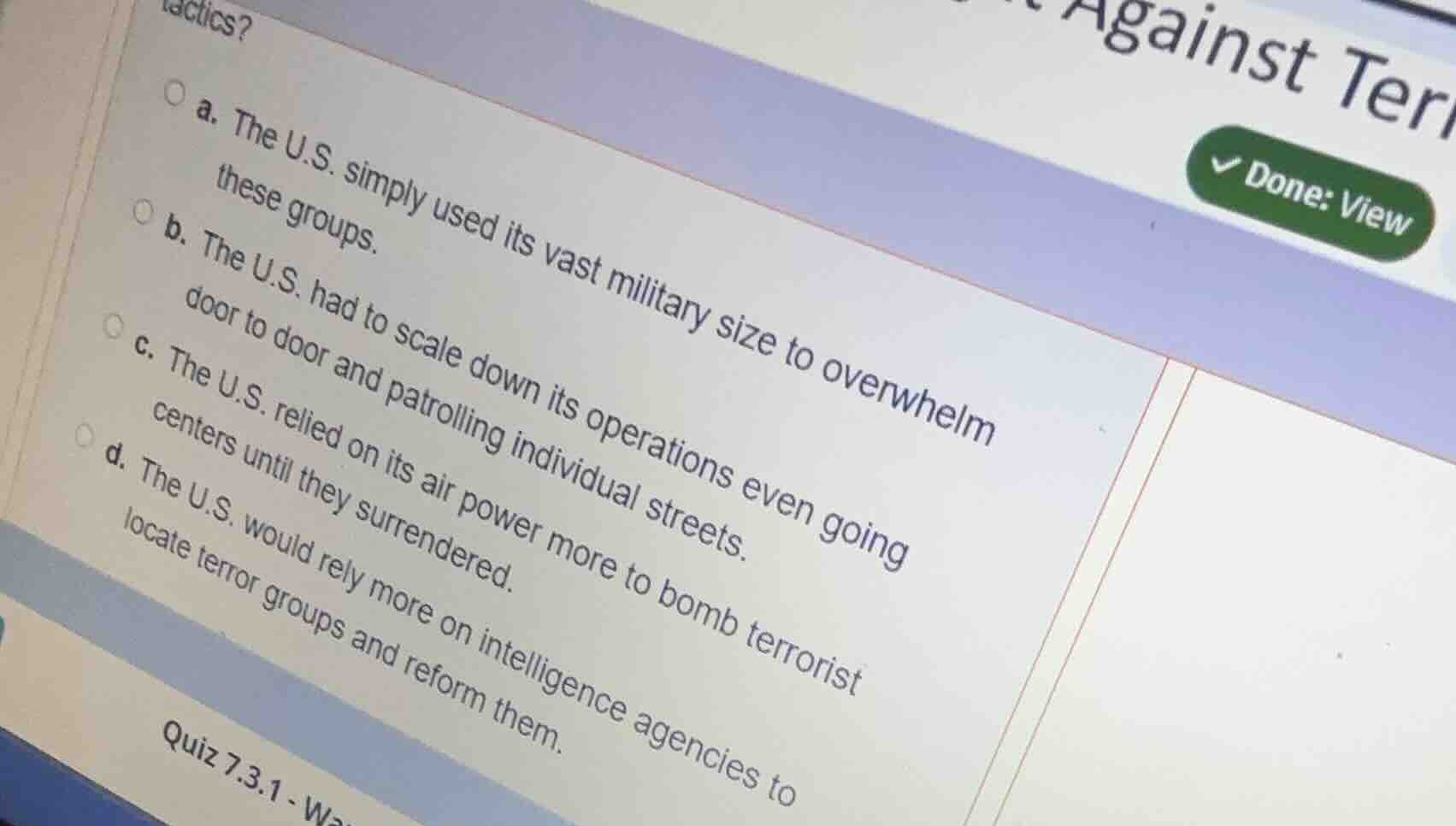
a. the u.s. simply used its vast military size to overwhelm these groups.
b. the u.s. had to scale down its operations even going door to door and patrolling individual streets.
c. the u.s. relied on its air power more to bomb terrorist centers until they surrendered.
d. the u.s. would rely more on intelligence agencies to locate terror groups and reform them.
Analyze the nature of counterterrorism operations
Traditional military strategies designed for state-on-state warfare, such as overwhelming force (a) or heavy reliance on strategic bombing (c), are ineffective against decentralized, non-state terrorist networks that blend into civilian populations.
Evaluate the tactical shift in fighting terrorism
To combat insurgent and terrorist tactics, the U.S. military had to adapt by scaling down large-scale conventional operations. This shift focused on localized counterinsurgency (COIN) tactics, which involved patrolling individual streets and conducting door-to-door operations to secure neighborhoods and gather intelligence.
Eliminate incorrect options
Option (a) is incorrect because conventional military size cannot easily overwhelm decentralized networks. Option (c) is incorrect because indiscriminate bombing is counterproductive and politically unfeasible. Option (d) is incorrect because intelligence agencies cannot "reform" terrorist groups. Therefore, option (b) correctly describes the tactical shift.

Snap & solve any problem in the app
Get step-by-step solutions on Sovi AI
Photo-based solutions with guided steps
Explore more problems and detailed explanations
- a. The U.S. simply used its vast military size to overwhelm these groups.
- b. The U.S. had to scale down its operations even going door to door and patrolling individual streets. (Correct answer)
- c. The U.S. relied on its air power more to bomb terrorist centers until they surrendered.
- d. The U.S. would rely more on intelligence agencies to locate terror groups and reform them.