QUESTION IMAGE
Question
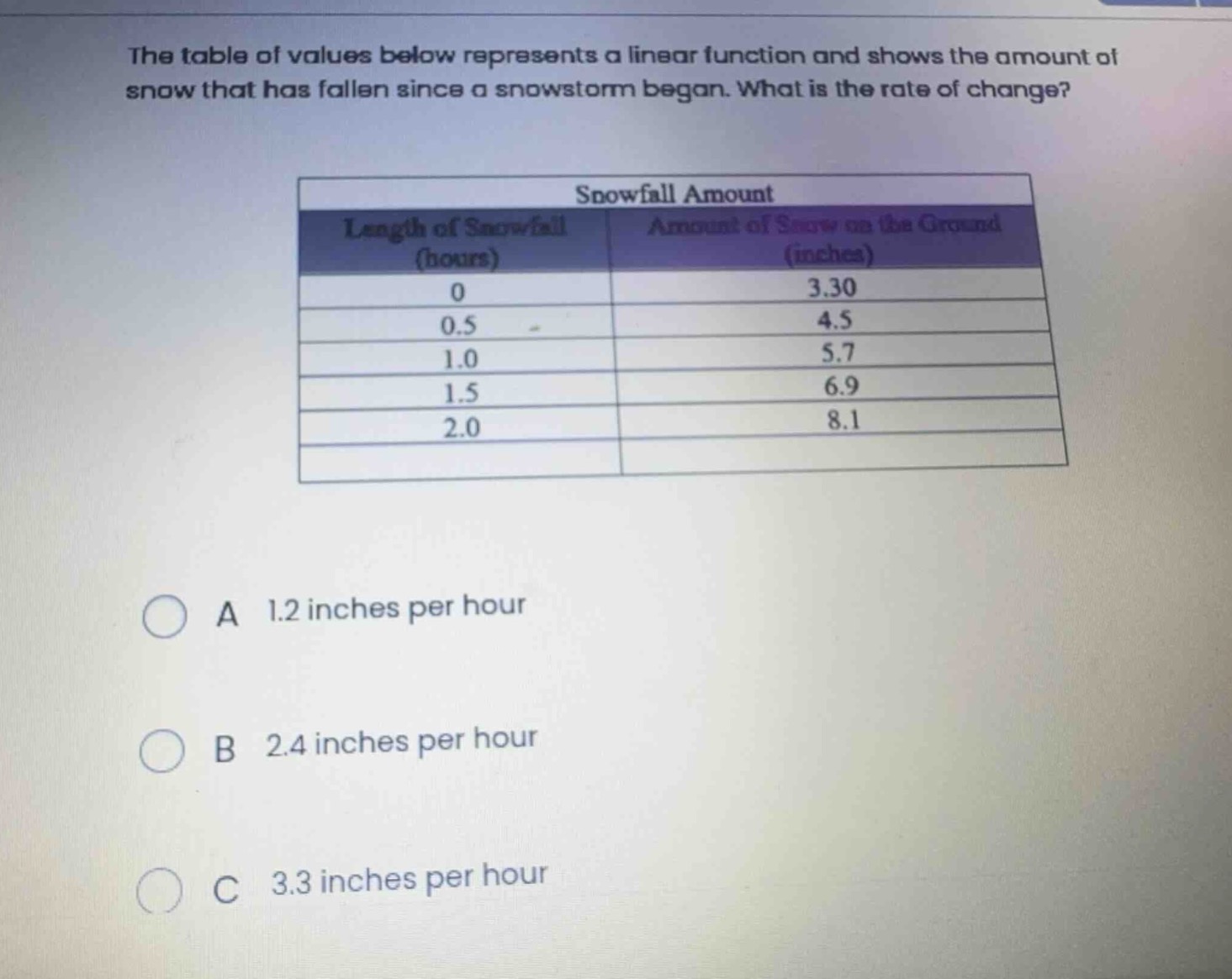
the table of values below represents a linear function and shows the amount of snow that has fallen since a snowstorm began. what is the rate of change?
\
a 1.2 inches per hour
b 2.4 inches per hour
c 3.3 inches per hour
🆕 New Concept Discovered: Rate of Change
How fast one quantity changes compared to another.
Step 1: Identify two points from the table
To find the rate of change of a linear function, we can choose any two points from the table in the form \((x, y)\), where \(x\) represents the length of snowfall (hours) and \(y\) represents the amount of snow on the ground (inches).
Let's choose:
- Point 1: \((x_1, y_1) = (1.0, 5.7)\)
- Point 2: \((x_2, y_2) = (2.0, 8.1)\)
Step 2: Apply the rate of change formula
The rate of change (slope) is the change in the dependent variable (\(y\)) divided by the change in the independent variable (\(x\)):
Substitute the chosen points into the formula:
Step 3: Calculate the final value
Subtract the values in the numerator and denominator:

Snap & solve any problem in the app
Get step-by-step solutions on Sovi AI
Photo-based solutions with guided steps
Explore more problems and detailed explanations
B 2.4 inches per hour