QUESTION IMAGE
Question
table of contents
i. fire ecology: a study of forest fires
ii. factors contributing to forest fires
iii. environmental risks of forest fires
iv. methods of controlling forest fires
v. conclusion
fire ecology: a study of forest fires
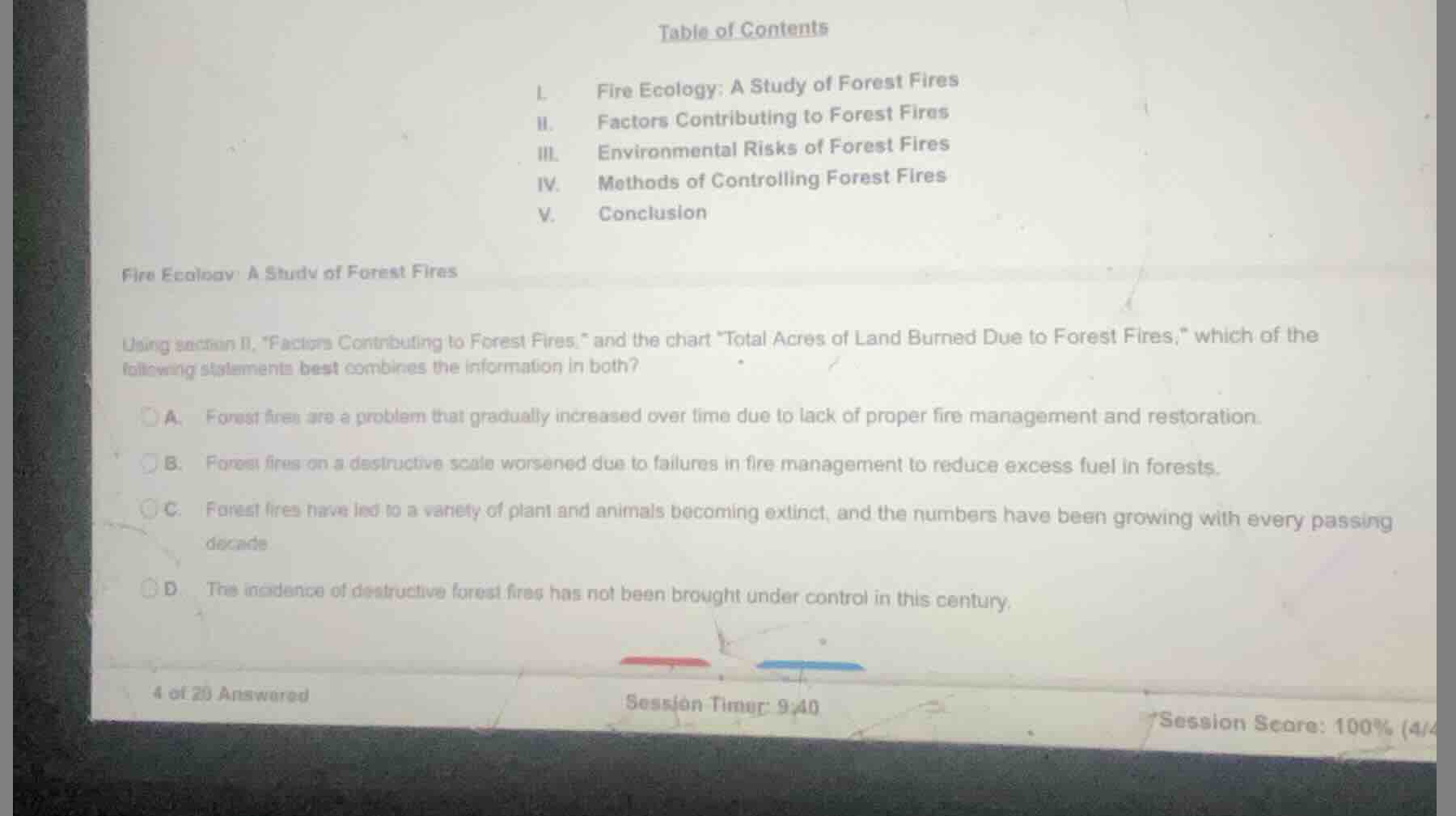
using section ii, \factors contributing to forest fires,\ and the chart \total acres of land burned due to forest fires,\ which of the following statements best combines the information in both?
a. forest fires are a problem that gradually increased over time due to lack of proper fire management and restoration.
b. forest fires on a destructive scale worsened due to failures in fire management to reduce excess fuel in forests.
c. forest fires have led to a variety of plant and animals becoming extinct, and the numbers have been growing with every passing decade.
d. the incidence of destructive forest fires has not been brought under control in this century.
Analyze the prompt requirements
The question asks us to identify which statement best combines information from two sources:
- Section II, "Factors Contributing to Forest Fires"
- A chart titled "Total Acres of Land Burned Due to Forest Fires"
We need to evaluate the options to find the one that synthesizes a contributing factor (from Section II) with quantitative trends or scale of destruction (from the chart).
Evaluate the options based on synthesis
- Option A mentions "lack of proper fire management and restoration" and that fires "gradually increased over time." While this combines a cause and a trend, "restoration" is typically associated with post-fire recovery rather than a direct factor contributing to the start or worsening of fires.
- Option B mentions "Forest fires on a destructive scale" (which aligns with a chart showing "Total Acres of Land Burned") and attributes this worsening to "failures in fire management to reduce excess fuel in forests" (which is a classic ecological factor contributing to severe forest fires). This successfully synthesizes the quantitative scale of destruction with a specific contributing factor.
- Option C focuses on plant and animal extinction, which is an environmental risk (Section III) rather than a contributing factor (Section II).
- Option D is a broad claim about control in this century, which does not clearly integrate a specific contributing factor from Section II.
Connect to historical and scientific evidence
Using Historical Evidence regarding forest management practices, we know that historical policies of total fire suppression led to an unnatural accumulation of underbrush and dead wood (excess fuel). When fires do start, this excess fuel leads to fires of a much more destructive scale, which would be reflected in a chart of total acres burned. Therefore, Option B is the most accurate synthesis of a contributing factor and the scale of destruction.

Snap & solve any problem in the app
Get step-by-step solutions on Sovi AI
Photo-based solutions with guided steps
Explore more problems and detailed explanations
- (A) Forest fires are a problem that gradually increased over time due to lack of proper fire management and restoration.
- (B) Forest fires on a destructive scale worsened due to failures in fire management to reduce excess fuel in forests. (Correct answer)
- (C) Forest fires have led to a variety of plant and animals becoming extinct, and the numbers have been growing with every passing decade.
- (D) The incidence of destructive forest fires has not been brought under control in this century.