QUESTION IMAGE
Question
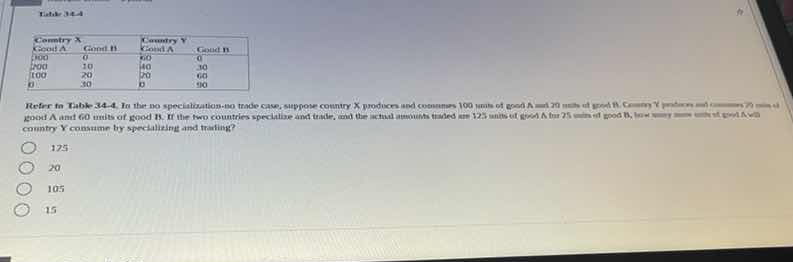
table 34-4
\
refer to table 34-4. in the no specialization-no trade case, suppose country x produces and consumes 100 units of good a and 20 units of good b. country y produces and consumes 20 units of good a and 60 units of good b. if the two countries specialize and trade, and the actual amounts traded are 125 units of good a for 25 units of good b, how many more units of good a will country y consume by specializing and trading?
(a) 125
(b) 20
(c) 105
(d) 15
Determine specialization based on comparative advantage
For Country X, the opportunity cost of producing 10 units of Good B is 100 units of Good A (from the table, combinations are (300, 0), (200, 10), (100, 20), (0, 30)). Thus, 1 unit of B costs 10 units of A.
For Country Y, the opportunity cost of producing 30 units of Good B is 20 units of Good A (combinations are (60, 0), (40, 30), (20, 60), (0, 90)). Thus, 1 unit of B costs \(\frac{2}{3}\) units of A.
Since Country Y has a lower opportunity cost for Good B, Country Y specializes completely in Good B (producing 90 units of B and 0 units of A).
Country X specializes completely in Good A (producing 300 units of A and 0 units of B).
Calculate post-trade consumption for Country Y
Country Y produces 0 units of Good A and 90 units of Good B.
The trade terms state that 125 units of Good A are traded for 25 units of Good B.
Since Country Y specializes in Good B, it exports 25 units of Good B to Country X and imports 125 units of Good A from Country X.
Therefore, Country Y's post-trade consumption of Good A is:
Calculate the increase in Good A consumption for Country Y
In the no-trade case, Country Y consumes 20 units of Good A.
With specialization and trade, Country Y consumes 125 units of Good A.
The increase in consumption of Good A for Country Y is:

Snap & solve any problem in the app
Get step-by-step solutions on Sovi AI
Photo-based solutions with guided steps
Explore more problems and detailed explanations
- (A) 125
- (B) 20
- (C) 105 (Correct answer)
- (D) 15