QUESTION IMAGE
Question
svlc algebra 1a - standard (15260)
introduction to linear functions
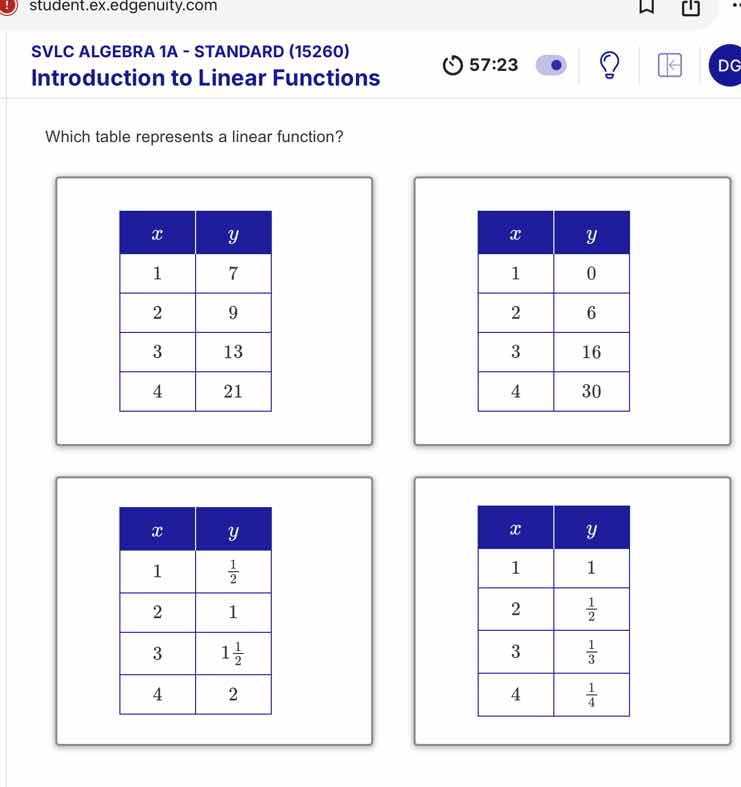
which table represents a linear function?
first table:
| x | y |
|---|---|
| 2 | 9 |
| 3 | 13 |
| 4 | 21 |
second table:
| x | y |
|---|---|
| 2 | 6 |
| 3 | 16 |
| 4 | 30 |
third table:
| x | y |
|---|---|
| 2 | 1 |
| 3 | \\(1\frac{1}{2}\\) |
| 4 | 2 |
fourth table:
| x | y |
|---|---|
| 2 | \\(\frac{1}{2}\\) |
| 3 | \\(\frac{1}{3}\\) |
| 4 | \\(\frac{1}{4}\\) |
Step1: Recall linear function property
A linear function has a constant rate of change (slope), i.e., the difference in \( y \)-values (\( \Delta y \)) for equal differences in \( x \)-values (\( \Delta x = 1 \) here) is constant.
Step2: Analyze Table 1 (Top - Left)
\( x = 1, y = 7 \); \( x = 2, y = 9 \): \( \Delta y = 9 - 7 = 2 \)
\( x = 2, y = 9 \); \( x = 3, y = 13 \): \( \Delta y = 13 - 9 = 4 \)
\( \Delta y \) is not constant. Not linear.
Step3: Analyze Table 2 (Top - Right)
\( x = 1, y = 0 \); \( x = 2, y = 6 \): \( \Delta y = 6 - 0 = 6 \)
\( x = 2, y = 6 \); \( x = 3, y = 16 \): \( \Delta y = 16 - 6 = 10 \)
\( \Delta y \) is not constant. Not linear.
Step4: Analyze Table 3 (Bottom - Left)
\( x = 1, y = \frac{1}{2} \); \( x = 2, y = 1 \): \( \Delta y = 1 - \frac{1}{2} = \frac{1}{2} \)
\( x = 2, y = 1 \); \( x = 3, y = 1\frac{1}{2} \): \( \Delta y = 1\frac{1}{2} - 1 = \frac{1}{2} \)
\( x = 3, y = 1\frac{1}{2} \); \( x = 4, y = 2 \): \( \Delta y = 2 - 1\frac{1}{2} = \frac{1}{2} \)
\( \Delta y \) is constant (\( \frac{1}{2} \)). Linear.
Step5: Analyze Table 4 (Bottom - Right)
\( x = 1, y = 1 \); \( x = 2, y = \frac{1}{2} \): \( \Delta y = \frac{1}{2} - 1 = -\frac{1}{2} \)
\( x = 2, y = \frac{1}{2} \); \( x = 3, y = \frac{1}{3} \): \( \Delta y = \frac{1}{3} - \frac{1}{2} = -\frac{1}{6} \)
\( \Delta y \) is not constant. Not linear.

Snap & solve any problem in the app
Get step-by-step solutions on Sovi AI
Photo-based solutions with guided steps
Explore more problems and detailed explanations
The table with \( x \) values 1, 2, 3, 4 and \( y \) values \( \frac{1}{2} \), 1, \( 1\frac{1}{2} \), 2 (bottom - left table) represents a linear function.