QUESTION IMAGE
Question
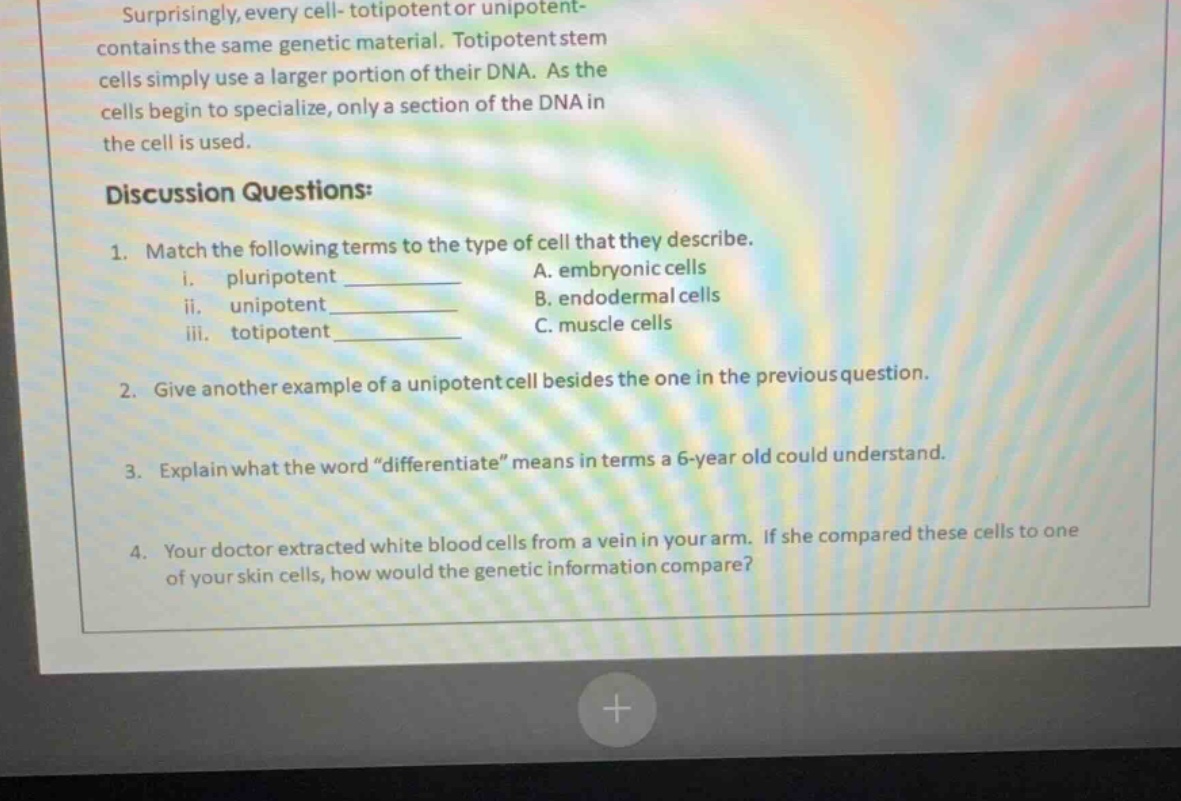
surprisingly, every cell- totipotent or unipotent- contains the same genetic material. totipotent stem cells simply use a larger portion of their dna. as the cells begin to specialize, only a section of the dna in the cell is used.
discussion questions:
- match the following terms to the type of cell that they describe.
i. pluripotent ______ a. embryonic cells
ii. unipotent ______ b. endodermal cells
iii. totipotent ______ c. muscle cells
- give another example of a unipotent cell besides the one in the previous question.
- explain what the word \differentiate\ means in terms a 6-year old could understand.
- your doctor extracted white blood cells from a vein in your arm. if she compared these cells to one of your skin cells, how would the genetic information compare?
Match stem cell potency terms to cell types
- i. Pluripotent stem cells can give rise to almost all cell types (inner cell mass/embryonic cells): i matches A.
- ii. Unipotent cells can only differentiate into one specific cell type (fully specialized cells like muscle cells): ii matches C.
- iii. Totipotent cells can form all cell types, including extraembryonic tissues (early embryonic/endodermal progenitor cells in this context represent multipotent/totipotent lineage progression): iii matches B.
Identify another unipotent cell example
- Unipotent cells are stem cells that self-renew but only produce one single specialized cell type.
- Skin epidermal stem cells (which only produce keratinocytes) or satellite cells (which only produce muscle fibers) are classic examples.
Define cell differentiation for a child
- Cell differentiation is like choosing a job when you grow up.
- At first, a cell can be anything, but then it grows up and learns to do one special job, like becoming a helper cell or a muscle cell.
Compare genetic information of different somatic cells
- Genomic equivalence states that all somatic cells in an organism contain the exact same DNA.
- Therefore, the genetic information in a white blood cell and a skin cell is identical.

Snap & solve any problem in the app
Get step-by-step solutions on Sovi AI
Photo-based solutions with guided steps
Explore more problems and detailed explanations
Question 1
i. pluripotent — A. embryonic cells
ii. unipotent — C. muscle cells
iii. totipotent — B. endodermal cells
Question 2
Skin stem cells (basal cells) that only produce keratinocytes.
Question 3
It is like when a cell grows up and chooses a special job to do, like becoming a helper cell or a muscle cell.
Question 4
The genetic information in both cells would be exactly identical.