QUESTION IMAGE
Question
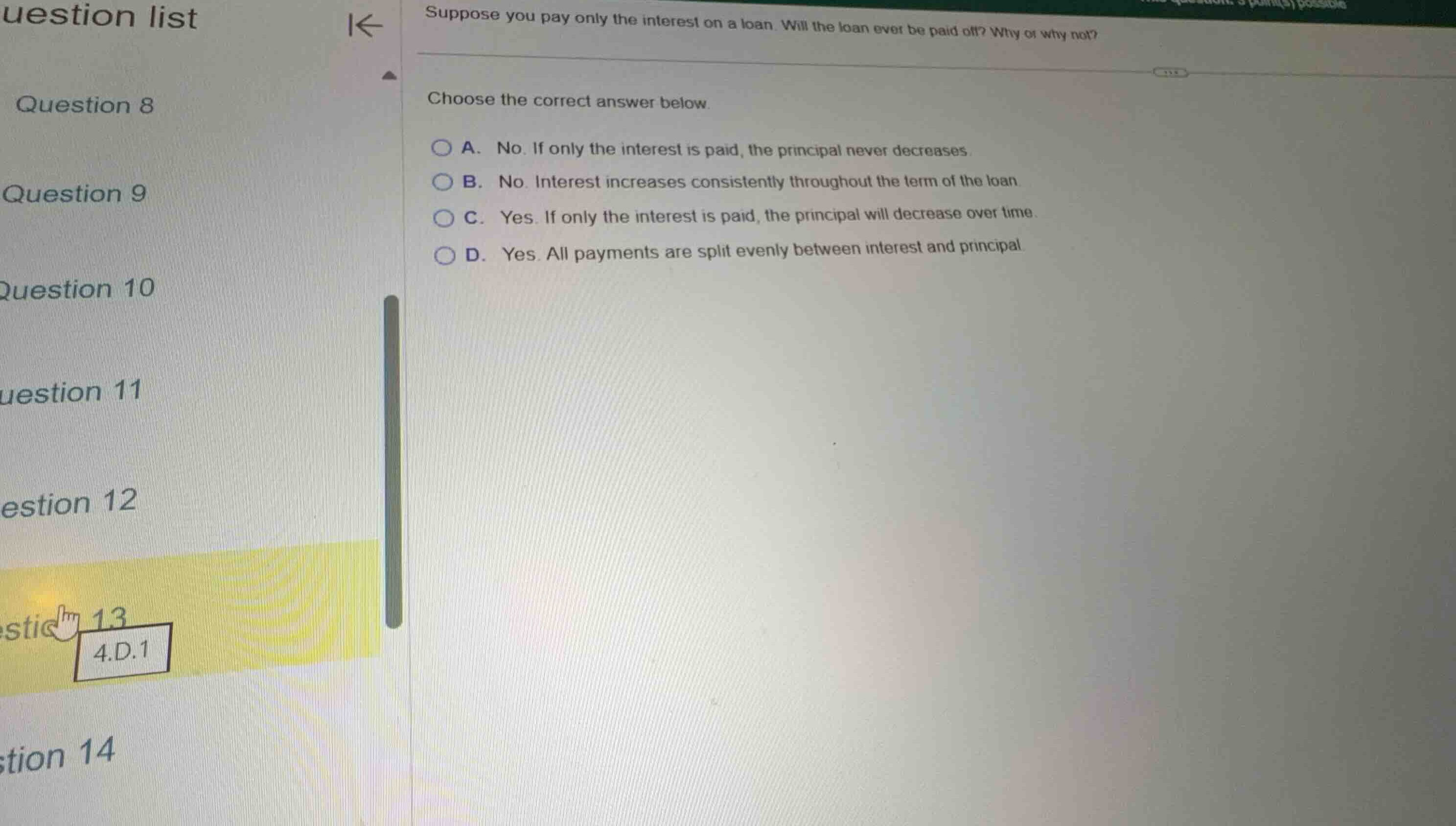
suppose you pay only the interest on a loan. will the loan ever be paid off? why or why not?
choose the correct answer below.
a. no. if only the interest is paid, the principal never decreases.
b. no. interest increases consistently throughout the term of the loan.
c. yes. if only the interest is paid, the principal will decrease over time.
d. yes. all payments are split evenly between interest and principal.
Analyze the effect of paying only interest on a loan
$$
\text{Payment} = \text{Interest Accrued}
$$
$$
\text{Change in Principal} = \text{Payment} - \text{Interest Accrued} = 0
$$
Evaluate the given multiple-choice options
- Option A: Correctly states that the principal never decreases because payments only cover the interest.
- Option B: Incorrectly states that interest increases consistently.
- Option C: Incorrectly states that the principal will decrease.
- Option D: Incorrectly states that payments are split between interest and principal.

Snap & solve any problem in the app
Get step-by-step solutions on Sovi AI
Photo-based solutions with guided steps
Explore more problems and detailed explanations
- A. No. If only the interest is paid, the principal never decreases. (Correct answer)
- B. No. Interest increases consistently throughout the term of the loan.
- C. Yes. If only the interest is paid, the principal will decrease over time.
- D. Yes. All payments are split evenly between interest and principal.