QUESTION IMAGE
Question
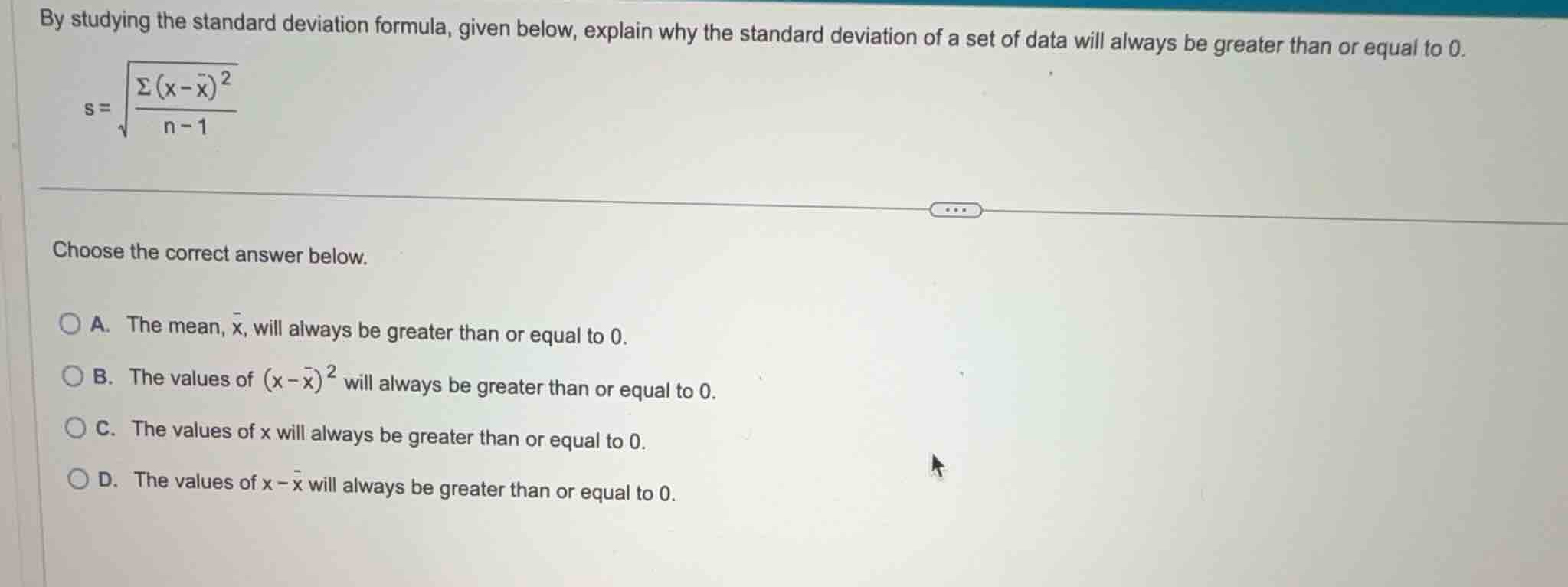
by studying the standard deviation formula, given below, explain why the standard deviation of a set of data will always be greater than or equal to 0.
\\s = \sqrt{\frac{\sum (x-\bar{x})^2}{n-1}}\\
choose the correct answer below.
a. the mean, \\(\bar{x}\\), will always be greater than or equal to 0.
b. the values of \\((x-\bar{x})^2\\) will always be greater than or equal to 0.
c. the values of \\(x\\) will always be greater than or equal to 0.
d. the values of \\(x-\bar{x}\\) will always be greater than or equal to 0.
Analyze the standard deviation formula
Using the Standard Deviation and Sample Standard Deviation knowledge points
Evaluate the terms inside the square root
Using the Standard Deviation and Sample Standard Deviation knowledge points
Determine the correct multiple-choice option
Using the Standard Deviation knowledge point
The principal square root of a non-negative number is always greater than or equal to 0. The term \((x-\bar{x})^2\) is a squared real number, which ensures it is always non-negative.

Snap & solve any problem in the app
Get step-by-step solutions on Sovi AI
Photo-based solutions with guided steps
Explore more problems and detailed explanations
- A. The mean, \(\bar{x}\), will always be greater than or equal to 0.
- B. The values of \((x-\bar{x})^2\) will always be greater than or equal to 0. (Correct answer)
- C. The values of \(x\) will always be greater than or equal to 0.
- D. The values of \(x-\bar{x}\) will always be greater than or equal to 0.