QUESTION IMAGE
Question
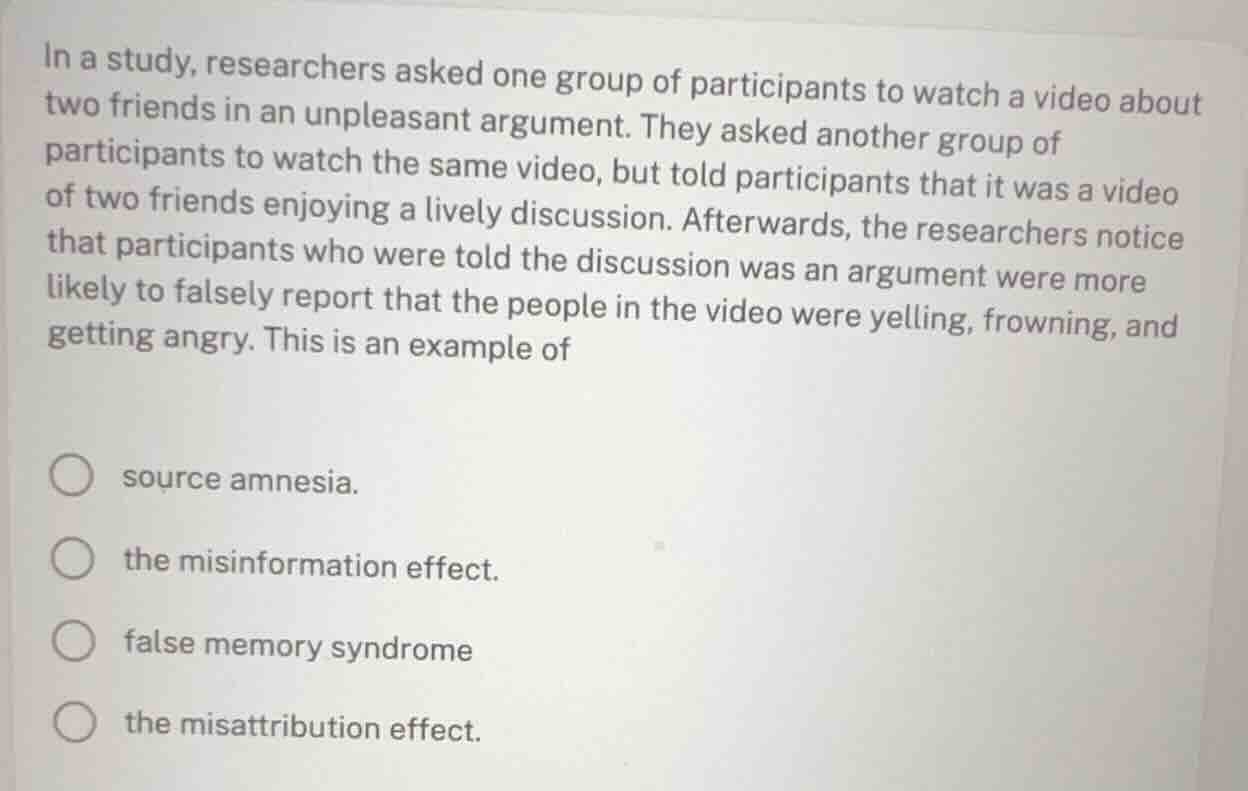
in a study, researchers asked one group of participants to watch a video about two friends in an unpleasant argument. they asked another group of participants to watch the same video, but told participants that it was a video of two friends enjoying a lively discussion. afterwards, the researchers notice that participants who were told the discussion was an argument were more likely to falsely report that the people in the video were yelling, frowning, and getting angry. this is an example of
source amnesia.
the misinformation effect.
false memory syndrome
the misattribution effect.
Analyze the experimental scenario
The scenario describes an experiment where participants watch the exact same video of two friends. However, one group is given post-event suggestive information (told it was an "unpleasant argument") while another group is told it was a "lively discussion."
Apply memory concepts
Using the Misinformation Effect knowledge point
- The introduction of misleading or suggestive post-event information alters a person's recollection of an event.
- Because participants were told the interaction was an "argument," they reconstructed their memory of the video to include non-existent details consistent with that framing (yelling, frowning, getting angry).
- This is a classic demonstration of the misinformation effect, where exposure to misleading information between encoding and retrieval distorts the original memory.
Evaluate the alternative options
- Source amnesia: Forgetting where, when, or how previously learned information was acquired. This does not fit, as the issue is memory distortion of the video content itself, not forgetting the source of the information.
- False memory syndrome: A condition in which a person's identity and relationships are strongly centered around a false but strongly believed memory of a traumatic experience. This is a clinical term and is too broad and severe for this simple laboratory memory distortion.
- The misattribution effect (or source misattribution): Misattributing the source of a memory (e.g., thinking you experienced something when you actually just heard about it). While related to memory errors, the specific phenomenon of post-event framing distorting details of a witnessed event is best defined as the misinformation effect.

Snap & solve any problem in the app
Get step-by-step solutions on Sovi AI
Photo-based solutions with guided steps
Explore more problems and detailed explanations
- source amnesia.
- the misinformation effect. (Correct answer)
- false memory syndrome
- the misattribution effect.