QUESTION IMAGE
Question
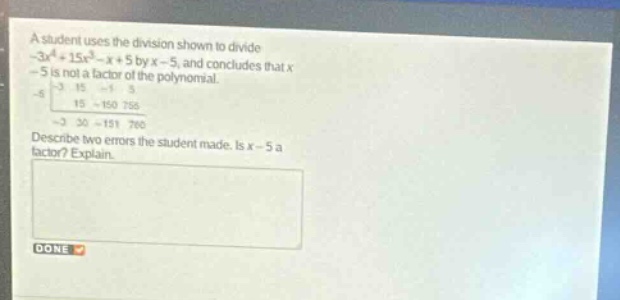
a student uses the division shown to divide \\(-3x^4 + 15x^3 - x + 5\\) by \\(x - 5\\), and concludes that \\(x - 5\\) is not a factor of the polynomial.
\\
\
\\
describe two errors the student made. is \\(x - 5\\) a factor? explain.
🆕 New Concept Discovered: Synthetic Division of Polynomials
Using a shortcut to divide polynomials by linear factors
Step 1: Identify the first error (the divisor setup)
When dividing a polynomial by a linear factor of the form \(x - c\) using synthetic division, the number used in the division box must be \(c\), not \(-c\).
Since the student is dividing by \(x - 5\), they should have used \(5\) on the left side of the synthetic division setup. Instead, the student incorrectly used \(-5\).
Step 2: Identify the second error (missing placeholder term)
The dividend polynomial is:
Notice that there is no \(x^2\) term in this polynomial. When setting up synthetic division, every power of \(x\) from the highest degree down to the constant term must be represented. If a term is missing, a placeholder of \(0\) must be used for its coefficient.
The student wrote the coefficients as:
They completely omitted the \(0\) coefficient for the \(x^2\) term. The correct coefficients should have been:
Step 3: Perform the correct synthetic division
Let's set up and calculate the synthetic division correctly using \(5\) as the divisor and including the \(0\) placeholder:
- First column: Bring down the \(-3\).
- Second column: Multiply \(-3 \times 5 = -15\). Add \(15 + (-15) = 0\).
- Third column: Multiply \(0 \times 5 = 0\). Add \(0 + 0 = 0\).
- Fourth column: Multiply \(0 \times 5 = 0\). Add \(-1 + 0 = -1\).
- Fifth column: Multiply \(-1 \times 5 = -5\). Add \(5 + (-5) = 0\).
Step 4: Determine if \(x - 5\) is a factor
According to the Remainder Theorem, a binomial \(x - c\) is a factor of a polynomial if and only if the remainder of the division is \(0\).
Since our correct synthetic division yields a remainder of \(0\) (the final number in the bottom row), \(x - 5\) is indeed a factor of the polynomial.

Snap & solve any problem in the app
Get step-by-step solutions on Sovi AI
Photo-based solutions with guided steps
Explore more problems and detailed explanations
- First Error: The student used \(-5\) instead of \(5\) as the divisor on the left side of the synthetic division setup.
- Second Error: The student did not include a placeholder of \(0\) for the missing \(x^2\) term in the dividend's coefficients.
Is \(x - 5\) a factor?
Yes, \(x - 5\) is a factor. When the synthetic division is performed correctly using the divisor \(5\) and the coefficients \(-3, 15, 0, -1, 5\), the remainder is \(0\).