QUESTION IMAGE
Question
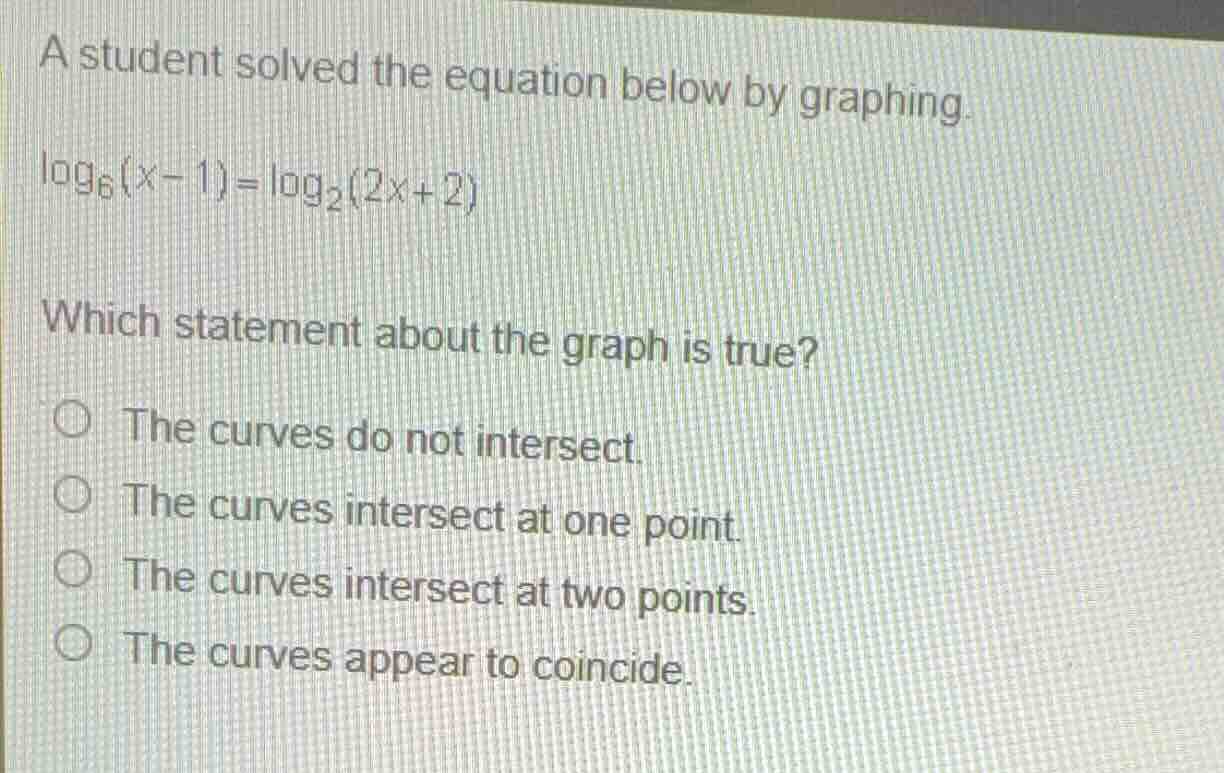
a student solved the equation below by graphing.
\\(\log_{6}(x-1) = \log_{2}(2x+2)\\)
which statement about the graph is true?
- the curves do not intersect.
- the curves intersect at one point.
- the curves intersect at two points.
- the curves appear to coincide.
Analyze the domains of the logarithmic functions
Using the Logarithmic Functions knowledge point
The domain of \(y = \log_6(x-1)\) requires:
The domain of \(y = \log_2(2x+2)\) requires:
Thus, any intersection must occur in the common domain \(x > 1\).
Evaluate function values to determine intersection behavior
Using the Solving Exponential Equations Graphically knowledge point
Let \(f(x) = \log_6(x-1)\) and \(g(x) = \log_2(2x+2)\).
For \(x > 1\):
- As \(x \to 1^+\), \(f(x) \to -\infty\), while \(g(x) \to \log_2(4) = 2\). Thus, \(f(x) < g(x)\) near \(x = 1\).
- Let's compare values at a larger point, say \(x = 7\):
Here, \(f(7) < g(7)\).
- Since both functions are strictly increasing, let's analyze their rates of growth. The derivative of each function is:
For all \(x > 1\), we have \(x - 1 < x + 1\) and \(\ln(2) < \ln(6)\). However, because the base of \(g(x)\) is \(2\) (which is much smaller than \(6\)), \(g(x)\) grows significantly faster than \(f(x)\). Specifically, \(g(x)\) starts at a higher value at the boundary \(x=1\) and has a larger value at all evaluated points. Since \(g(x) > f(x)\) for all \(x > 1\), the two curves do not intersect.

Snap & solve any problem in the app
Get step-by-step solutions on Sovi AI
Photo-based solutions with guided steps
Explore more problems and detailed explanations
- The curves do not intersect. (Correct answer)
- The curves intersect at one point.
- The curves intersect at two points.
- The curves appear to coincide.