QUESTION IMAGE
Question
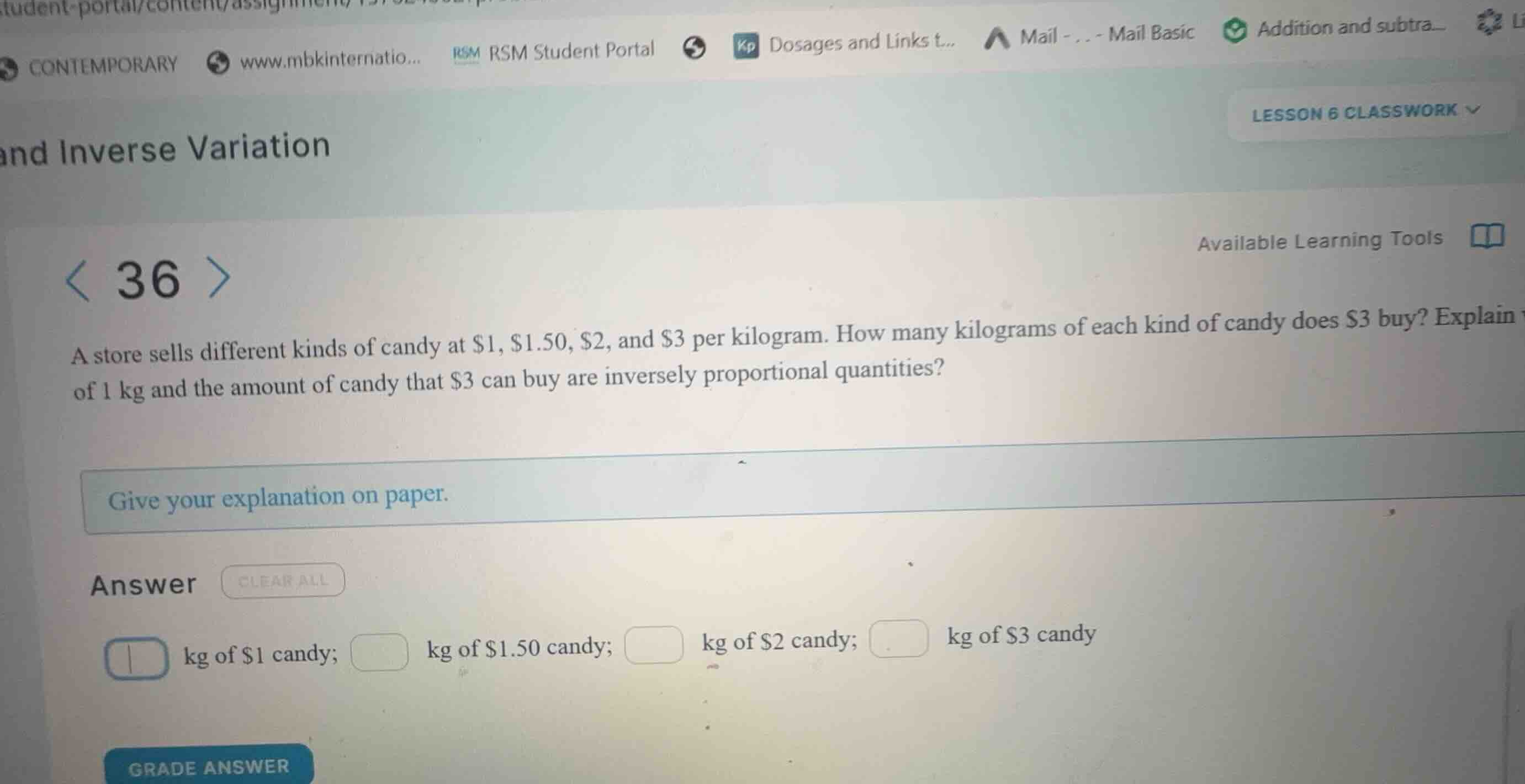
a store sells different kinds of candy at \\$1, \\$1.50, \\$2, and \\$3 per kilogram. how many kilograms of each kind of candy does \\$3 buy? explain why the price of 1 kg and the amount of candy that \\$3 can buy are inversely proportional quantities?
give your explanation on paper.
answer
kg of \\$1 candy; kg of \\$1.50 candy; kg of \\$2 candy; kg of \\$3 candy
Identify the given values
We have a total budget of \( \$3 \).
The prices per kilogram are \( \$1 \), \( \$1.50 \), \( \$2 \), and \( \$3 \).
Set up the relationship
Using the Inverse Proportionality concept, the amount of candy \( q \) in kilograms bought with a fixed budget \( B \) at a price \( p \) per kilogram is:
Here, \( B = 3 \).
Calculate each quantity
Using the Inverse Variation concept, we compute the kilograms for each price:
- For \( \$1 \) candy:
- For \( \$1.50 \) candy:
- For \( \$2 \) candy:
- For \( \$3 \) candy:
Explain the inverse relationship
The product of the price per kilogram and the quantity purchased is always constant:
Since their product is constant, the price and quantity are inversely proportional.

Snap & solve any problem in the app
Get step-by-step solutions on Sovi AI
Photo-based solutions with guided steps
Explore more problems and detailed explanations
A store sells different kinds of candy at $1, $1.50, $2, and $3 per kilogram. How many kilograms of each kind of candy does $3 buy? Explain why the price of 1 kg and the amount of candy that $3 can buy are inversely proportional quantities?
<blank>3</blank> kg of $1 candy;