Sovi.AI - AI Math Tutor

Scan to solve math questions

QUESTION IMAGE

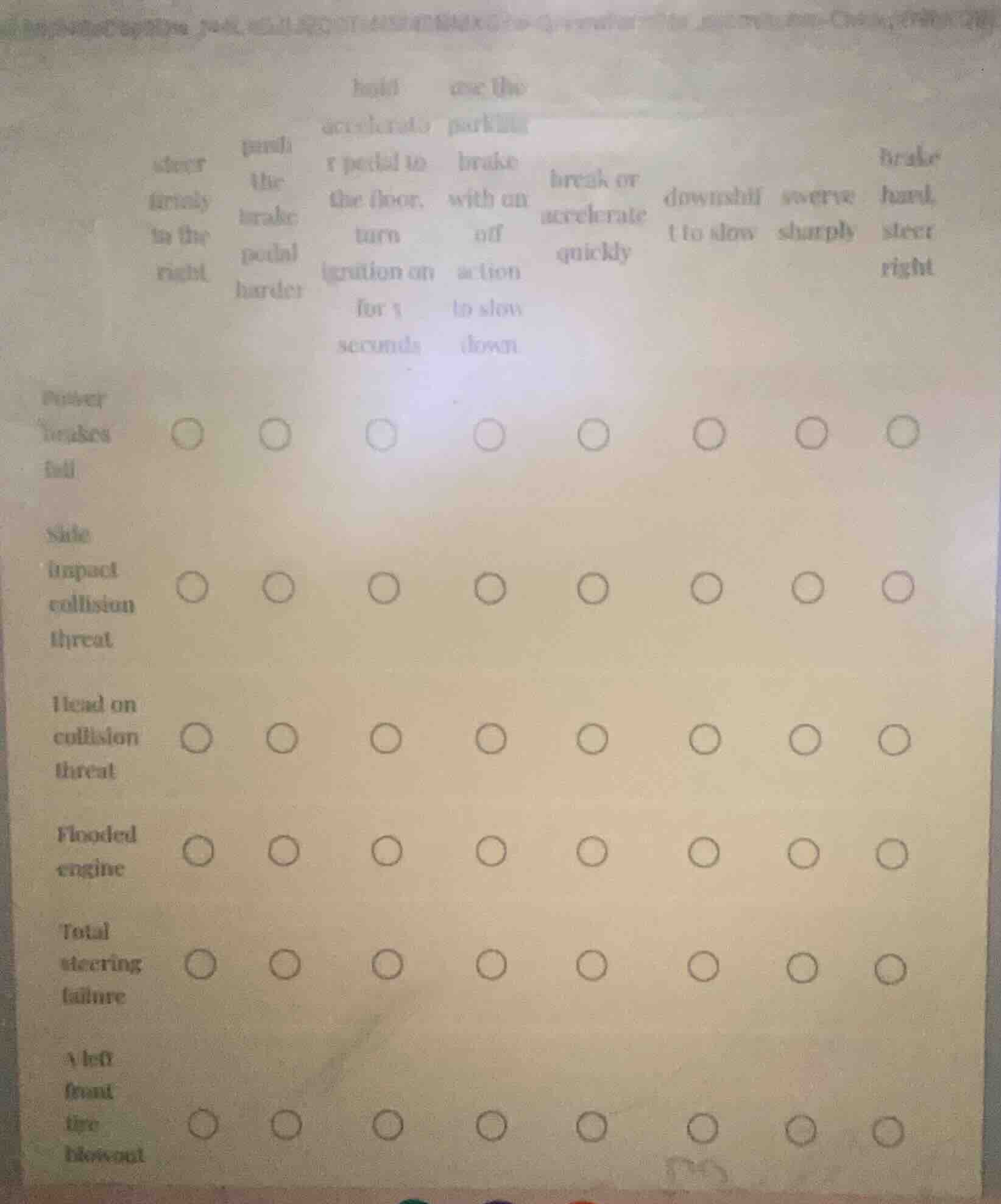
steer firmly to the right | push the brake pedal harder | hold accelera…

Question

steer firmly to the right | push the brake pedal harder | hold accelerator pedal to the floor, turn ignition on for 5 seconds | use the parking brake with an off action to slow down | break or accelerate quickly | downshift to slow | swerve sharply | brake hard, steer right

power brakes fail
side impact collision threat
head on collision threat
flooded engine
total steering failure
a left front tire blowout

Explanation:

Response

<pre_analysis>
{
"quality": "clear",
"question_count": 6,
"skills_matched": [
"direct_cot",
"explain_then_answer",
"tutor"
],
"needs_drawing": false,
"concepts_used": [
"Driver Education",
"Defensive Driving",
"Traffic Safety"
],
"new_concepts": [
"Emergency Driving Maneuvers",
"Vehicle Malfunctions"
],
"current_concepts": [
"Driver Education",
"Defensive Driving",
"Traffic Safety",
"Emergency Driving Maneuvers",
"Vehicle Malfunctions"
]
}
</pre_analysis>

<reasoning>

Identify the emergency scenarios and actions

We need to match each emergency scenario on the left with the correct defensive driving action from the top columns. Let's analyze each scenario:

  1. Power brakes fail: When power brakes fail, the system loses its power assist, but mechanical braking is still possible. The driver must pump the brake pedal harder to build up hydraulic pressure and stop the vehicle.
  • Matching action: "pump the brake pedal harder" (Column 2).
  1. Side impact collision threat: If a side-impact collision is imminent, accelerating or braking quickly can help avoid the impact zone or minimize the severity of the crash.
  • Matching action: "break or accelerate quickly" (Column 5).
  1. Head on collision threat: To avoid a head-on collision, the driver should steer to the right (towards the shoulder or ditch) rather than into oncoming traffic on the left.
  • Matching action: "steer firmly to the right" (Column 1).
  1. Flooded engine: If the engine is flooded with fuel, holding the accelerator pedal to the floor while cranking the engine allows more air in to clear the excess fuel.
  • Matching action: "hold accelerator pedal to the floor, turn ignition on for 5 seconds" (Column 3).
  1. Total steering failure: If steering fails completely, the driver cannot guide the vehicle. The best action is to use the parking brake with an on-off action to slow down safely without locking the wheels.
  • Matching action: "use the parking brake with an off action to slow down" (Column 4).
  1. A left front tire blowout: When a front tire blows out, the car pulls heavily toward the side of the blowout. The driver must brake hard and steer in the opposite direction (steer right) to keep the vehicle on the road.
  • Matching action: "brake hard, steer right" (Column 8).

Verify the column options

Let's list the columns from left to right to ensure correct mapping:

  • Column 1: steer firmly to the right
  • Column 2: pump the brake pedal harder
  • Column 3: hold accelerator pedal to the floor, turn ignition on for 5 seconds
  • Column 4: use the parking brake with an off action to slow down
  • Column 5: break or accelerate quickly
  • Column 6: downshift to slow
  • Column 7: swerve sharply
  • Column 8: brake hard, steer right

Match each row to its column

  • Power brakes fail $

ightarrow$ Column 2 ("pump the brake pedal harder")

  • Side impact collision threat $

ightarrow$ Column 5 ("break or accelerate quickly")

  • Head on collision threat $

ightarrow$ Column 1 ("steer firmly to the right")

  • Flooded engine $

ightarrow$ Column 3 ("hold accelerator pedal to the floor, turn ignition on for 5 seconds")

  • Total steering failure $

ightarrow$ Column 4 ("use the parking brake with an off action to slow down")

  • A left front tire blowout $

ightarrow$ Column 8 ("brake hard, steer right")
</reasoning>

<answer>

Question 1

Power brakes fail: pump the brake pedal harder (Column 2)

Question 2

Side impact collision threat: **break or accelerate qui…

Answer:

<pre_analysis>
{
"quality": "clear",
"question_count": 6,
"skills_matched": [
"direct_cot",
"explain_then_answer",
"tutor"
],
"needs_drawing": false,
"concepts_used": [
"Driver Education",
"Defensive Driving",
"Traffic Safety"
],
"new_concepts": [
"Emergency Driving Maneuvers",
"Vehicle Malfunctions"
],
"current_concepts": [
"Driver Education",
"Defensive Driving",
"Traffic Safety",
"Emergency Driving Maneuvers",
"Vehicle Malfunctions"
]
}
</pre_analysis>

<reasoning>

Identify the emergency scenarios and actions

We need to match each emergency scenario on the left with the correct defensive driving action from the top columns. Let's analyze each scenario:

  1. Power brakes fail: When power brakes fail, the system loses its power assist, but mechanical braking is still possible. The driver must pump the brake pedal harder to build up hydraulic pressure and stop the vehicle.
  • Matching action: "pump the brake pedal harder" (Column 2).
  1. Side impact collision threat: If a side-impact collision is imminent, accelerating or braking quickly can help avoid the impact zone or minimize the severity of the crash.
  • Matching action: "break or accelerate quickly" (Column 5).
  1. Head on collision threat: To avoid a head-on collision, the driver should steer to the right (towards the shoulder or ditch) rather than into oncoming traffic on the left.
  • Matching action: "steer firmly to the right" (Column 1).
  1. Flooded engine: If the engine is flooded with fuel, holding the accelerator pedal to the floor while cranking the engine allows more air in to clear the excess fuel.
  • Matching action: "hold accelerator pedal to the floor, turn ignition on for 5 seconds" (Column 3).
  1. Total steering failure: If steering fails completely, the driver cannot guide the vehicle. The best action is to use the parking brake with an on-off action to slow down safely without locking the wheels.
  • Matching action: "use the parking brake with an off action to slow down" (Column 4).
  1. A left front tire blowout: When a front tire blows out, the car pulls heavily toward the side of the blowout. The driver must brake hard and steer in the opposite direction (steer right) to keep the vehicle on the road.
  • Matching action: "brake hard, steer right" (Column 8).

Verify the column options

Let's list the columns from left to right to ensure correct mapping:

  • Column 1: steer firmly to the right
  • Column 2: pump the brake pedal harder
  • Column 3: hold accelerator pedal to the floor, turn ignition on for 5 seconds
  • Column 4: use the parking brake with an off action to slow down
  • Column 5: break or accelerate quickly
  • Column 6: downshift to slow
  • Column 7: swerve sharply
  • Column 8: brake hard, steer right

Match each row to its column

  • Power brakes fail $

ightarrow$ Column 2 ("pump the brake pedal harder")

  • Side impact collision threat $

ightarrow$ Column 5 ("break or accelerate quickly")

  • Head on collision threat $

ightarrow$ Column 1 ("steer firmly to the right")

  • Flooded engine $

ightarrow$ Column 3 ("hold accelerator pedal to the floor, turn ignition on for 5 seconds")

  • Total steering failure $

ightarrow$ Column 4 ("use the parking brake with an off action to slow down")

  • A left front tire blowout $

ightarrow$ Column 8 ("brake hard, steer right")
</reasoning>

<answer>

Question 1

Power brakes fail: pump the brake pedal harder (Column 2)

Question 2

Side impact collision threat: break or accelerate quickly (Column 5)

Question 3

Head on collision threat: steer firmly to the right (Column 1)

Question 4

Flooded engine: hold accelerator pedal to the floor, turn ignition on for 5 seconds (Column 3)

Question 5

Total steering failure: use the parking brake with an off action to slow down (Column 4)

Question 6

A left front tire blowout: brake hard, steer right (Column 8)
</answer>

<post_analysis>
{
"subject": "Others",
"question_type": "Multi-part",
"knowledge_point": [
"Others",
"Driver Education",
"Emergency Driving Maneuvers"
]
}
</post_analysis>