QUESTION IMAGE
Question
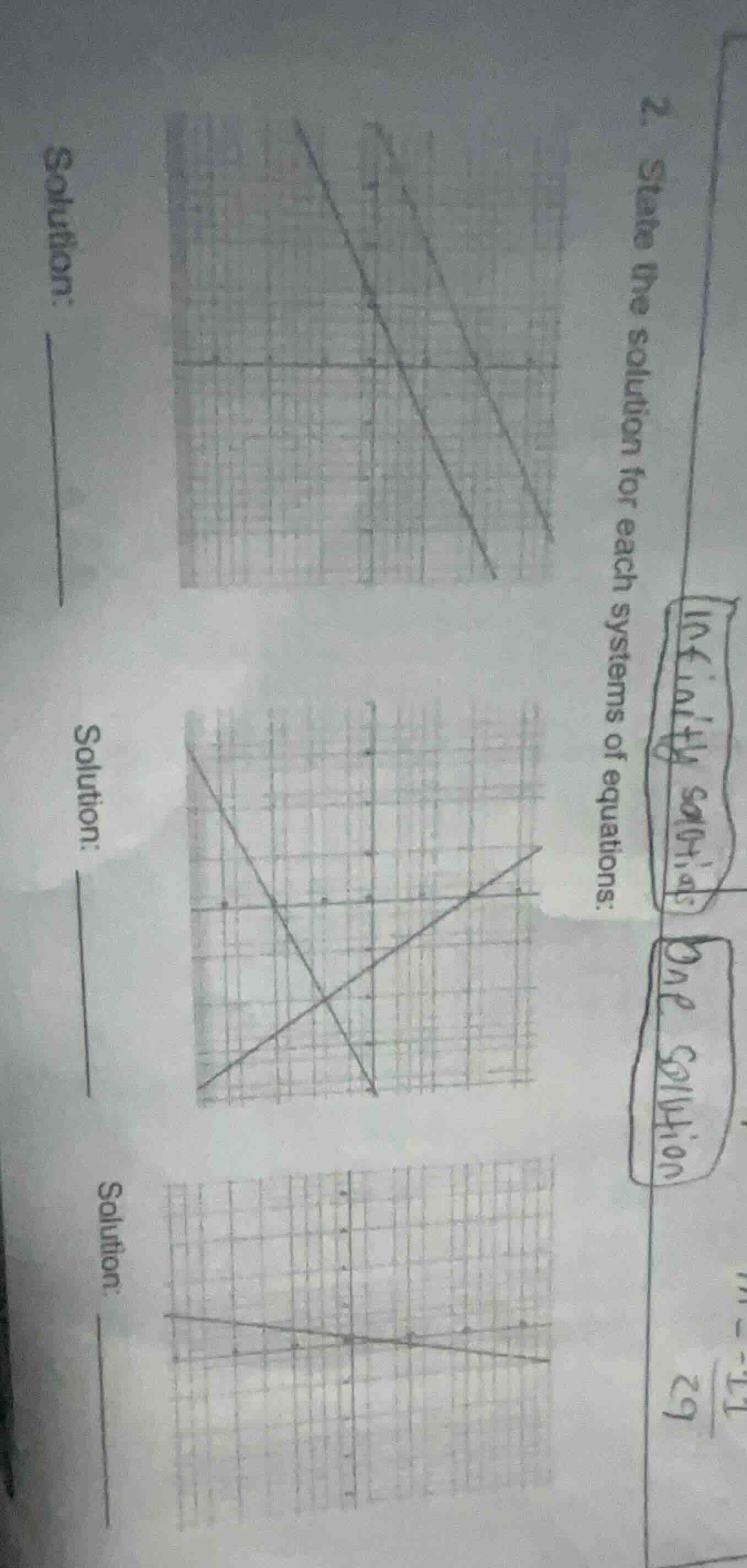
- state the solution for each systems of equations.
solution:
solution:
solution:
To solve the problem of identifying the solution for each system of linear equations from their graphs, we analyze each graph based on the intersection of the lines:
First Graph (Top):
Step 1: Identify Intersection
The two lines intersect at a single point. To find the coordinates, we observe the grid. Let's assume the grid has integer coordinates. From the graph, the intersection point appears to be \((x, y) = (4, 2)\) (or similar, depending on grid scale—adjust if needed).
Step 2: Conclusion
A single intersection means one solution at the point of intersection.
Second Graph (Middle):
Step 1: Check Line Relationship
The two lines are parallel (same slope, different y - intercepts). Parallel lines never intersect.
Step 2: Conclusion
No intersection means no solution.
Third Graph (Bottom):
Step 1: Check Line Relationship
The two lines are coincident (same line, same slope and y - intercept). Every point on the line is a solution.
Step 2: Conclusion
Coincident lines mean infinitely many solutions.
Final Answers:
- First Graph: One solution (e.g., \((4, 2)\) – adjust based on exact grid).
- Second Graph: No solution.
- Third Graph: Infinitely many solutions.
(Note: If the grid has specific markings, refine the intersection point. For example, if each grid square is 1 unit, count the units from the origin to the intersection.)

Snap & solve any problem in the app
Get step-by-step solutions on Sovi AI
Photo-based solutions with guided steps
Explore more problems and detailed explanations
To solve the problem of identifying the solution for each system of linear equations from their graphs, we analyze each graph based on the intersection of the lines:
First Graph (Top):
Step 1: Identify Intersection
The two lines intersect at a single point. To find the coordinates, we observe the grid. Let's assume the grid has integer coordinates. From the graph, the intersection point appears to be \((x, y) = (4, 2)\) (or similar, depending on grid scale—adjust if needed).
Step 2: Conclusion
A single intersection means one solution at the point of intersection.
Second Graph (Middle):
Step 1: Check Line Relationship
The two lines are parallel (same slope, different y - intercepts). Parallel lines never intersect.
Step 2: Conclusion
No intersection means no solution.
Third Graph (Bottom):
Step 1: Check Line Relationship
The two lines are coincident (same line, same slope and y - intercept). Every point on the line is a solution.
Step 2: Conclusion
Coincident lines mean infinitely many solutions.
Final Answers:
- First Graph: One solution (e.g., \((4, 2)\) – adjust based on exact grid).
- Second Graph: No solution.
- Third Graph: Infinitely many solutions.
(Note: If the grid has specific markings, refine the intersection point. For example, if each grid square is 1 unit, count the units from the origin to the intersection.)