QUESTION IMAGE
Question
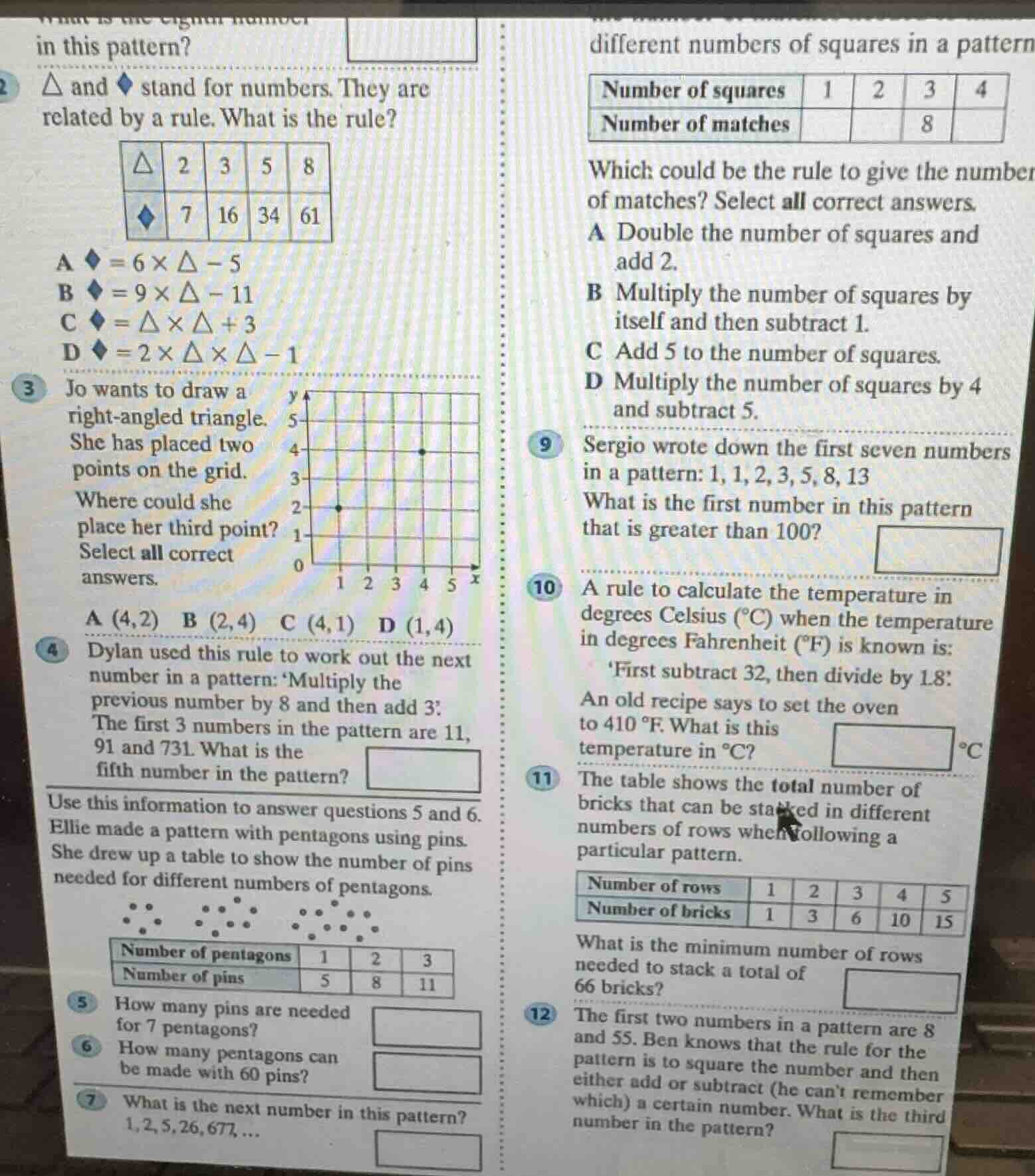
- \\(\delta\\) and \\(\blacklozenge\\) stand for numbers. they are related by a rule. what is the rule?
\
a \\(\blacklozenge = 6 \times \delta - 5\\)
b \\(\blacklozenge = 9 \times \delta - 11\\)
c \\(\blacklozenge = \delta \times \delta + 3\\)
d \\(\blacklozenge = 2 \times \delta \times \delta - 1\\)
- jo wants to draw a right-angled triangle. she has placed two points on the grid. where could she place her third point? select all correct answers.
a (4,2) b (2,4) c (4,1) d (1,4)
- dylan used this rule to work out the next number in a pattern: multiply the previous number by 8 and then add 3. the first 3 numbers in the pattern are 11, 91 and 731. what is the fifth number in the pattern?
use this information to answer questions 5 and 6. ellie made a pattern with pentagons using pins. she drew up a table to show the number of pins needed for different numbers of pentagons.
\
- how many pins are needed for 7 pentagons?
- how many pentagons can be made with 60 pins?
- what is the next number in this pattern? 1, 2, 5, 26, 677, ...
- different numbers of squares in a pattern
\
which could be the rule to give the number of matches? select all correct answers.
a double the number of squares and add 2.
b multiply the number of squares by itself and then subtract 1.
c add 5 to the number of squares.
d multiply the number of squares by 4 and subtract 5.
- sergio wrote down the first seven numbers in a pattern: 1, 1, 2, 3, 5, 8, 13. what is the first number in this pattern that is greater than 100?
- a rule to calculate the temperature in degrees celsius (\\(^{\circ}\text{c}\\)) when the temperature in degrees fahrenheit (\\(^{\circ}\text{f}\\)) is known is: first subtract 32, then divide by 1.8. an old recipe says to set the oven to 410 \\(^{\circ}\text{f}\\). what is this temperature in \\(^{\circ}\text{c}\\)?
- the table shows the total number of bricks that can be stacked in different numbers of rows when following a particular pattern.
\
what is the minimum number of rows needed to stack a total of 66 bricks?
- the first two numbers in a pattern are 8 and 55. ben knows that the rule for the pattern is to square the number and then either add or subtract (he cant remember which) a certain number. what is the third number in the pattern?
Analyze questions 2 through 4
- Question 2: Find the rule relating \(\Delta\) and \(\blacklozenge\).
Given pairs \((\Delta, \blacklozenge)\): \((2, 7)\), \((3, 16)\), \((5, 34)\), \((8, 61)\).
Test option D: \(\blacklozenge = 2 \times \Delta \times \Delta - 1\).
For \(\Delta = 2\): \(2(2)^2 - 1 = 7\).
For \(\Delta = 3\): \(2(3)^2 - 1 = 17
eq 16\).
Test option C: \(\blacklozenge = \Delta \times \Delta + 3\).
For \(\Delta = 3\): \(3^2 + 3 = 12
eq 16\).
Test option B: \(\blacklozenge = 9 \times \Delta - 11\).
For \(\Delta = 2\): \(9(2) - 11 = 7\).
For \(\Delta = 3\): \(9(3) - 11 = 16\).
For \(\Delta = 5\): \(9(5) - 11 = 34\).
For \(\Delta = 8\): \(9(8) - 11 = 61\).
Thus, B is correct.
- Question 3: Right-angled triangle.
Two points are plotted at \((1, 2)\) and \((4, 4)\).
To form a right-angled triangle, the third point must form a right angle with the segment connecting \((1, 2)\) and \((4, 4)\).
If the right angle is at the third point \(P(x, y)\) with horizontal and vertical sides:
Option A: \((4, 2)\) forms a right triangle with vertices \((1, 2)\), \((4, 4)\), and \((4, 2)\) (right angle at \((4, 2)\)).
Option D: \((1, 4)\) forms a right triangle with vertices \((1, 2)\), \((4, 4)\), and \((1, 4)\) (right angle at \((1, 4)\)).
Thus, A and D are correct.
- Question 4: Rule: Multiply by 8, then add 3.
\(a_1 = 11\)
\(a_2 = 11 \times 8 + 3 = 91\)
\(a_3 = 91 \times 8 + 3 = 731\)
\(a_4 = 731 \times 8 + 3 = 5851\)
\(a_5 = 5851 \times 8 + 3 = 46811\)
Analyze questions 5 through 8
- Question 5: Pattern of pentagons: \(5, 8, 11, \dots\)
Rule: \(P(n) = 3n + 2\).
For \(n = 7\): \(3(7) + 2 = 23\).
- Question 6: Find \(n\) when \(P(n) = 60\).
\(3n + 2 = 60 \implies 3n = 58 \implies n = 19.33\).
Since \(n\) must be an integer, the maximum number of complete pentagons is 19.
- Question 7: Pattern: \(1, 2, 5, 26, 677, \dots\)
Rule: \(a_{n} = a_{n-1}^2 + 1\).
Next term: \(677^2 + 1 = 458329 + 1 = 458330\).
- Question 8: Pattern of matches for squares.
For \(n = 3\), matches = 8.
Test option B: Multiply by itself and subtract 1: \(3^2 - 1 = 8\).
Test option C: Add 5: \(3 + 5 = 8\).
Test option D: Multiply by 4 and subtract 5: \(3 \times 4 - 5 = 7
eq 8\).
Thus, B and C are correct.
Analyze questions 9 through 12
- Question 9: Fibonacci sequence: \(1, 1, 2, 3, 5, 8, 13, 21, 34, 55, 89, 144, \dots\)
First number greater than 100 is 144.
- Question 10: Formula: \(C = (F - 32) / 1.8\).
For \(F = 410\): \(C = (410 - 32) / 1.8 = 378 / 1.8 = 210\).
- Question 11: Triangular numbers: \(1, 3, 6, 10, 15, \dots\)
Formula: \(S_n = \frac{n(n+1)}{2}\).
We want \(S_n = 66\):
\(\frac{n(n+1)}{2} = 66 \implies n(n+1) = 132 \implies n^2 + n - 132 = 0 \implies (n-11)(n+12) = 0 \implies n = 11\).
- Question 12: First two numbers: 8 and 55.
Rule: \(a_n = a_{n-1}^2 \pm C\).
Let's find \(C\): \(55 = 8^2 - C \implies 55 = 64 - C \implies C = 9\).
So the rule is \(a_n = a_{n-1}^2 - 9\).
Third number: \(55^2 - 9 = 3025 - 9 = 3016\).…

Snap & solve any problem in the app
Get step-by-step solutions on Sovi AI
Photo-based solutions with guided steps
Explore more problems and detailed explanations
| No. | Answer |
|---|---|
| 3 | A, D |
| 4 | 46811 |
| 5 | 23 |
| 6 | 19 |
| 7 | 458330 |
| 8 | B, C |
| 9 | 144 |
| 10 | 210 |
| 11 | 11 |
| 12 | 3016 |