Sovi.AI - AI Math Tutor

Scan to solve math questions

QUESTION IMAGE

a square stained glass window is divided into four congruent triangular…

Question

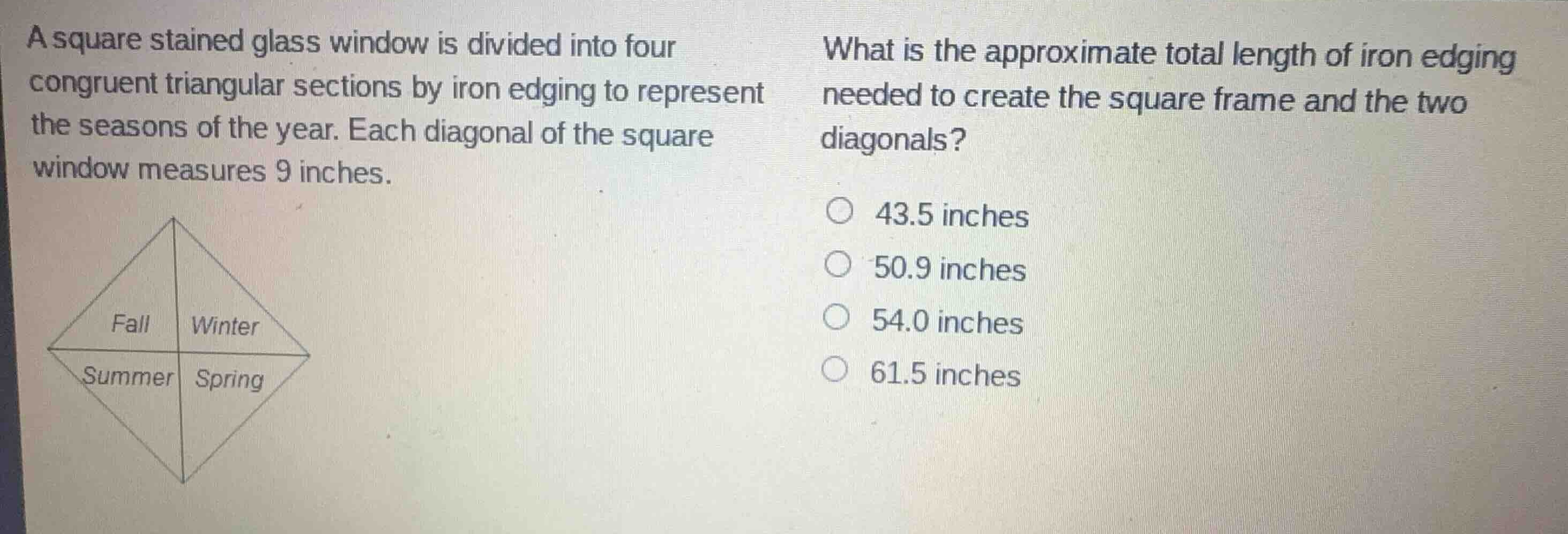
a square stained glass window is divided into four congruent triangular sections by iron edging to represent the seasons of the year. each diagonal of the square window measures 9 inches.

what is the approximate total length of iron edging needed to create the square frame and the two diagonals?

43.5 inches
50.9 inches
54.0 inches
61.5 inches

Explanation:

Response

<pre_analysis>
{
"quality": "clear",
"question_count": 1,
"skills_matched": [
"step_cot",
"multiple_choice_formatter",
"explain_then_answer",
"tutor",
"mastery_adaptive_brevity"
],
"needs_drawing": false,
"concepts_used": [
"Pythagorean Theorem",
"Properties of Rectangles"
],
"new_concepts": [
"Square Diagonal Properties",
"Perimeter of a Square"
],
"current_concepts": [
"Pythagorean Theorem",
"Properties of Rectangles",
"Square Diagonal Properties",
"Perimeter of a Square"
]
}
</pre_analysis>

<reasoning>

Identify the given values and target

We are given a square window with two diagonals.

  • Diagonal length \(d = 9\text{ inches}\).
  • There are two diagonals, so the total diagonal length is \(2 \times 9 = 18\text{ inches}\).
  • We need to find the total length of iron edging, which consists of the square's perimeter plus the two diagonals.

Calculate the side length of the square

Using the Pythagorean Theorem knowledge point
\[

$$\begin{aligned} s^2 + s^2 &= d^2 \\ 2s^2 &= 9^2 = 81 \\ s^2 &= 40.5 \\ s &= \sqrt{40.5} \approx 6.364\text{ inches} \end{aligned}$$

\]

Calculate the perimeter of the square

Using the Properties of Rectangles knowledge point
\[

$$\begin{aligned} P &= 4s \\ P &\approx 4 \times 6.364 = 25.456\text{ inches} \end{aligned}$$

\]

Calculate the total length of iron edging

We sum the perimeter of the square frame and the lengths of the two diagonals:
\[

$$\begin{aligned} L_{\text{total}} &= P + 2d \\ L_{\text{total}} &\approx 25.456 + 18 = 43.456\text{ inches} \end{aligned}$$

\]
Rounding to the nearest tenth gives \(43.5\text{ inches}\).
</reasoning>

<answer>
<mcq-correct>(A) 43.5 inches</mcq-correct>
<mcq-option>(B) 50.9 inches</mcq-option>
<mcq-option>(C) 54.0 inches</mcq-option>
<mcq-option>(D) 61.5 inches</mcq-option>
</answer>

<post_analysis>
{
"subject": "Mathematics",
"question_type": "Multiple Choice",
"knowledge_point": [
"Mathematics",
"Geometry",
"Pythagorean Theorem"
]
}
</post_analysis>

Answer:

<pre_analysis>
{
"quality": "clear",
"question_count": 1,
"skills_matched": [
"step_cot",
"multiple_choice_formatter",
"explain_then_answer",
"tutor",
"mastery_adaptive_brevity"
],
"needs_drawing": false,
"concepts_used": [
"Pythagorean Theorem",
"Properties of Rectangles"
],
"new_concepts": [
"Square Diagonal Properties",
"Perimeter of a Square"
],
"current_concepts": [
"Pythagorean Theorem",
"Properties of Rectangles",
"Square Diagonal Properties",
"Perimeter of a Square"
]
}
</pre_analysis>

<reasoning>

Identify the given values and target

We are given a square window with two diagonals.

  • Diagonal length \(d = 9\text{ inches}\).
  • There are two diagonals, so the total diagonal length is \(2 \times 9 = 18\text{ inches}\).
  • We need to find the total length of iron edging, which consists of the square's perimeter plus the two diagonals.

Calculate the side length of the square

Using the Pythagorean Theorem knowledge point
\[

$$\begin{aligned} s^2 + s^2 &= d^2 \\ 2s^2 &= 9^2 = 81 \\ s^2 &= 40.5 \\ s &= \sqrt{40.5} \approx 6.364\text{ inches} \end{aligned}$$

\]

Calculate the perimeter of the square

Using the Properties of Rectangles knowledge point
\[

$$\begin{aligned} P &= 4s \\ P &\approx 4 \times 6.364 = 25.456\text{ inches} \end{aligned}$$

\]

Calculate the total length of iron edging

We sum the perimeter of the square frame and the lengths of the two diagonals:
\[

$$\begin{aligned} L_{\text{total}} &= P + 2d \\ L_{\text{total}} &\approx 25.456 + 18 = 43.456\text{ inches} \end{aligned}$$

\]
Rounding to the nearest tenth gives \(43.5\text{ inches}\).
</reasoning>

<answer>
<mcq-correct>(A) 43.5 inches</mcq-correct>
<mcq-option>(B) 50.9 inches</mcq-option>
<mcq-option>(C) 54.0 inches</mcq-option>
<mcq-option>(D) 61.5 inches</mcq-option>
</answer>

<post_analysis>
{
"subject": "Mathematics",
"question_type": "Multiple Choice",
"knowledge_point": [
"Mathematics",
"Geometry",
"Pythagorean Theorem"
]
}
</post_analysis>