QUESTION IMAGE
Question
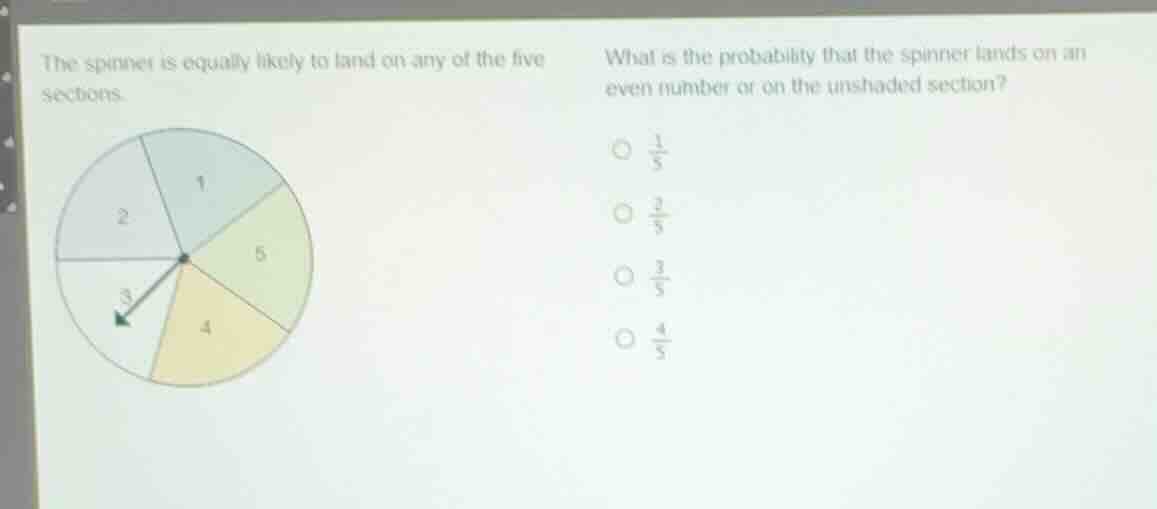
the spinner is equally likely to land on any of the five sections.
what is the probability that the spinner lands on an even number or on the unshaded section?
\\(\frac{1}{5}\\)
\\(\frac{2}{5}\\)
\\(\frac{3}{5}\\)
\\(\frac{4}{5}\\)
Identify the sample space and outcomes
Using the Theoretical Probability and Favorable Outcomes knowledge points
The spinner has 5 equally likely sections labeled 1, 2, 3, 4, and 5.
Sample space \(S = \{1, 2, 3, 4, 5\}\) with total outcomes \(n(S) = 5\).
Shaded sections: 1 (blue-grey), 4 (yellow), 5 (green).
Unshaded sections: 2 (grey), 3 (white).
Define the events
Using the Theoretical Probability knowledge point
Let \(A\) be the event that the spinner lands on an even number:
Let \(B\) be the event that the spinner lands on an unshaded section:
Find the union of the events
Using the Probability Addition Rule and Non-Mutually Exclusive Events knowledge points
We want to find the probability of landing on an even number OR an unshaded section, which is \(P(A \cup B)\).
Find the union of the sets:
The number of favorable outcomes is \(n(A \cup B) = 3\).
Calculate the probability
Using the Theoretical Probability knowledge point

Snap & solve any problem in the app
Get step-by-step solutions on Sovi AI
Photo-based solutions with guided steps
Explore more problems and detailed explanations
- (A) \(\frac{1}{5}\)
- (B) \(\frac{2}{5}\)
- (C) \(\frac{3}{5}\) (Correct answer)
- (D) \(\frac{4}{5}\)