QUESTION IMAGE
Question
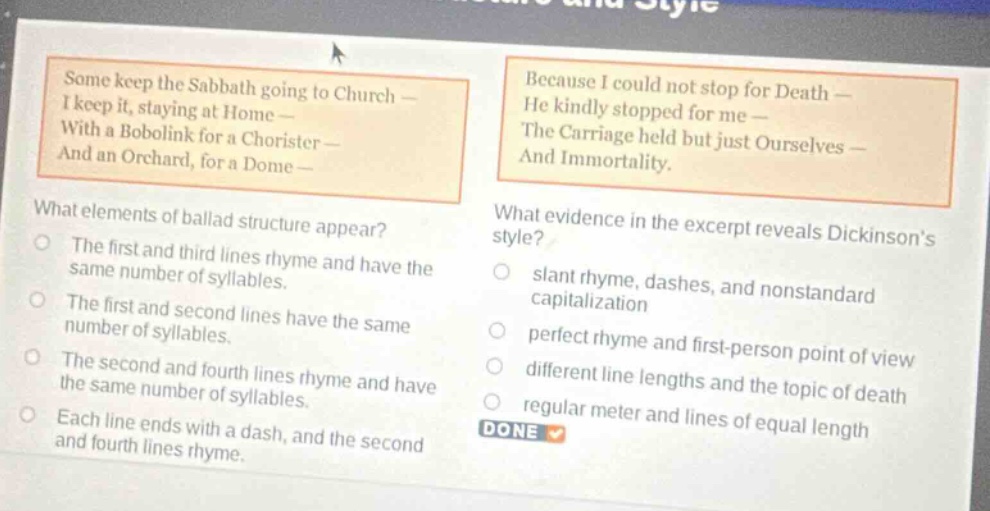
some keep the sabbath going to church -
i keep it, staying at home -
with a bobolink for a chorister -
and an orchard, for a dome -
what elements of ballad structure appear?
- the first and third lines rhyme and have the same number of syllables.
- the first and second lines have the same number of syllables.
- the second and fourth lines rhyme and have the same number of syllables.
- each line ends with a dash, and the second and fourth lines rhyme.
because i could not stop for death -
he kindly stopped for me -
the carriage held but just ourselves -
and immortality.
what evidence in the excerpt reveals dickinsons style?
- slant rhyme, dashes, and nonstandard capitalization
- perfect rhyme and first-person point of view
- different line lengths and the topic of death
- regular meter and lines of equal length
⚡ Using what you learned: close reading methods for poetic texts
Step 1: Analyze the first question (Ballad Structure)
The first excerpt is from Emily Dickinson's poem:
Some keep the Sabbath going to Church —
I keep it, staying at Home —
With a Bobolink for a Chorister —
And an Orchard, for a Dome —
Let's evaluate the options regarding ballad structure:
- Option 1: "The first and third lines rhyme..." — "Church" and "Chorister" do not rhyme.
- Option 2: "The first and second lines have the same number of syllables." — Line 1 has 10 syllables ("Some keep the Sab-bath go-ing to Church"), and Line 2 has 8 syllables ("I keep it, stay-ing at Home"). They do not match.
- Option 3: "The second and fourth lines rhyme and have the same number of syllables." — Line 2 ends in "Home" (8 syllables) and Line 4 ends in "Dome" (8 syllables: "And an Or-chard, for a Dome"). "Home" and "Dome" are perfect rhymes, and both lines contain exactly 8 syllables.
- Option 4: "Each line ends with a dash, and the second and fourth lines rhyme." — Line 3 ends with a dash, but Line 1 ends with a dash in some prints, though the syllable and rhyme structure in Option 3 is the defining structural characteristic of ballad meter (specifically common meter, which alternates iambic tetrameter and iambic trimeter, where the second and fourth lines rhyme and share the same syllable count).
Thus, the third option is the correct choice for the first question.
Step 2: Analyze the second question (Dickinson's Style)
The second excerpt is:
Because I could not stop for Death —
He kindly stopped for me —
The Carriage held but just Ourselves —
And Immortality.
Let's look at the stylistic elements present in this stanza:
- Dashes: Em-dashes are used at the end of lines ("Death —", "me —", "Ourselves —").
- Nonstandard capitalization: Words like "Death", "Carriage", "Ourselves", and "Immortality" are capitalized mid-sentence.
- Slant rhyme: "me" and "Immortality" form a slant (or near) rhyme in the context of her broader rhythmic patterns, or "Death" and "Ourselves" do not rhyme, which is characteristic of her frequent use of slant rhymes.
Comparing this to the options:
- Option 1: "slant rhyme, dashes, and nonstandard capitalization" directly names these signature elements of Dickinson's poetic style.
Thus, the first option is the correct choice for the second question.

Snap & solve any problem in the app
Get step-by-step solutions on Sovi AI
Photo-based solutions with guided steps
Explore more problems and detailed explanations
- Left Question (Ballad Structure):
The second and fourth lines rhyme and have the same number of syllables.
- Right Question (Dickinson's Style):
slant rhyme, dashes, and nonstandard capitalization