QUESTION IMAGE
Question
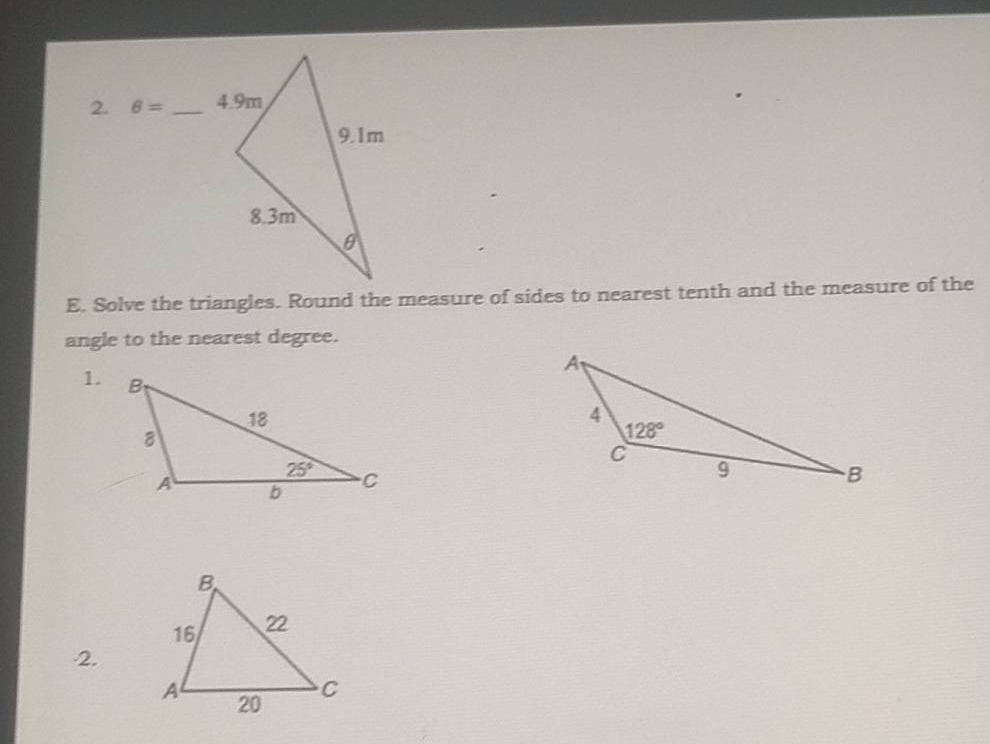
- \\(\theta = \underline{\quad}\\)
e. solve the triangles. round the measure of sides to nearest tenth and the measure of the angle to the nearest degree.
1.
2.
🆕 New Concept Discovered: Laws of Sines and Cosines
Solving non-right triangles using side and angle relationships.
---
Understanding the Tools
When solving non-right (oblique) triangles, we cannot use basic right-triangle trigonometry (\(\text{SOH CAH TOA}\)) directly. Instead, we use two powerful tools:
- The Law of Sines: Useful when we know an angle and its opposite side, plus one other piece of information.
- The Law of Cosines: Useful when we know two sides and the angle between them (SAS), or all three sides (SSS).
Let's solve each problem step-by-step.
---
Part 1: Top Problem (labeled "2.")
We are given a triangle with three known sides:
- Side opposite to \(\theta\): \(a = 4.9\text{ m}\)
- Adjacent sides: \(b = 8.3\text{ m}\) and \(c = 9.1\text{ m}\)
We need to find the angle \(\theta\).
Step 1: Apply the Law of Cosines
Since we know all three sides (SSS), we use the Law of Cosines to find the angle \(\theta\) opposite to the side of length \(4.9\text{ m}\):
Step 2: Calculate the values
Calculate the squares and products:
Isolate \(\cos(\theta)\):
Step 3: Find the angle \(\theta\)
Take the inverse cosine:
Rounding to the nearest degree:
---
Part E, Problem 1: Triangle ABC (left)
We are given:
- Side \(c = 8\) (opposite to angle \(C\))
- Side \(a = 18\) (opposite to angle \(A\))
- Angle \(C = 25^{\circ}\)
We need to "solve the triangle," which means finding all remaining sides and angles: angle \(A\), angle \(B\), and side \(b\).
Step 1: Find Angle \(A\) using the Law of Sines
Since we know side \(c\) and its opposite angle \(C\), we can set up the ratio:
Since side \(a\) (\(18\)) is longer than side \(c\) (\(8\)), angle \(A\) must be larger than angle \(C\) (\(25^{\circ}\)). Looking at the diagram, angle \(A\) is clearly an obtuse angle (greater than \(90^{\circ}\)).
Let's find both possible angles for \(\sin(A) = 0.9509\):
- Acute option: \(A \approx \sin^{-1}(0.9509) \approx 72^{\circ}\)
- Obtuse option: \(A \approx 180^{\circ} - 72^{\circ} = 108^{\circ}\)
Based on the visual representation of the obtuse angle \(A\):
Step 2: Find Angle \(B\)
The sum of angles in a triangle is always \(180^{\circ}\):
Step 3: Find Side \(b\) using the Law of Sines
---
Part E, Problem 1 (right): Triangle ABC
We are given:
- Side \(b = 4\) (opposite to angle \(B\))
- Side \(a = 9\) (opposite to angle \(A\))
- Angle \(C = 128^{\circ}\) (included angle between sides \(a\) and \(b\))
We need to find side \(c\), angle \(A\), and angle \(B\).
Step 1…

Snap & solve any problem in the app
Get step-by-step solutions on Sovi AI
Photo-based solutions with guided steps
Explore more problems and detailed explanations
Top Problem (2):
- \(\theta = 32^{\circ}\)
---
Section E Solutions:
1. Left Triangle:
- \(A = 108^{\circ}\)
- \(B = 47^{\circ}\)
- \(b = 13.8\)
1. Right Triangle:
- \(c = 11.9\)
- \(A = 37^{\circ}\)
- \(B = 15^{\circ}\)
2. Bottom-Left Triangle:
- \(A = 74^{\circ}\)
- \(B = 61^{\circ}\)
- \(C = 45^{\circ}\)