QUESTION IMAGE
Question
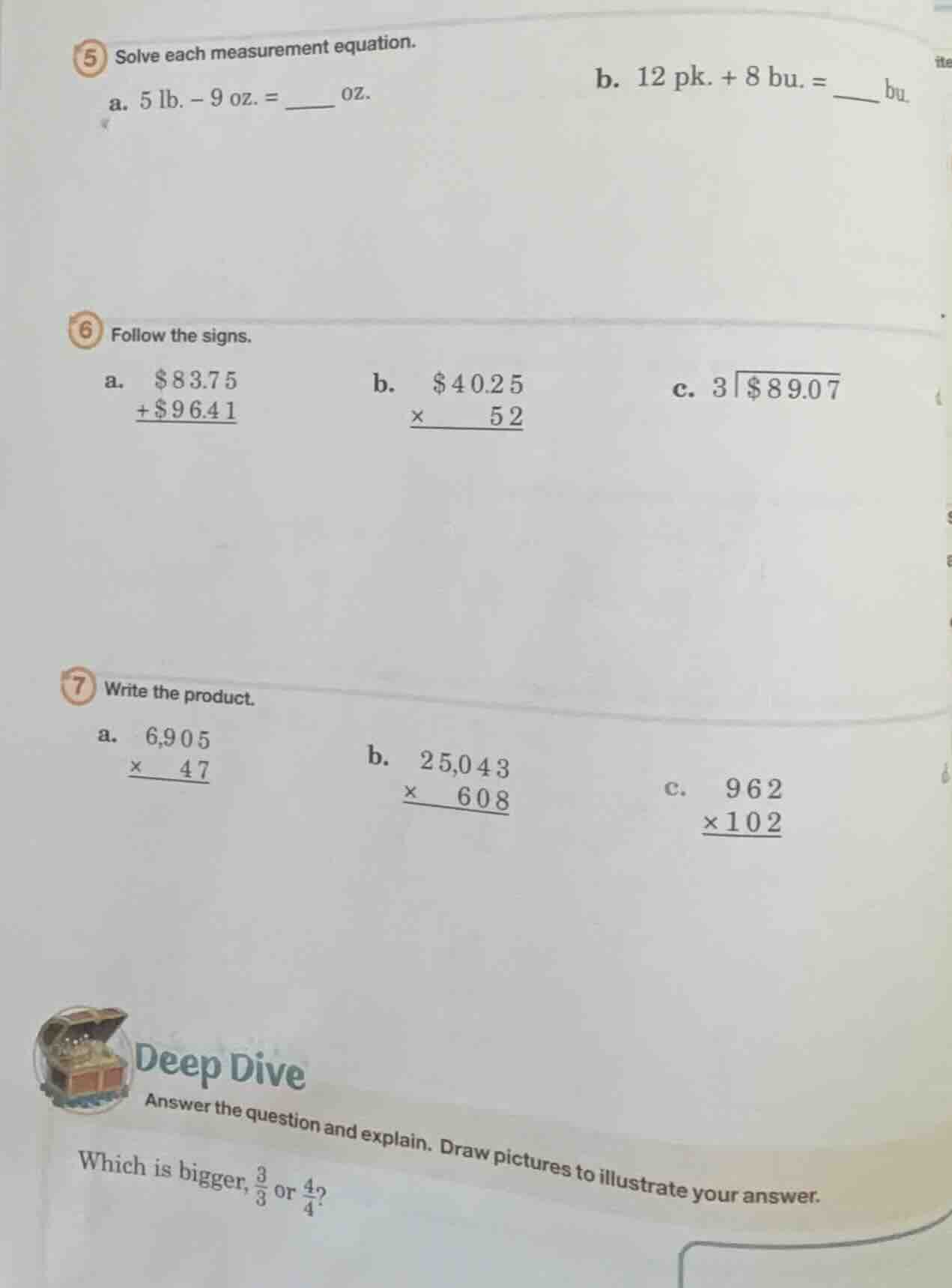
5 solve each measurement equation.
a. \\(5\text{ lb.} - 9\text{ oz.} = \text{___ oz.}\\)
b. \\(12\text{ pk.} + 8\text{ bu.} = \text{___ bu.}\\)
6 follow the signs.
a. \\(\
\\)
b. \\(\
\\)
c. \\(3 \overline{) \\$89.07}\\)
7 write the product.
a. \\(\
\\)
b. \\(\
\\)
c. \\(\
\\)
deep dive
answer the question and explain. draw pictures to illustrate your answer.
which is bigger, \\(\frac{3}{3}\\) or \\(\frac{4}{4}\\)?
Solve measurement equations
Convert units to perform arithmetic:
- For 5a: \(1\text{ lb} = 16\text{ oz}\). Thus, \(5\text{ lb} - 9\text{ oz} = 5 \times 16\text{ oz} - 9\text{ oz} = 80\text{ oz} - 9\text{ oz} = 71\text{ oz}\).
- For 5b: \(4\text{ pk} = 1\text{ bu}\). Thus, \(12\text{ pk} + 8\text{ bu} = \frac{12}{4}\text{ bu} + 8\text{ bu} = 3\text{ bu} + 8\text{ bu} = 11\text{ bu}\).
Perform decimal and integer arithmetic
Calculate each arithmetic operation:
- For 6a: \(\$83.75 + \$96.41 = \$180.16\).
- For 6b: \(\$40.25 \times 52 = \$2093.00\).
- For 6c: \(\$89.07 \div 3 = \$29.69\).
- For 7a: \(6905 \times 47 = 324535\).
- For 7b: \(25043 \times 608 = 15226144\).
- For 7c: \(962 \times 102 = 98124\).
Compare fractions
Analyze the fractions in the Deep Dive section:
- \(\frac{3}{3} = 1\)
- \(\frac{4}{4} = 1\)
- Since both fractions equal 1, they are equal in size. Neither is bigger.

Snap & solve any problem in the app
Get step-by-step solutions on Sovi AI
Photo-based solutions with guided steps
Explore more problems and detailed explanations
Question 5
a. <blank>71</blank>
b. <blank>11</blank>
Question 6
a. \(\$180.16\)
b. \(\$2,093.00\)
c. \(\$29.69\)
Question 7
a. \(324,535\)
b. \(15,226,144\)
c. \(98,124\)
Deep Dive
They are equal. Both \(\frac{3}{3}\) and \(\frac{4}{4}\) are equal to \(1\).