QUESTION IMAGE
Question
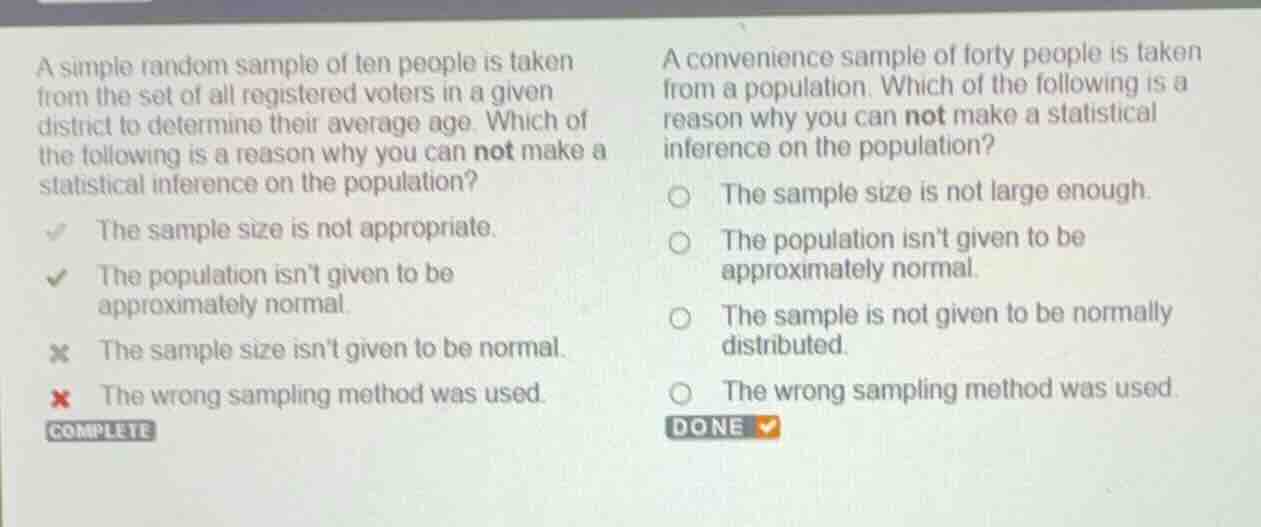
a simple random sample of ten people is taken from the set of all registered voters in a given district to determine their average age. which of the following is a reason why you can not make a statistical inference on the population?
- the sample size is not appropriate.
- the population isnt given to be approximately normal.
- the sample size isnt given to be normal.
- the wrong sampling method was used.
a convenience sample of forty people is taken from a population. which of the following is a reason why you can not make a statistical inference on the population?
- the sample size is not large enough.
- the population isnt given to be approximately normal.
- the sample size is not given to be normally distributed.
- the wrong sampling method was used.
Analyze Question 1
Using the Statistical Inference Assumptions and Central Limit Theorem Conditions knowledge points
- Given: A simple random sample (SRS) of size \(n = 10\) is taken from registered voters to estimate average age.
- Goal: Identify why we cannot make a statistical inference on the population.
- Analysis:
- The sampling method is a simple random sample, which is appropriate.
- However, the sample size \(n = 10\) is small (\(n < 30\)). For small sample sizes, we can only make inferences about the population mean if the underlying population is approximately normally distributed.
- Since we do not know if the population is approximately normal, and the sample size is too small to rely on the Central Limit Theorem, we cannot safely make statistical inferences.
- Therefore, the correct reasons are: "The sample size is not appropriate" (since \(n=10\) is too small without normality) and "The population isn't given to be approximately normal."
Analyze Question 2
Using the Convenience Sampling and Sampling Bias Sources knowledge points
- Given: A convenience sample of forty people is taken from a population.
- Goal: Identify why we cannot make a statistical inference on the population.
- Analysis:
- Convenience sampling is a non-probability sampling method where elements are selected based on ease of access rather than random selection.
- This method introduces severe selection bias, meaning the sample is highly unlikely to be representative of the population.
- For statistical inference to be valid, the sample must be selected randomly so that every member of the population has a known, non-zero chance of being selected.
- Therefore, the primary reason we cannot make a statistical inference is that the wrong sampling method (non-random convenience sampling) was used.

Snap & solve any problem in the app
Get step-by-step solutions on Sovi AI
Photo-based solutions with guided steps
Explore more problems and detailed explanations
Question 1
- The sample size is not appropriate. (Correct answer)
- The population isn't given to be approximately normal. (Correct answer)
- The sample size isn't given to be normal.
- The wrong sampling method was used.
Question 2
- The sample size is not large enough.
- The population isn't given to be approximately normal.
- The sample is not given to be normally distributed.
- The wrong sampling method was used. (Correct answer)