QUESTION IMAGE
Question
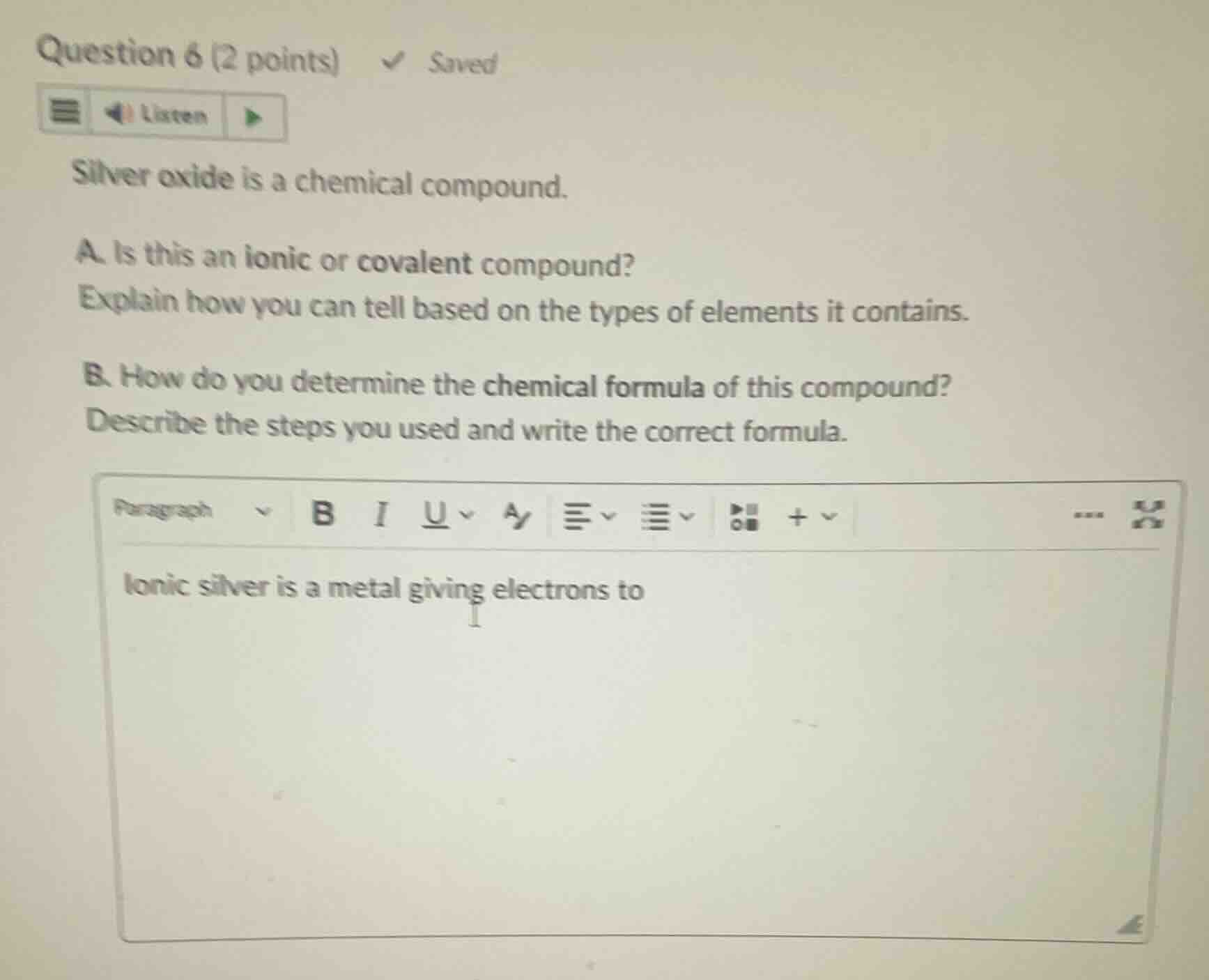
silver oxide is a chemical compound.
a. is this an ionic or covalent compound?
explain how you can tell based on the types of elements it contains.
b. how do you determine the chemical formula of this compound?
describe the steps you used and write the correct formula.
<pre_analysis>
{
"quality": "clear",
"question_count": 2,
"skills_matched": [
"direct_cot",
"explain_then_answer",
"tutor"
],
"needs_drawing": false,
"concepts_used": [
"Chemical Nomenclature"
],
"new_concepts": [
"Ionic Bonding",
"Chemical Formula Derivation"
],
"current_concepts": [
"Chemical Nomenclature",
"Ionic Bonding",
"Chemical Formula Derivation"
]
}
</pre_analysis>
<reasoning>
Identify compound type
Silver oxide contains silver (a metal) and oxygen (a nonmetal).
Using Chemical Nomenclature rules, a metal combined with a nonmetal forms an ionic compound.
Determine ionic charges
Silver forms a \(1+\) cation, written as \(\text{Ag}^+\).
Oxygen forms a \(2-\) anion, written as \(\text{O}^{2-}\).
Balance the charges
To balance the charges, two \(\text{Ag}^+\) ions are needed for every one \(\text{O}^{2-}\) ion.
This makes the overall compound neutral: \(2(+1) + 1(-2) = 0\).
Write final formula
Combining the balanced ions gives the chemical formula \(\text{Ag}_2\text{O}\).
</reasoning>
<answer>
Question A
Silver oxide is an ionic compound. It consists of silver, which is a metal, and oxygen, which is a nonmetal.
Question B
To determine the formula, identify the charges of the ions: silver is \(\text{Ag}^+\) and oxide is \(\text{O}^{2-}\). Balance the charges to make the compound neutral, requiring two silver ions for every one oxide ion, which gives the formula \(\text{Ag}_2\text{O}\).
</answer>
<post_analysis>
{
"subject": "Natural Science",
"question_type": "Multi-part",
"knowledge_point": [
"Natural Science",
"Chemistry",
"Ionic Compounds"
]
}
</post_analysis>
Snap & solve any problem in the app
Get step-by-step solutions on Sovi AI
Photo-based solutions with guided steps
Explore more problems and detailed explanations
<pre_analysis>
{
"quality": "clear",
"question_count": 2,
"skills_matched": [
"direct_cot",
"explain_then_answer",
"tutor"
],
"needs_drawing": false,
"concepts_used": [
"Chemical Nomenclature"
],
"new_concepts": [
"Ionic Bonding",
"Chemical Formula Derivation"
],
"current_concepts": [
"Chemical Nomenclature",
"Ionic Bonding",
"Chemical Formula Derivation"
]
}
</pre_analysis>
<reasoning>
Identify compound type
Silver oxide contains silver (a metal) and oxygen (a nonmetal).
Using Chemical Nomenclature rules, a metal combined with a nonmetal forms an ionic compound.
Determine ionic charges
Silver forms a \(1+\) cation, written as \(\text{Ag}^+\).
Oxygen forms a \(2-\) anion, written as \(\text{O}^{2-}\).
Balance the charges
To balance the charges, two \(\text{Ag}^+\) ions are needed for every one \(\text{O}^{2-}\) ion.
This makes the overall compound neutral: \(2(+1) + 1(-2) = 0\).
Write final formula
Combining the balanced ions gives the chemical formula \(\text{Ag}_2\text{O}\).
</reasoning>
<answer>
Question A
Silver oxide is an ionic compound. It consists of silver, which is a metal, and oxygen, which is a nonmetal.
Question B
To determine the formula, identify the charges of the ions: silver is \(\text{Ag}^+\) and oxide is \(\text{O}^{2-}\). Balance the charges to make the compound neutral, requiring two silver ions for every one oxide ion, which gives the formula \(\text{Ag}_2\text{O}\).
</answer>
<post_analysis>
{
"subject": "Natural Science",
"question_type": "Multi-part",
"knowledge_point": [
"Natural Science",
"Chemistry",
"Ionic Compounds"
]
}
</post_analysis>