QUESTION IMAGE
Question
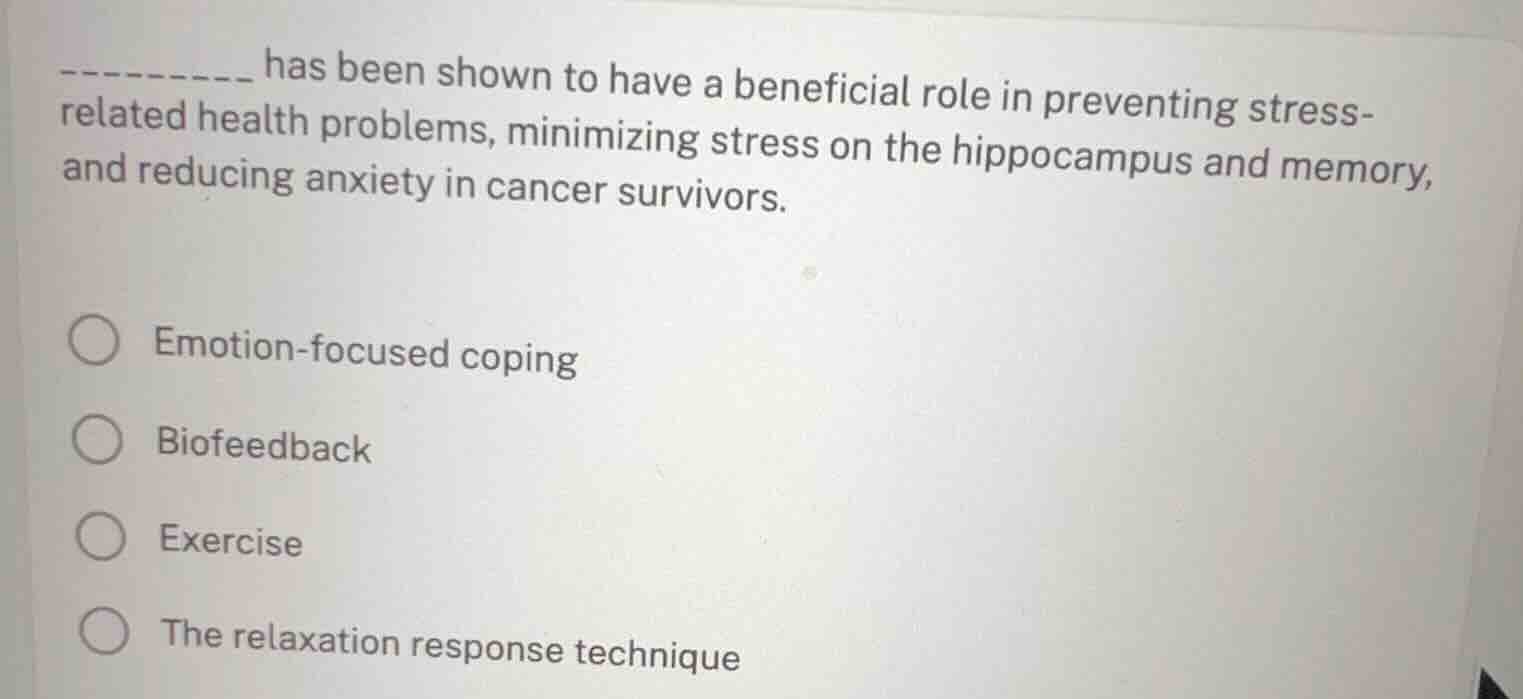
________ has been shown to have a beneficial role in preventing stress-related health problems, minimizing stress on the hippocampus and memory, and reducing anxiety in cancer survivors.
emotion-focused coping
biofeedback
exercise
the relaxation response technique
<pre_analysis>
{
"quality": "clear",
"question_count": 1,
"skills_matched": [
"direct_cot",
"multiple_choice_formatter",
"explain_then_answer",
"quick"
],
"needs_drawing": false,
"concepts_used": [
"Exercise and Stress"
],
"new_concepts": [],
"current_concepts": [
"Exercise and Stress",
"Coping Mechanisms",
"Biofeedback",
"Stress Regulation Tools"
]
}
</pre_analysis>
<reasoning>
Analyze the question stem
The question asks to identify the intervention or behavior that has been shown to prevent stress-related health problems, minimize stress on the hippocampus, and reduce anxiety in cancer survivors.
Evaluate the options
- Emotion-focused coping: While helpful for managing emotional distress, it is a broad cognitive/behavioral strategy rather than a specific physical intervention linked directly to physical hippocampal protection in this context.
- Biofeedback: A technique to gain voluntary control over physiological functions, but not specifically characterized by this exact combination of physiological benefits (especially hippocampal protection).
- Exercise: Physical exercise is well-documented in health psychology to promote neurogenesis, protect the hippocampus from stress-induced atrophy, reduce anxiety in clinical populations (including cancer survivors), and prevent stress-related health issues.
- The relaxation response technique: Primarily used for immediate stress reduction and physiological calming, but exercise is the primary lifestyle intervention associated with preventing hippocampal volume loss and stress-related cognitive decline.
Confirm the correct choice
Based on standard psychological and physiological research regarding stress regulation, aerobic exercise is the correct answer.
</reasoning>
<answer>
<mcq-option>Emotion-focused coping</mcq-option>
<mcq-option>Biofeedback</mcq-option>
<mcq-correct>Exercise</mcq-correct>
<mcq-option>The relaxation response technique</mcq-option>
</answer>
<post_analysis>
{
"subject": "Social Science",
"question_type": "Multiple Choice",
"knowledge_point": [
"Social Science",
"Psychology",
"Stress and Health"
]
}
</post_analysis>
Snap & solve any problem in the app
Get step-by-step solutions on Sovi AI
Photo-based solutions with guided steps
Explore more problems and detailed explanations
<pre_analysis>
{
"quality": "clear",
"question_count": 1,
"skills_matched": [
"direct_cot",
"multiple_choice_formatter",
"explain_then_answer",
"quick"
],
"needs_drawing": false,
"concepts_used": [
"Exercise and Stress"
],
"new_concepts": [],
"current_concepts": [
"Exercise and Stress",
"Coping Mechanisms",
"Biofeedback",
"Stress Regulation Tools"
]
}
</pre_analysis>
<reasoning>
Analyze the question stem
The question asks to identify the intervention or behavior that has been shown to prevent stress-related health problems, minimize stress on the hippocampus, and reduce anxiety in cancer survivors.
Evaluate the options
- Emotion-focused coping: While helpful for managing emotional distress, it is a broad cognitive/behavioral strategy rather than a specific physical intervention linked directly to physical hippocampal protection in this context.
- Biofeedback: A technique to gain voluntary control over physiological functions, but not specifically characterized by this exact combination of physiological benefits (especially hippocampal protection).
- Exercise: Physical exercise is well-documented in health psychology to promote neurogenesis, protect the hippocampus from stress-induced atrophy, reduce anxiety in clinical populations (including cancer survivors), and prevent stress-related health issues.
- The relaxation response technique: Primarily used for immediate stress reduction and physiological calming, but exercise is the primary lifestyle intervention associated with preventing hippocampal volume loss and stress-related cognitive decline.
Confirm the correct choice
Based on standard psychological and physiological research regarding stress regulation, aerobic exercise is the correct answer.
</reasoning>
<answer>
<mcq-option>Emotion-focused coping</mcq-option>
<mcq-option>Biofeedback</mcq-option>
<mcq-correct>Exercise</mcq-correct>
<mcq-option>The relaxation response technique</mcq-option>
</answer>
<post_analysis>
{
"subject": "Social Science",
"question_type": "Multiple Choice",
"knowledge_point": [
"Social Science",
"Psychology",
"Stress and Health"
]
}
</post_analysis>