QUESTION IMAGE
Question
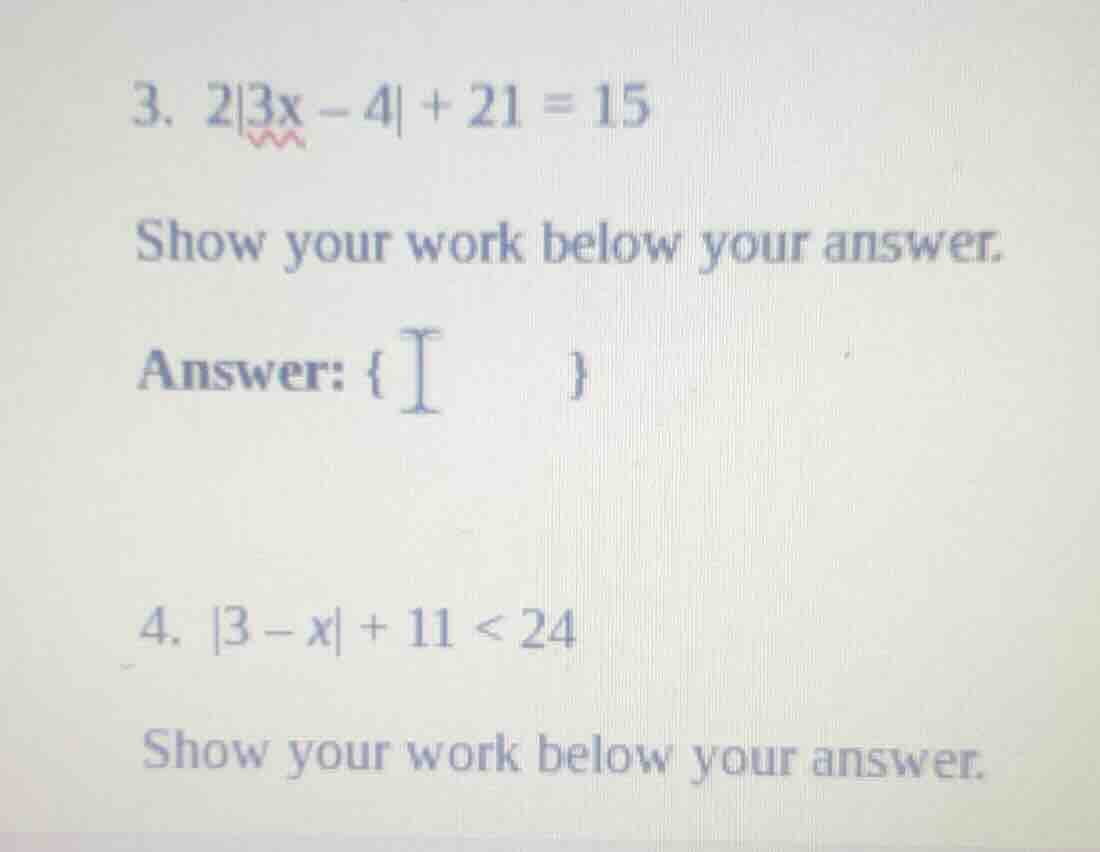
- $2|3x - 4| + 21 = 15$
show your work below your answer.
answer: { }
- $|3 - x| + 11 < 24$
show your work below your answer.
Problem 3: Solve \( 2|3x - 4| + 21 = 15 \)
Step 1: Isolate the absolute value term
Subtract 21 from both sides of the equation.
\( 2|3x - 4| + 21 - 21 = 15 - 21 \)
\( 2|3x - 4| = -6 \)
Step 2: Divide both sides by 2
\( \frac{2|3x - 4|}{2} = \frac{-6}{2} \)
\( |3x - 4| = -3 \)
Step 3: Analyze the absolute value equation
The absolute value of a number is always non - negative (i.e., greater than or equal to 0). So, \( |3x - 4| \) can never be equal to - 3. This means the equation \( 2|3x - 4|+21 = 15 \) has no solution.
Step 1: Isolate the absolute value term
Subtract 11 from both sides of the inequality.
\( |3 - x|+11 - 11<24 - 11 \)
\( |3 - x|<13 \)
Step 2: Rewrite the absolute value inequality
Recall that if \( |a|0 \)), then \( -b < a < b \). So, for \( |3 - x|<13 \), we have:
\( - 13<3 - x<13 \)
Step 3: Solve the compound inequality
First, solve the left - hand inequality \( -13 < 3 - x \):
Subtract 3 from both sides: \( -13-3 < 3 - x-3 \)
\( -16 < -x \)
Multiply both sides by - 1 (and reverse the inequality sign): \( 16>x \) or \( x < 16 \)
Next, solve the right - hand inequality \( 3 - x<13 \):
Subtract 3 from both sides: \( 3 - x-3<13 - 3 \)
\( -x < 10 \)
Multiply both sides by - 1 (and reverse the inequality sign): \( x>- 10 \)

Snap & solve any problem in the app
Get step-by-step solutions on Sovi AI
Photo-based solutions with guided steps
Explore more problems and detailed explanations
\(\varnothing\) (the empty set)