QUESTION IMAGE
Question
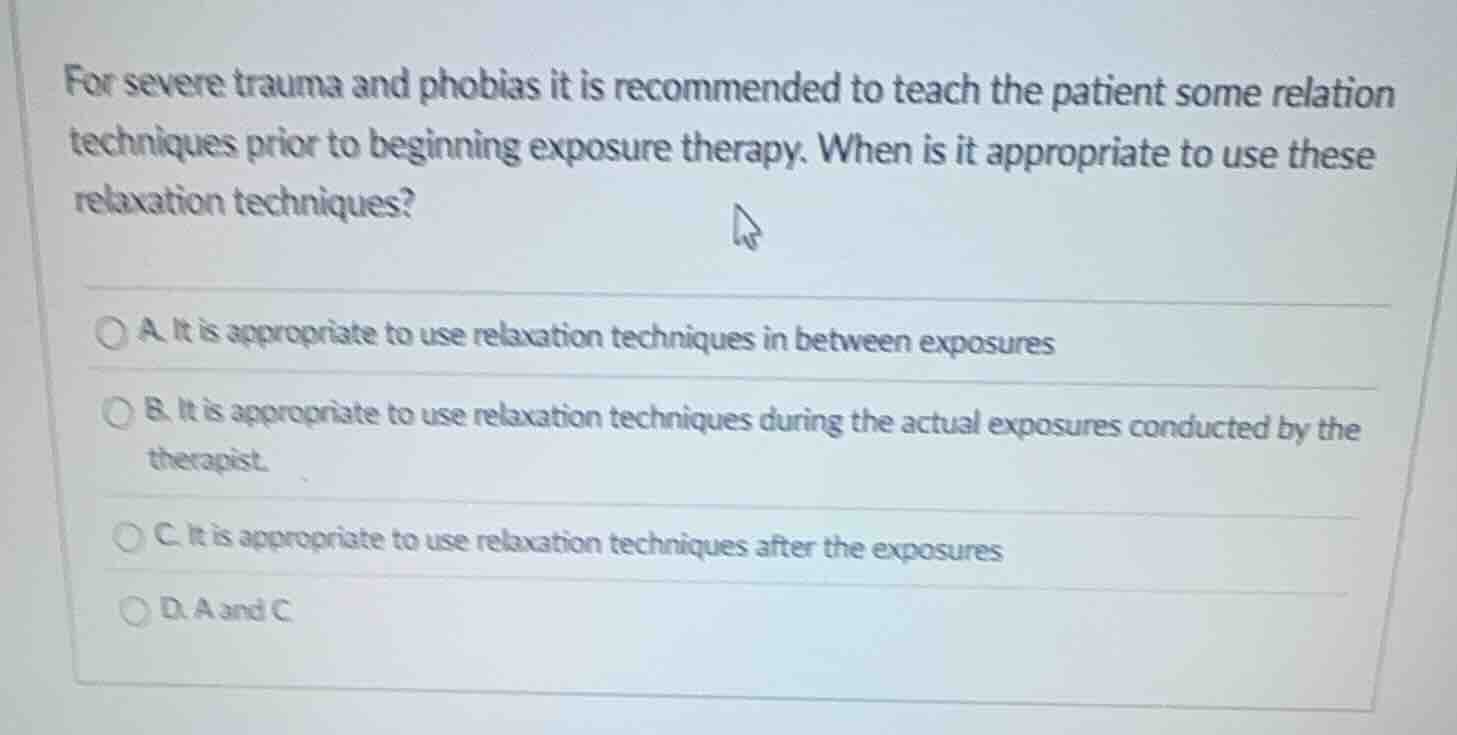
for severe trauma and phobias it is recommended to teach the patient some relation techniques prior to beginning exposure therapy. when is it appropriate to use these relaxation techniques?
a. it is appropriate to use relaxation techniques in between exposures
b. it is appropriate to use relaxation techniques during the actual exposures conducted by the therapist.
c. it is appropriate to use relaxation techniques after the exposures
d. a and c
🆕 New Concept Discovered: Exposure Therapy Protocols
Integrating relaxation without disrupting emotional processing
Step 1: Understand the mechanism of exposure therapy
In exposure therapy, the primary therapeutic mechanism is habituation or inhibitory learning. For this to occur, the patient must fully experience the physiological and emotional arousal triggered by the feared stimulus.
If a patient uses relaxation techniques during the actual exposure (Option B), it acts as a form of safety behavior or avoidance. This prevents the patient from fully experiencing the anxiety, thereby disrupting the natural habituation process and limiting the therapy's effectiveness.
Step 2: Identify when relaxation is appropriate
Because relaxation techniques should not be used during the exposure itself, they are taught beforehand to help the patient manage overall baseline anxiety and to facilitate recovery after high-stress situations. Therefore, it is appropriate to use these techniques:
- In between exposures (Option A): To help the patient calm down and stabilize their nervous system before the next session or trial.
- After the exposures (Option C): To return the patient to a state of safety and equilibrium once the active exposure trial is complete.
Step 3: Select the correct option
Since both Option A and Option C are appropriate times to use relaxation techniques, the correct choice is Option D (A and C).

Snap & solve any problem in the app
Get step-by-step solutions on Sovi AI
Photo-based solutions with guided steps
Explore more problems and detailed explanations
D. A and C