QUESTION IMAGE
Question
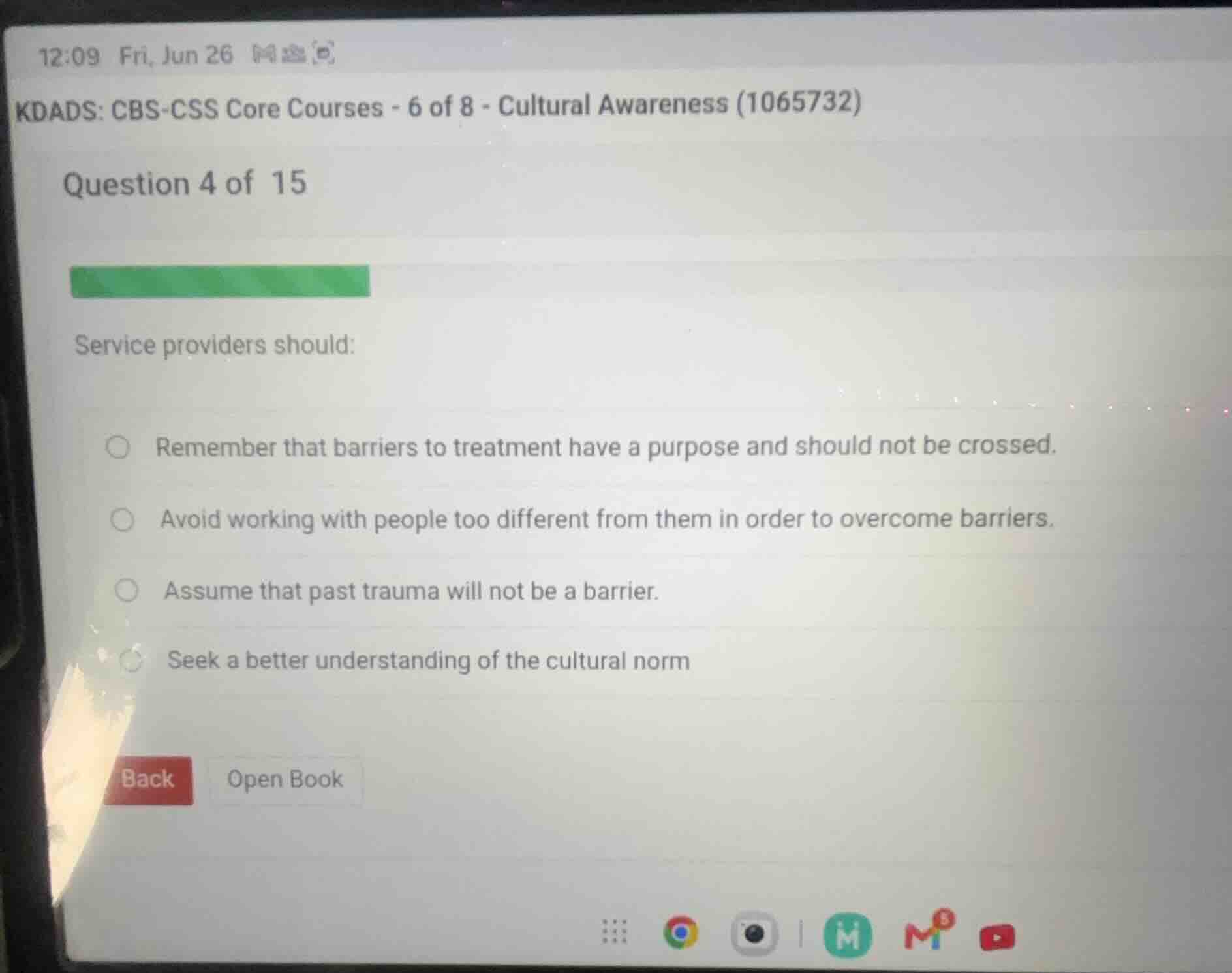
service providers should:
remember that barriers to treatment have a purpose and should not be crossed.
avoid working with people too different from them in order to overcome barriers.
assume that past trauma will not be a barrier.
seek a better understanding of the cultural norm
Analyze the course context
The course title shown at the top is "KDADS: CBS-CSS Core Courses - 6 of 8 - Cultural Awareness". This indicates the question focuses on best practices for service providers regarding cultural awareness and competence.
Evaluate the options
- "Remember that barriers to treatment have a purpose and should not be crossed": Incorrect. Barriers to treatment (such as systemic, cultural, or language barriers) hinder care and should be addressed or overcome, not left uncrossed.
- "Avoid working with people too different from them in order to overcome barriers": Incorrect. Service providers must serve diverse populations and cannot avoid clients based on differences.
- "Assume that past trauma will not be a barrier": Incorrect. Trauma-informed care requires recognizing that past trauma is often a significant barrier to treatment.
- "Seek a better understanding of the cultural norm": Correct. In a cultural awareness course, actively seeking to understand a client's cultural norms is a fundamental responsibility of a service provider to deliver effective, respectful care.
Determine the correct choice
The fourth option is the only professional, culturally competent, and supportive action for a service provider to take.

Snap & solve any problem in the app
Get step-by-step solutions on Sovi AI
Photo-based solutions with guided steps
Explore more problems and detailed explanations
- (A) Remember that barriers to treatment have a purpose and should not be crossed.
- (B) Avoid working with people too different from them in order to overcome barriers.
- (C) Assume that past trauma will not be a barrier.
- (D) Seek a better understanding of the cultural norm (Correct answer)