QUESTION IMAGE
Question
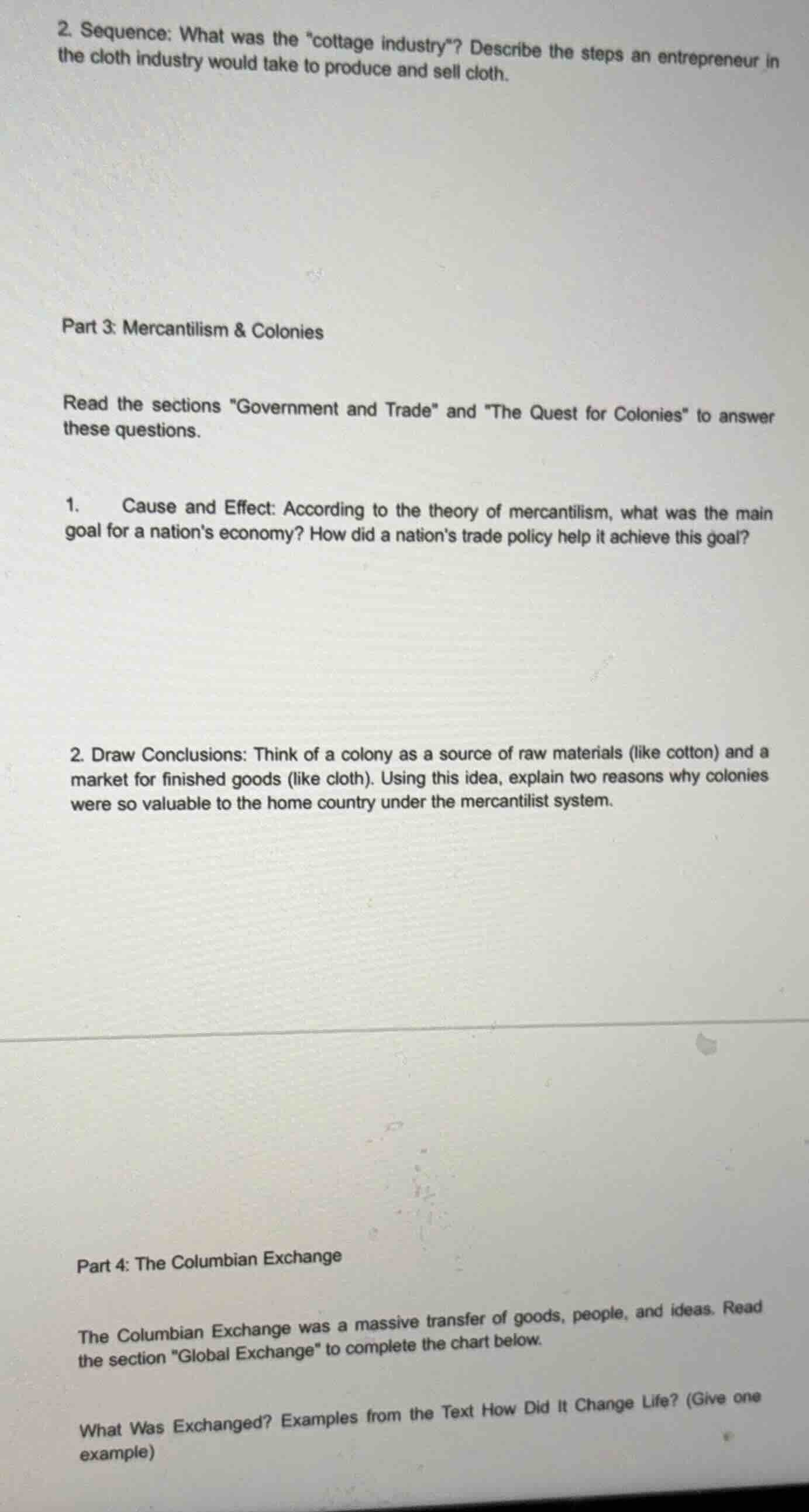
- sequence: what was the \cottage industry\? describe the steps an entrepreneur in the cloth industry would take to produce and sell cloth.
part 3: mercantilism & colonies
read the sections \government and trade\ and \the quest for colonies\ to answer these questions.
- cause and effect: according to the theory of mercantilism, what was the main goal for a nations economy? how did a nations trade policy help it achieve this goal?
- draw conclusions: think of a colony as a source of raw materials (like cotton) and a market for finished goods (like cloth). using this idea, explain two reasons why colonies were so valuable to the home country under the mercantilist system.
part 4: the columbian exchange
the columbian exchange was a massive transfer of goods, people, and ideas. read the section \global exchange\ to complete the chart below.
what was exchanged? examples from the text how did it change life? (give one example)
Define the cottage industry
The "cottage industry" was a business system where goods were produced by hand in people's homes rather than in factories. It was a key part of the Commercial Revolution and early Capitalism. An entrepreneur would buy raw wool or cotton, distribute it to families to spin into thread and weave into cloth in their cottages, and then collect and sell the finished product.
Explain mercantilism goals
Under mercantilism, the main goal for a nation's economy was to increase its wealth and power, measured by its supply of gold and silver. A nation's trade policy helped achieve this by maintaining a favorable balance of trade, meaning the country exported more valuable goods than it imported.
Analyze colonial value
Colonies were highly valuable to the home country under mercantilism for two main reasons:
- They provided cheap raw materials (like cotton) directly to the home country, reducing the need to buy from rivals.
- They served as exclusive markets for the home country's manufactured finished goods (like cloth), ensuring steady profits.
Describe Columbian Exchange
The Columbian Exchange was a massive transfer of goods, plants, animals, and ideas between the Eastern and Western Hemispheres. For example, potatoes and maize (corn) were introduced from the Americas to Europe, which significantly improved nutrition and led to rapid population growth in European societies.

Snap & solve any problem in the app
Get step-by-step solutions on Sovi AI
Photo-based solutions with guided steps
Explore more problems and detailed explanations
Question 1
The "cottage industry" was an early capitalist production system where goods were made by hand in rural homes. An entrepreneur would:
- Purchase raw materials (like wool).
- Distribute them to families to spin and weave in their cottages.
- Pay the workers for their labor.
- Collect the finished cloth and sell it for a profit.
Question 2
According to mercantilism, the main goal was to maximize a nation's wealth and power, measured in gold and silver. Trade policies helped achieve this by encouraging exports and restricting imports to maintain a favorable balance of trade.
Question 3
Colonies were valuable to the home country because:
- They supplied cheap raw materials, saving the home country from buying from competitors.
- They served as a captive market, forced to buy the home country's manufactured goods.
Question 4
- What Was Exchanged? Potatoes and maize (corn) from the Americas to Europe.
- How Did It Change Life? These nutrient-rich crops improved diets, leading to significant population growth across Europe.