QUESTION IMAGE
Question
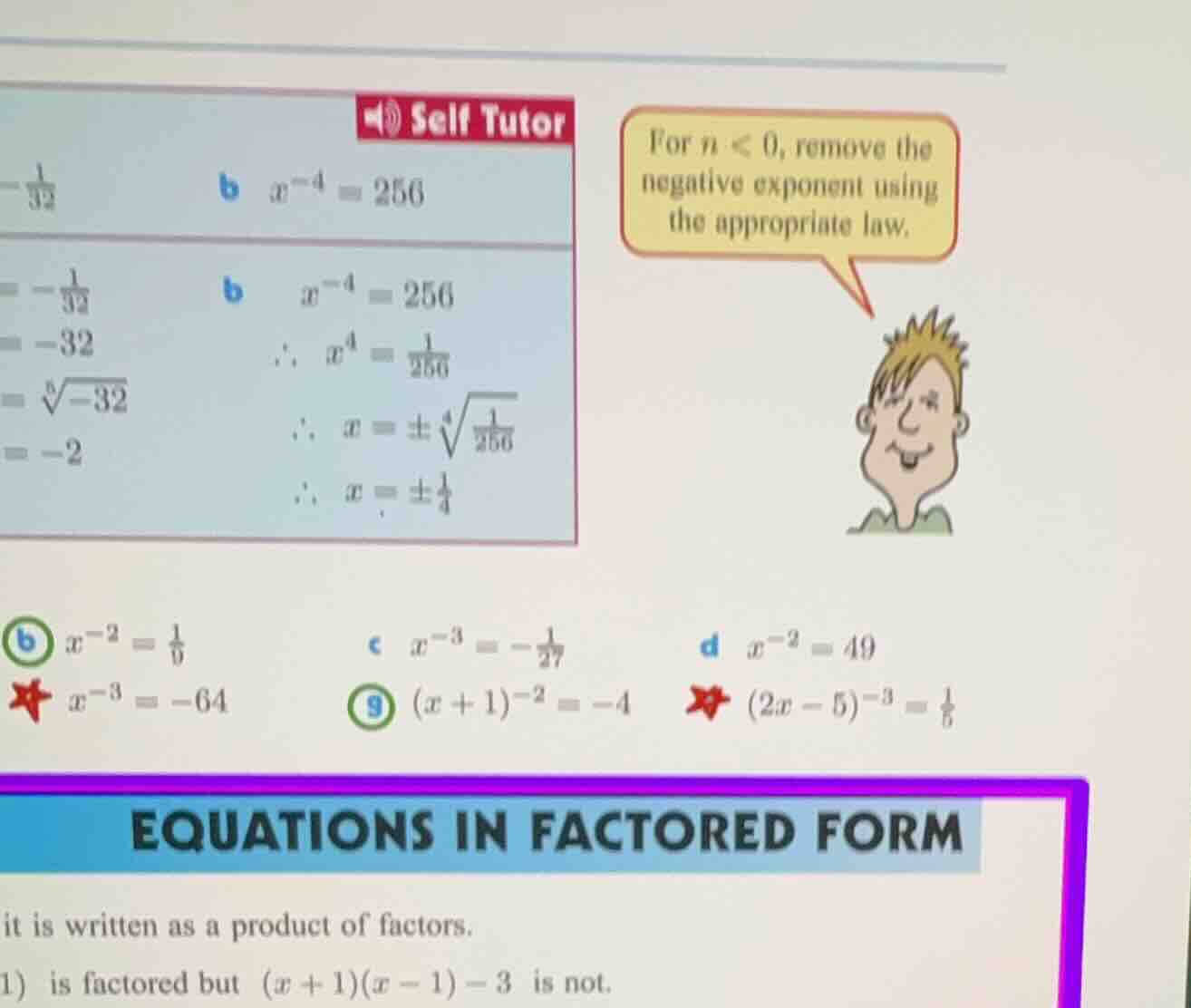
self tutor
for n < 0, remove the
negative exponent using
the appropriate law.
-1/32
b x⁻⁴ = 256
= -1/32
b x⁻⁴ = 256
= -32
∴ x⁴ = 1/256
= ∛(-32)
∴ x = ±∜(1/256)
= -2
∴ x = ±1/4
b x⁻² = 1/9
c x⁻³ = -1/27
d x⁻² = 49
x⁻³ = -64
g (x + 1)⁻² = -4
(2x - 5)⁻³ = 1/8
equations in factored form
it is written as a product of factors.
- is factored but (x + 1)(x - 1) - 3 is not.
Step1: Solve $x^{-2}=\frac{1}{9}$
Use negative exponent rule: $x^{-n}=\frac{1}{x^n}$
$\frac{1}{x^2}=\frac{1}{9} \implies x^2=9 \implies x=\pm3$
Step2: Solve $x^{-3}=-64$
Rewrite using negative exponent rule: $\frac{1}{x^3}=-64$
$x^3=-\frac{1}{64} \implies x=\sqrt[3]{-\frac{1}{64}}=-\frac{1}{4}$
Step3: Solve $x^{-3}=-\frac{1}{27}$
Rewrite using negative exponent rule: $\frac{1}{x^3}=-\frac{1}{27}$
$x^3=-27 \implies x=\sqrt[3]{-27}=-3$
Step4: Solve $(x+1)^{-2}=-4$
Rewrite using negative exponent rule: $\frac{1}{(x+1)^2}=-4$
A square of a real number is non-negative, so $\frac{1}{(x+1)^2}>0$, no real solution.
Step5: Solve $x^{-2}=49$
Rewrite using negative exponent rule: $\frac{1}{x^2}=49$
$x^2=\frac{1}{49} \implies x=\pm\frac{1}{7}$
Step6: Solve $(2x-5)^{-3}=\frac{1}{8}$
Rewrite using negative exponent rule: $\frac{1}{(2x-5)^3}=\frac{1}{8}$
$(2x-5)^3=8 \implies 2x-5=\sqrt[3]{8}=2 \implies 2x=7 \implies x=\frac{7}{2}$

Snap & solve any problem in the app
Get step-by-step solutions on Sovi AI
Photo-based solutions with guided steps
Explore more problems and detailed explanations
- $x^{-2}=\frac{1}{9}$: $x=\pm3$
- $x^{-3}=-64$: $x=-\frac{1}{4}$
- $x^{-3}=-\frac{1}{27}$: $x=-3$
- $(x+1)^{-2}=-4$: No real solution
- $x^{-2}=49$: $x=\pm\frac{1}{7}$
- $(2x-5)^{-3}=\frac{1}{8}$: $x=\frac{7}{2}$