QUESTION IMAGE
Question
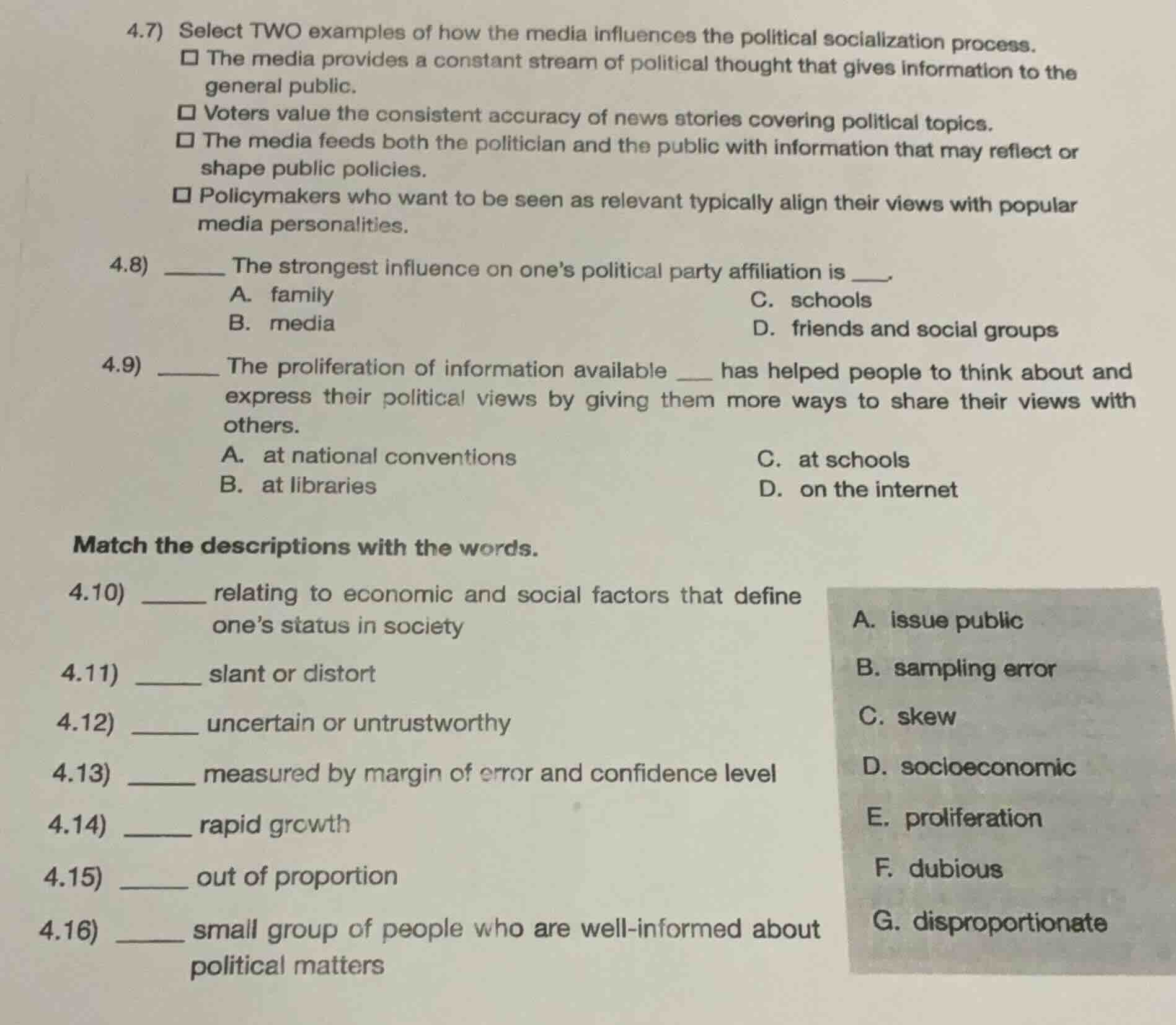
4.7) select two examples of how the media influences the political socialization process.
the media provides a constant stream of political thought that gives information to the general public.
voters value the consistent accuracy of news stories covering political topics.
the media feeds both the politician and the public with information that may reflect or shape public policies.
policymakers who want to be seen as relevant typically align their views with popular media personalities.
4.8) ____ the strongest influence on one’s political party affiliation is __.
a. family
c. schools
b. media
d. friends and social groups
4.9) ____ the proliferation of information available __ has helped people to think about and express their political views by giving them more ways to share their views with others.
a. at national conventions
c. at schools
b. at libraries
d. on the internet
match the descriptions with the words.
4.10) ______ relating to economic and social factors that define one’s status in society
4.11) ______ slant or distort
4.12) ______ uncertain or untrustworthy
4.13) ______ measured by margin of error and confidence level
4.14) ______ rapid growth
4.15) ______ out of proportion
4.16) ______ small group of people who are well - informed about political matters
a. issue public
b. sampling error
c. skew
d. socioeconomic
e. proliferation
f. dubious
g. disproportionate
4.7
Political socialization is the process by which people form their political beliefs. The media influences this by providing ongoing political information to the public, and by shaping or reflecting public policy through the information it shares with both politicians and the public.
4.8
Research in political socialization consistently shows that family is the primary and strongest influence on a person's political party affiliation, as children often adopt the political views of their parents early in life.
4.9
The internet is the only option that provides widespread, accessible platforms for people to access vast amounts of political information and share their own views with others through social media, forums, etc.
4.10-4.16
These are direct vocabulary matches based on standard definitions in political science and social research:
- "Socioeconomic" refers to economic and social status factors.
- "Skew" means to slant or distort information.
- "Dubious" describes something uncertain or untrustworthy.
- "Sampling error" is measured using margin of error and confidence levels in research.
- "Proliferation" means rapid growth or spread.
- "Disproportionate" means out of proportion.
- "Issue public" refers to a small, well-informed group focused on specific political matters.

Snap & solve any problem in the app
Get step-by-step solutions on Sovi AI
Photo-based solutions with guided steps
Explore more problems and detailed explanations
4.7)
- The media provides a constant stream of political thought that gives information to the general public.
- The media feeds both the politician and the public with information that may reflect or shape public policies.
4.8) A. family
4.9) D. on the internet
4.10) D. socioeconomic
4.11) C. skew
4.12) F. dubious
4.13) B. sampling error
4.14) E. proliferation
4.15) G. disproportionate
4.16) A. issue public