QUESTION IMAGE
Question
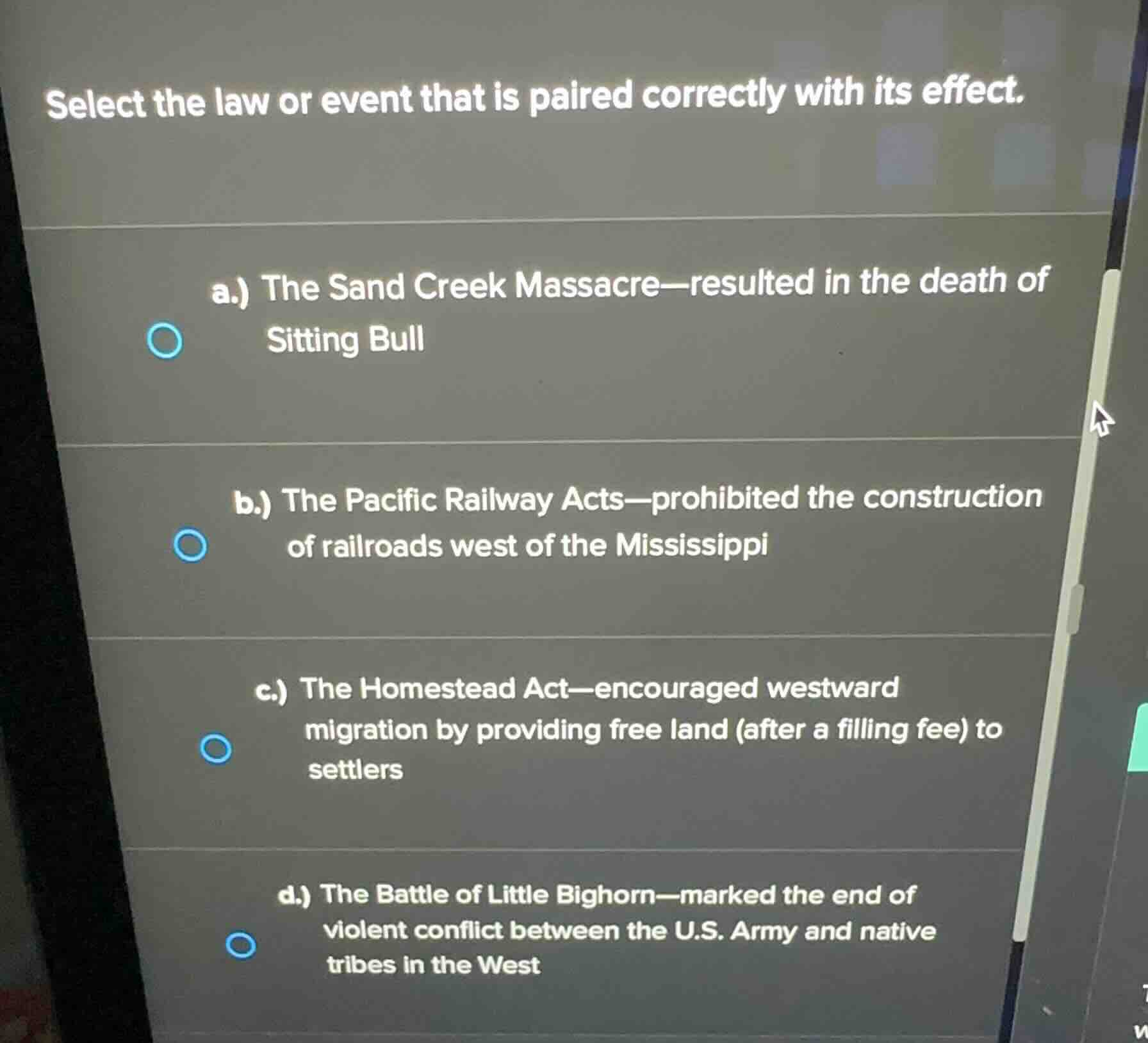
select the law or event that is paired correctly with its effect.
a.) the sand creek massacre-resulted in the death of sitting bull
b.) the pacific railway acts-prohibited the construction of railroads west of the mississippi
c.) the homestead act-encouraged westward migration by providing free land (after a filling fee) to settlers
d.) the battle of little bighorn-marked the end of violent conflict between the u.s. army and native tribes in the west
Analyze the historical events and their pairings
To determine which law or event is paired correctly with its effect, let's evaluate each option individually:
- Option a: The Sand Creek Massacre—resulted in the death of Sitting Bull
- Analysis: The Sand Creek Massacre occurred in 1864 in Colorado, where U.S. volunteer cavalry attacked a peaceful village of Cheyenne and Arapaho. Sitting Bull, a prominent Hunkpapa Lakota leader, was not present at Sand Creek; he was killed much later, in 1890, by Indian agency police on the Standing Rock Indian Reservation. Therefore, this pairing is incorrect.
- Option b: The Pacific Railway Acts—prohibited the construction of railroads west of the Mississippi
- Analysis: The Pacific Railway Acts of 1862 and 1864 actually promoted and funded the construction of the transcontinental railroad by authorizing land grants and government bonds to railroad companies. It directly enabled, rather than prohibited, railroad construction west of the Mississippi River. Therefore, this pairing is incorrect.
- Option c: The Homestead Act—encouraged westward migration by providing free land (after a filing fee) to settlers
- Analysis: Signed into law by President Abraham Lincoln in 1862, the Homestead Act allowed any adult citizen (or intended citizen) who had never borne arms against the U.S. government to claim 160 acres of surveyed government land. Claimants had to pay a small filing fee and live on the land for five years, improving it by building a dwelling and cultivating crops, before receiving full ownership. This significantly accelerated the settlement of the western territories. Therefore, this pairing is correct.
- Option d: The Battle of Little Bighorn—marked the end of violent conflict between the U.S. Army and native tribes in the West
- Analysis: The Battle of the Little Bighorn in 1876 was a major victory for the Lakota, Northern Cheyenne, and Arapaho forces against the U.S. Army's 7th Cavalry. Rather than ending the conflict, it outraged the American public and led the U.S. government to intensify its military campaigns, ultimately crushing native resistance. The end of major armed conflict is more traditionally associated with the Wounded Knee Massacre in 1890. Therefore, this pairing is incorrect.

Snap & solve any problem in the app
Get step-by-step solutions on Sovi AI
Photo-based solutions with guided steps
Explore more problems and detailed explanations
- a.) The Sand Creek Massacre—resulted in the death of Sitting Bull
- b.) The Pacific Railway Acts—prohibited the construction of railroads west of the Mississippi
- c.) The Homestead Act—encouraged westward migration by providing free land (after a filing fee) to settlers (Correct answer)
- d.) The Battle of Little Bighorn—marked the end of violent conflict between the U.S. Army and native tribes in the West