QUESTION IMAGE
Question
select the correct text in the passage.
which detail best shapes the idea that the japanese art of boat building may be lost to future generations?
excerpt from school of hard knots
by alex hanson
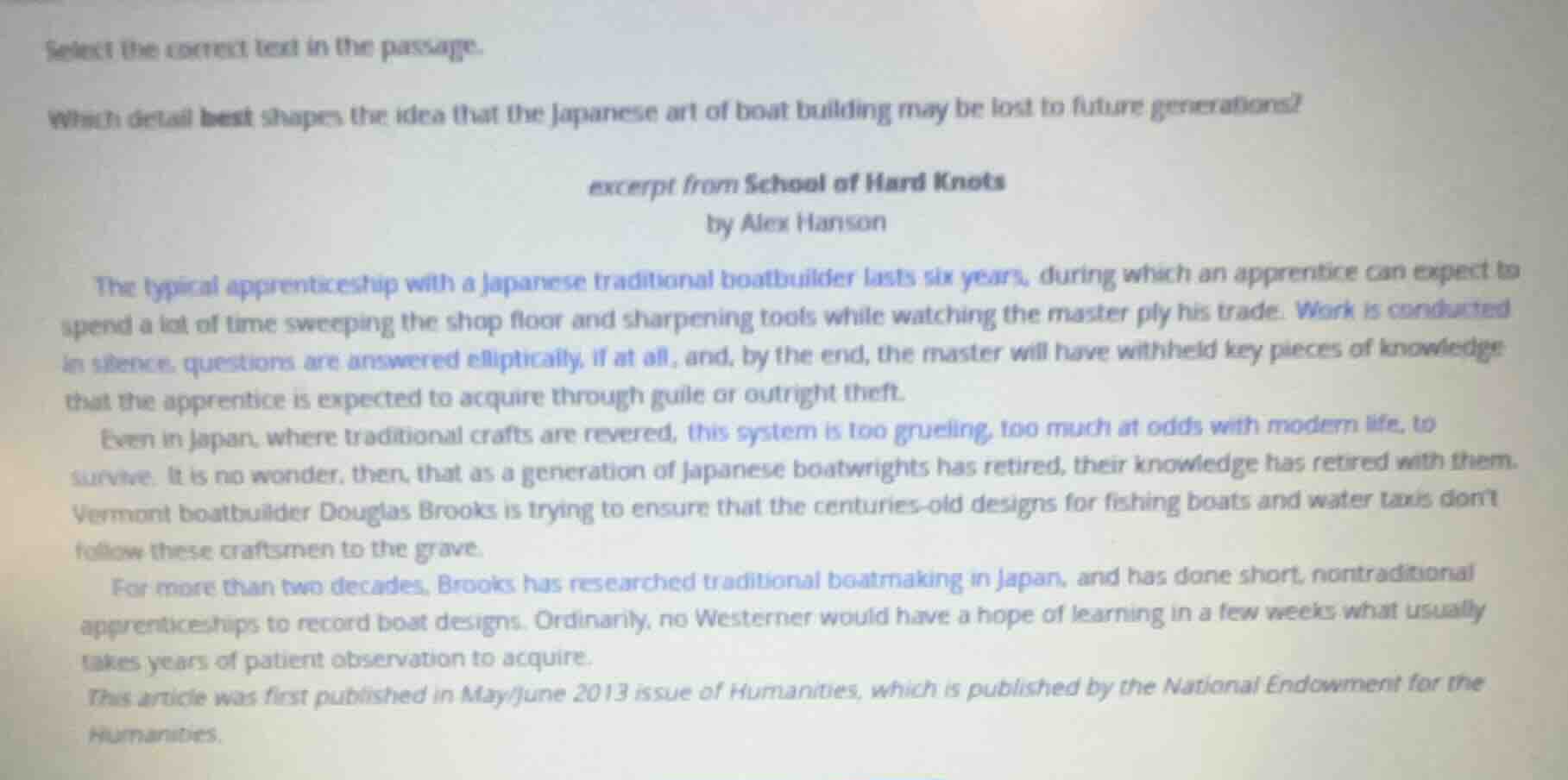
the typical apprenticeship with a japanese traditional boatbuilder lasts six years, during which an apprentice can expect to spend a lot of time sweeping the shop floor and sharpening tools while watching the master ply his trade. work is conducted in silence, questions are answered elliptically, if at all, and, by the end, the master will have withheld key pieces of knowledge that the apprentice is expected to acquire through guile or outright theft.
even in japan, where traditional crafts are revered, this system is too grueling, too much at odds with modern life, to survive. it is no wonder, then, that as a generation of japanese boatwrights has retired, their knowledge has retired with them. vermont boatbuilder douglas brooks is trying to ensure that the centuries-old designs for fishing boats and water taxis dont follow these craftsmen to the grave.
for more than two decades, brooks has researched traditional boatmaking in japan, and has done short, nontraditional apprenticeships to record boat designs. ordinarily, no westerner would have a hope of learning in a few weeks what usually takes years of patient observation to acquire.
this article was first published in may/june 2013 issue of humanities, which is published by the national endowment for the humanities.
Analyze the prompt and target idea
The question asks to select the detail in the passage that best shapes the idea that the Japanese art of boat building may be lost to future generations.
Evaluate the sentences in the passage
- "The typical apprenticeship with a Japanese traditional boatbuilder lasts six years..." describes the process and difficulty of the apprenticeship.
- "Even in Japan, where traditional crafts are revered, this system is too grueling, too much at odds with modern life, to survive." explains why the apprenticeship system is failing to continue.
- "It is no wonder, then, that as a generation of Japanese boatwrights has retired, their knowledge has retired with them." directly states that the knowledge (the art of boat building) is disappearing as the older generation retires, meaning it is being lost to future generations.
- "Vermont boatbuilder Douglas Brooks is trying to ensure that the centuries-old designs for fishing boats and water taxis don't follow these craftsmen to the grave." describes an effort to save the designs, which highlights the threat of loss but is a response to it.
The sentence that most directly and best shapes the idea of the knowledge being lost to future generations is: "It is no wonder, then, that as a generation of Japanese boatwrights has retired, their knowledge has retired with them."

Snap & solve any problem in the app
Get step-by-step solutions on Sovi AI
Photo-based solutions with guided steps
Explore more problems and detailed explanations
- The typical apprenticeship with a Japanese traditional boatbuilder lasts six years, during which an apprentice can expect to spend a lot of time sweeping the shop floor and sharpening tools while watching the master ply his trade.
- Work is conducted in silence, questions are answered elliptically, if at all, and, by the end, the master will have withheld key pieces of knowledge that the apprentice is expected to acquire through guile or outright theft.
- Even in Japan, where traditional crafts are revered, this system is too grueling, too much at odds with modern life, to survive.
- It is no wonder, then, that as a generation of Japanese boatwrights has retired, their knowledge has retired with them. (Correct answer)
- Vermont boatbuilder Douglas Brooks is trying to ensure that the centuries-old designs for fishing boats and water taxis don't follow these craftsmen to the grave.