QUESTION IMAGE
Question
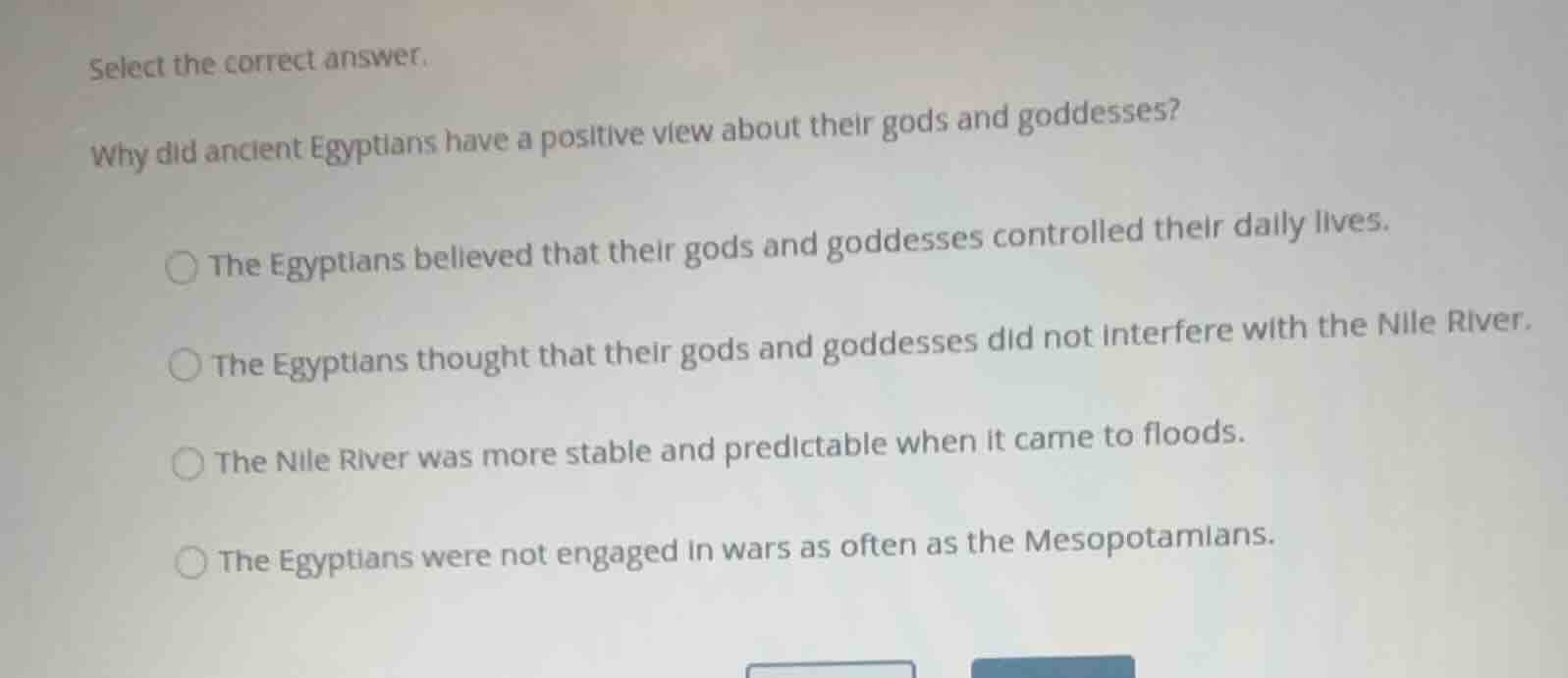
select the correct answer.
why did ancient egyptians have a positive view about their gods and goddesses?
- the egyptians believed that their gods and goddesses controlled their daily lives.
- the egyptians thought that their gods and goddesses did not interfere with the nile river.
- the nile river was more stable and predictable when it came to floods.
- the egyptians were not engaged in wars as often as the mesopotamians.
<pre_analysis>
{
"quality": "clear",
"question_count": 1,
"skills_matched": [
"direct_cot",
"multiple_choice_formatter",
"explain_then_answer",
"tutor"
],
"needs_drawing": false,
"concepts_used": [
"Ancient Egyptian Religion",
"Nile River Geography"
],
"new_concepts": [],
"current_concepts": [
"Ancient Egyptian Religion",
"Nile River Geography",
"Ancient Polytheism"
]
}
</pre_analysis>
<reasoning>
Analyze the connection between geography and religion
In ancient civilizations, religious beliefs were deeply intertwined with environmental realities. The Egyptians relied heavily on the Nile River, which flooded annually in a highly predictable and stable manner. This regular cycle brought fertile soil (silt) that sustained their agriculture, leading them to view their environment—and by extension, the gods who controlled it—as benevolent, orderly, and generous. This contrasts sharply with the unpredictable and violent flooding of the Tigris and Euphrates rivers in Mesopotamia, which led to a more anxious and pessimistic religious outlook. Therefore, the stability and predictability of the Nile's floods fostered a positive view of their deities.
Evaluate the given options
- Option 1: "The Egyptians believed that their gods and goddesses controlled their daily lives." While true, this belief was shared by many ancient cultures (including those with pessimistic views, like the Mesopotamians) and does not directly explain why their view was specifically positive.
- Option 2: "The Egyptians thought that their gods and goddesses did not interfere with the Nile River." This is historically incorrect; Egyptians believed their deities directly controlled the river and its annual inundation (Hapi was specifically the god of the annual flooding of the Nile).
- Option 3: "The Nile River was more stable and predictable when it came to floods." This geographical stability directly shaped their optimistic worldview, as they perceived their gods as reliable providers of life and order (Ma'at).
- Option 4: "The Egyptians were not engaged in wars as often as the Mesopotamians." While geography offered Egypt some natural barriers, this is not the primary reason for their positive religious outlook regarding their deities.
Select the best explanation
Using the Nile River Geography and Ancient Egyptian Religion knowledge points, we can conclude that the predictable nature of the Nile's floods created a sense of security and order. This environmental stability led the Egyptians to believe that their gods were caring and orderly, rather than chaotic or destructive. Thus, the third option is the correct choice.
</reasoning>
<answer>
<mcq-option>(A) The Egyptians believed that their gods and goddesses controlled their daily lives.</mcq-option>
<mcq-option>(B) The Egyptians thought that their gods and goddesses did not interfere with the Nile River.</mcq-option>
<mcq-correct>(C) The Nile River was more stable and predictable when it came to floods.</mcq-correct>
<mcq-option>(D) The Egyptians were not engaged in wars as often as the Mesopotamians.</mcq-option>
</answer>
<post_analysis>
{
"subject": "Social Science",
"question_type": "Multiple Choice",
"knowledge_point": [
"Social Science",
"History",
"Ancient Egyptian Religion"
]
}
</post_analysis>
Snap & solve any problem in the app
Get step-by-step solutions on Sovi AI
Photo-based solutions with guided steps
Explore more problems and detailed explanations
<pre_analysis>
{
"quality": "clear",
"question_count": 1,
"skills_matched": [
"direct_cot",
"multiple_choice_formatter",
"explain_then_answer",
"tutor"
],
"needs_drawing": false,
"concepts_used": [
"Ancient Egyptian Religion",
"Nile River Geography"
],
"new_concepts": [],
"current_concepts": [
"Ancient Egyptian Religion",
"Nile River Geography",
"Ancient Polytheism"
]
}
</pre_analysis>
<reasoning>
Analyze the connection between geography and religion
In ancient civilizations, religious beliefs were deeply intertwined with environmental realities. The Egyptians relied heavily on the Nile River, which flooded annually in a highly predictable and stable manner. This regular cycle brought fertile soil (silt) that sustained their agriculture, leading them to view their environment—and by extension, the gods who controlled it—as benevolent, orderly, and generous. This contrasts sharply with the unpredictable and violent flooding of the Tigris and Euphrates rivers in Mesopotamia, which led to a more anxious and pessimistic religious outlook. Therefore, the stability and predictability of the Nile's floods fostered a positive view of their deities.
Evaluate the given options
- Option 1: "The Egyptians believed that their gods and goddesses controlled their daily lives." While true, this belief was shared by many ancient cultures (including those with pessimistic views, like the Mesopotamians) and does not directly explain why their view was specifically positive.
- Option 2: "The Egyptians thought that their gods and goddesses did not interfere with the Nile River." This is historically incorrect; Egyptians believed their deities directly controlled the river and its annual inundation (Hapi was specifically the god of the annual flooding of the Nile).
- Option 3: "The Nile River was more stable and predictable when it came to floods." This geographical stability directly shaped their optimistic worldview, as they perceived their gods as reliable providers of life and order (Ma'at).
- Option 4: "The Egyptians were not engaged in wars as often as the Mesopotamians." While geography offered Egypt some natural barriers, this is not the primary reason for their positive religious outlook regarding their deities.
Select the best explanation
Using the Nile River Geography and Ancient Egyptian Religion knowledge points, we can conclude that the predictable nature of the Nile's floods created a sense of security and order. This environmental stability led the Egyptians to believe that their gods were caring and orderly, rather than chaotic or destructive. Thus, the third option is the correct choice.
</reasoning>
<answer>
<mcq-option>(A) The Egyptians believed that their gods and goddesses controlled their daily lives.</mcq-option>
<mcq-option>(B) The Egyptians thought that their gods and goddesses did not interfere with the Nile River.</mcq-option>
<mcq-correct>(C) The Nile River was more stable and predictable when it came to floods.</mcq-correct>
<mcq-option>(D) The Egyptians were not engaged in wars as often as the Mesopotamians.</mcq-option>
</answer>
<post_analysis>
{
"subject": "Social Science",
"question_type": "Multiple Choice",
"knowledge_point": [
"Social Science",
"History",
"Ancient Egyptian Religion"
]
}
</post_analysis>