QUESTION IMAGE
Question
select the correct answer.
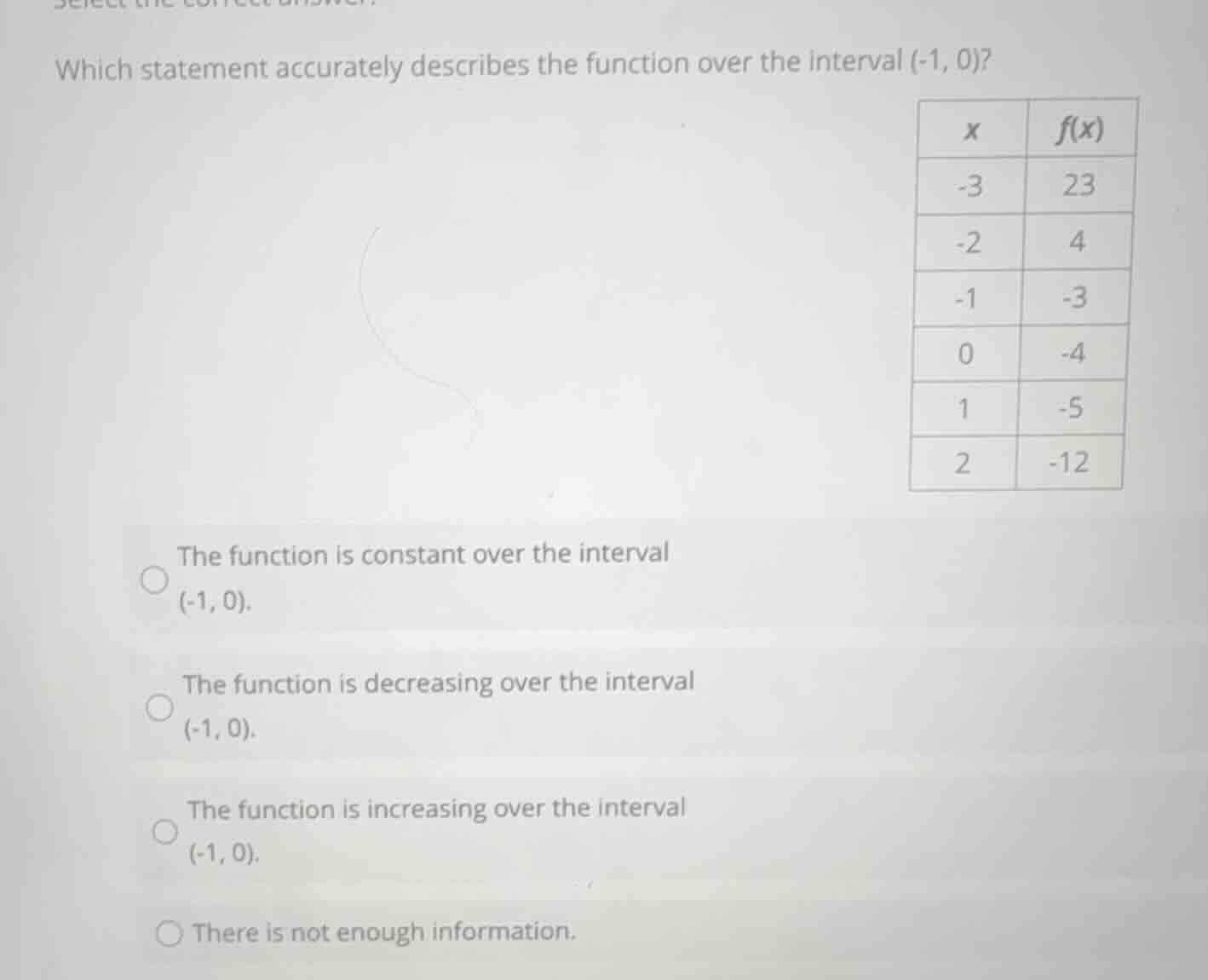
which statement accurately describes the function over the interval \\((-1, 0)\\)?
\\(\
\\)
- the function is constant over the interval \\((-1, 0)\\).
- the function is decreasing over the interval \\((-1, 0)\\).
- the function is increasing over the interval \\((-1, 0)\\).
- there is not enough information.
<pre_analysis>
{
"quality": "clear",
"question_count": 1,
"skills_matched": [
"direct_cot",
"multiple_choice_formatter",
"explain_then_answer",
"tutor"
],
"needs_drawing": false,
"concepts_used": [],
"new_concepts": [
"Interval Behavior",
"Discrete Data Limits"
],
"current_concepts": [
"Interval Behavior",
"Discrete Data Limits",
"Function Analysis"
]
}
</pre_analysis>
<reasoning>
Analyze the given data points
The table provides discrete values of the function \(f(x)\) at integer inputs:
- \(f(-1) = -3\)
- \(f(0) = -4\)
Evaluate the interval behavior
To determine if a function is increasing, decreasing, or constant over an entire interval \((-1, 0)\), we must know the behavior of \(f(x)\) for all real numbers \(x\) in that open interval.
Assess information completeness
The table only provides values at the discrete integer endpoints \(x = -1\) and \(x = 0\). We have no information about the function's values, continuity, or behavior between these two integers. The function could increase, decrease, oscillate, or remain constant in between. Therefore, there is not enough information to describe the function over the interval \((-1, 0)\).
</reasoning>
<answer>
<mcq-option>The function is constant over the interval \((-1, 0)\).</mcq-option>
<mcq-option>The function is decreasing over the interval \((-1, 0)\).</mcq-option>
<mcq-option>The function is increasing over the interval \((-1, 0)\).</mcq-option>
<mcq-correct>There is not enough information.</mcq-correct>
</answer>
<post_analysis>
{
"subject": "Mathematics",
"question_type": "Multiple Choice",
"knowledge_point": [
"Mathematics",
"Algebra",
"Function Analysis"
]
}
</post_analysis>
Snap & solve any problem in the app
Get step-by-step solutions on Sovi AI
Photo-based solutions with guided steps
Explore more problems and detailed explanations
<pre_analysis>
{
"quality": "clear",
"question_count": 1,
"skills_matched": [
"direct_cot",
"multiple_choice_formatter",
"explain_then_answer",
"tutor"
],
"needs_drawing": false,
"concepts_used": [],
"new_concepts": [
"Interval Behavior",
"Discrete Data Limits"
],
"current_concepts": [
"Interval Behavior",
"Discrete Data Limits",
"Function Analysis"
]
}
</pre_analysis>
<reasoning>
Analyze the given data points
The table provides discrete values of the function \(f(x)\) at integer inputs:
- \(f(-1) = -3\)
- \(f(0) = -4\)
Evaluate the interval behavior
To determine if a function is increasing, decreasing, or constant over an entire interval \((-1, 0)\), we must know the behavior of \(f(x)\) for all real numbers \(x\) in that open interval.
Assess information completeness
The table only provides values at the discrete integer endpoints \(x = -1\) and \(x = 0\). We have no information about the function's values, continuity, or behavior between these two integers. The function could increase, decrease, oscillate, or remain constant in between. Therefore, there is not enough information to describe the function over the interval \((-1, 0)\).
</reasoning>
<answer>
<mcq-option>The function is constant over the interval \((-1, 0)\).</mcq-option>
<mcq-option>The function is decreasing over the interval \((-1, 0)\).</mcq-option>
<mcq-option>The function is increasing over the interval \((-1, 0)\).</mcq-option>
<mcq-correct>There is not enough information.</mcq-correct>
</answer>
<post_analysis>
{
"subject": "Mathematics",
"question_type": "Multiple Choice",
"knowledge_point": [
"Mathematics",
"Algebra",
"Function Analysis"
]
}
</post_analysis>