QUESTION IMAGE
Question
select the correct answer.
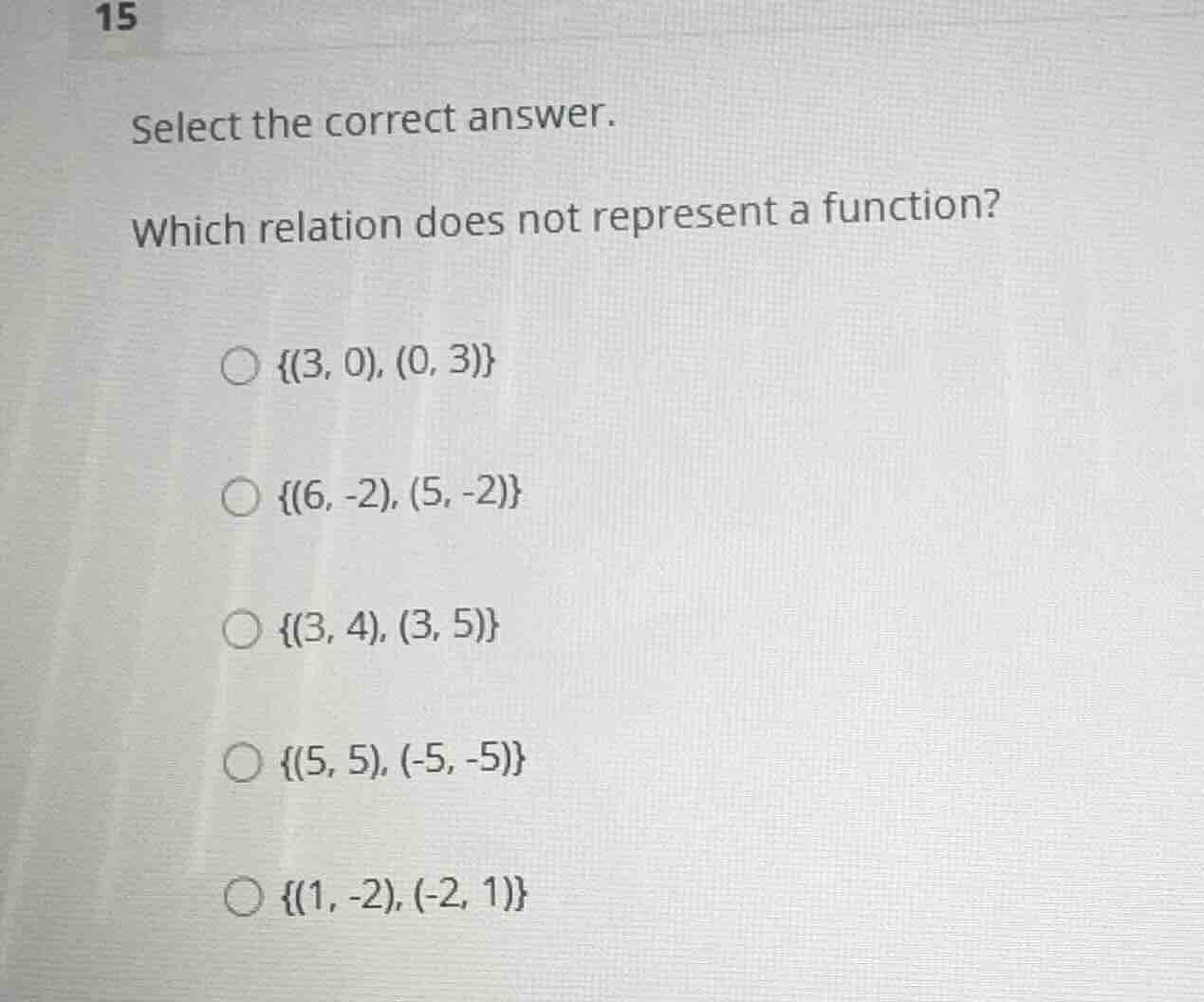
which relation does not represent a function?
\\( \bigcirc \\{(3, 0), (0, 3)\\} \\)
\\( \bigcirc \\{(6, -2), (5, -2)\\} \\)
\\( \bigcirc \\{(3, 4), (3, 5)\\} \\)
\\( \bigcirc \\{(5, 5), (-5, -5)\\} \\)
\\( \bigcirc \\{(1, -2), (-2, 1)\\} \\)
Recall the definition of a function
A relation is a function if and only if each input value \(x\) is paired with exactly one output value \(y\).
Analyze the given relations
- \(\{(3, 0), (0, 3)\}\): Inputs are \(3\) and \(0\). Each has one output.
- \(\{(6, -2), (5, -2)\}\): Inputs are \(6\) and \(5\). Each has one output.
- \(\{(3, 4), (3, 5)\}\): Input \(3\) is paired with two different outputs, \(4\) and \(5\).
- \(\{(5, 5), (-5, -5)\}\): Inputs are \(5\) and \(-5\). Each has one output.
- \(\{(1, -2), (-2, 1)\}\): Inputs are \(1\) and \(-2\). Each has one output.
Identify the non-function relation
The relation \(\{(3, 4), (3, 5)\}\) does not represent a function because the input \(3\) maps to multiple outputs.

Snap & solve any problem in the app
Get step-by-step solutions on Sovi AI
Photo-based solutions with guided steps
Explore more problems and detailed explanations
- (A) \(\{(3, 0), (0, 3)\}\)
- (B) \(\{(6, -2), (5, -2)\}\)
- (C) \(\{(3, 4), (3, 5)\}\) (Correct answer)
- (D) \(\{(5, 5), (-5, -5)\}\)
- (E) \(\{(1, -2), (-2, 1)\}\)