QUESTION IMAGE
Question
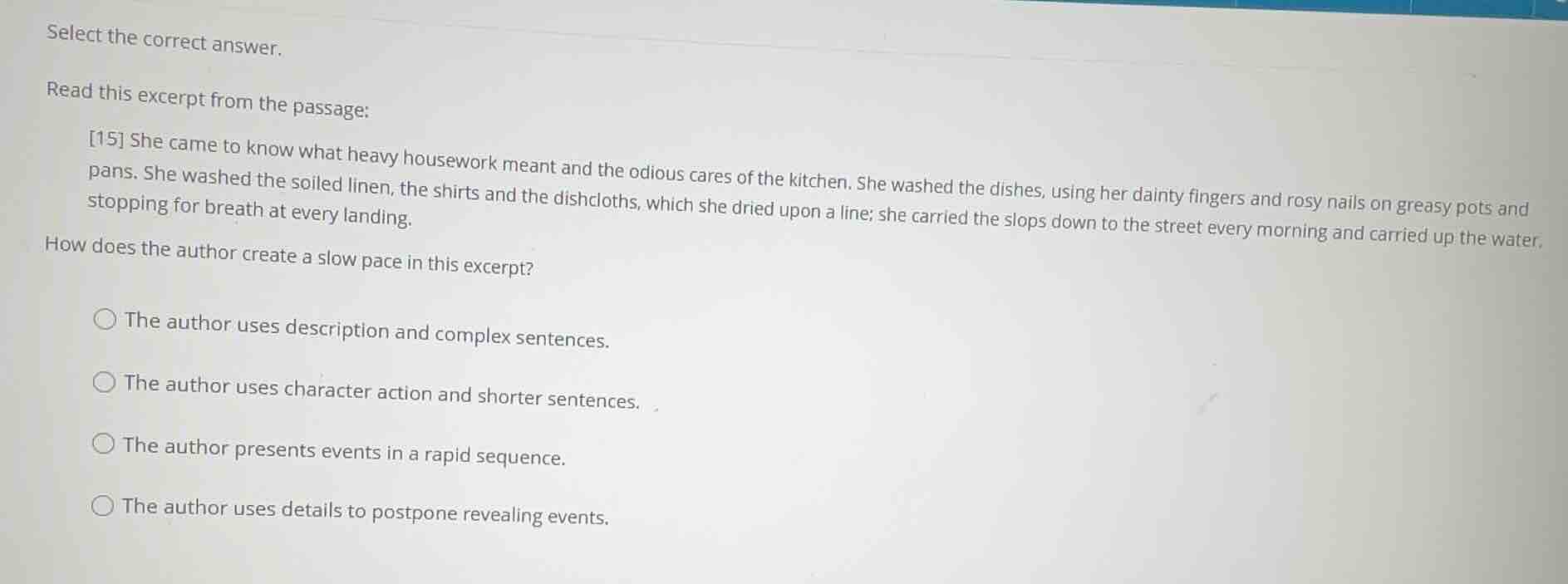
select the correct answer.
read this excerpt from the passage:
15 she came to know what heavy housework meant and the odious cares of the kitchen. she washed the dishes, using her dainty fingers and rosy nails on greasy pots and pans. she washed the soiled linen, the shirts and the dishcloths, which she dried upon a line; she carried the slops down to the street every morning and carried up the water, stopping for breath at every landing.
how does the author create a slow pace in this excerpt?
- the author uses description and complex sentences.
- the author uses character action and shorter sentences.
- the author presents events in a rapid sequence.
- the author uses details to postpone revealing events.
Analyze the sentence structure and length
The excerpt consists of two long, descriptive sentences. The second sentence is highly complex, containing multiple clauses linked by conjunctions and semicolons ("She washed the dishes...; she carried the slops..."). This structure naturally slows down the reading speed.
Examine the descriptive details
The author uses vivid, sensory descriptions ("odious cares," "soiled linen," "dainty fingers and rosy nails on greasy pots," "stopping for breath at every landing"). These detailed lists of domestic chores expand the narrative time, making the passage feel slow and laborious.
Evaluate the answer choices
- Option 1 correctly identifies the use of description and complex sentences to slow the pace.
- Option 2 is incorrect because the sentences are long and complex, not short.
- Option 3 is incorrect because a rapid sequence of events would speed up the pace.
- Option 4 is incorrect because the details describe ongoing daily chores rather than postponing a specific plot event.

Snap & solve any problem in the app
Get step-by-step solutions on Sovi AI
Photo-based solutions with guided steps
Explore more problems and detailed explanations
- (A) The author uses description and complex sentences. (Correct answer)
- (B) The author uses character action and shorter sentences.
- (C) The author presents events in a rapid sequence.
- (D) The author uses details to postpone revealing events.