QUESTION IMAGE
Question
select the correct answer.
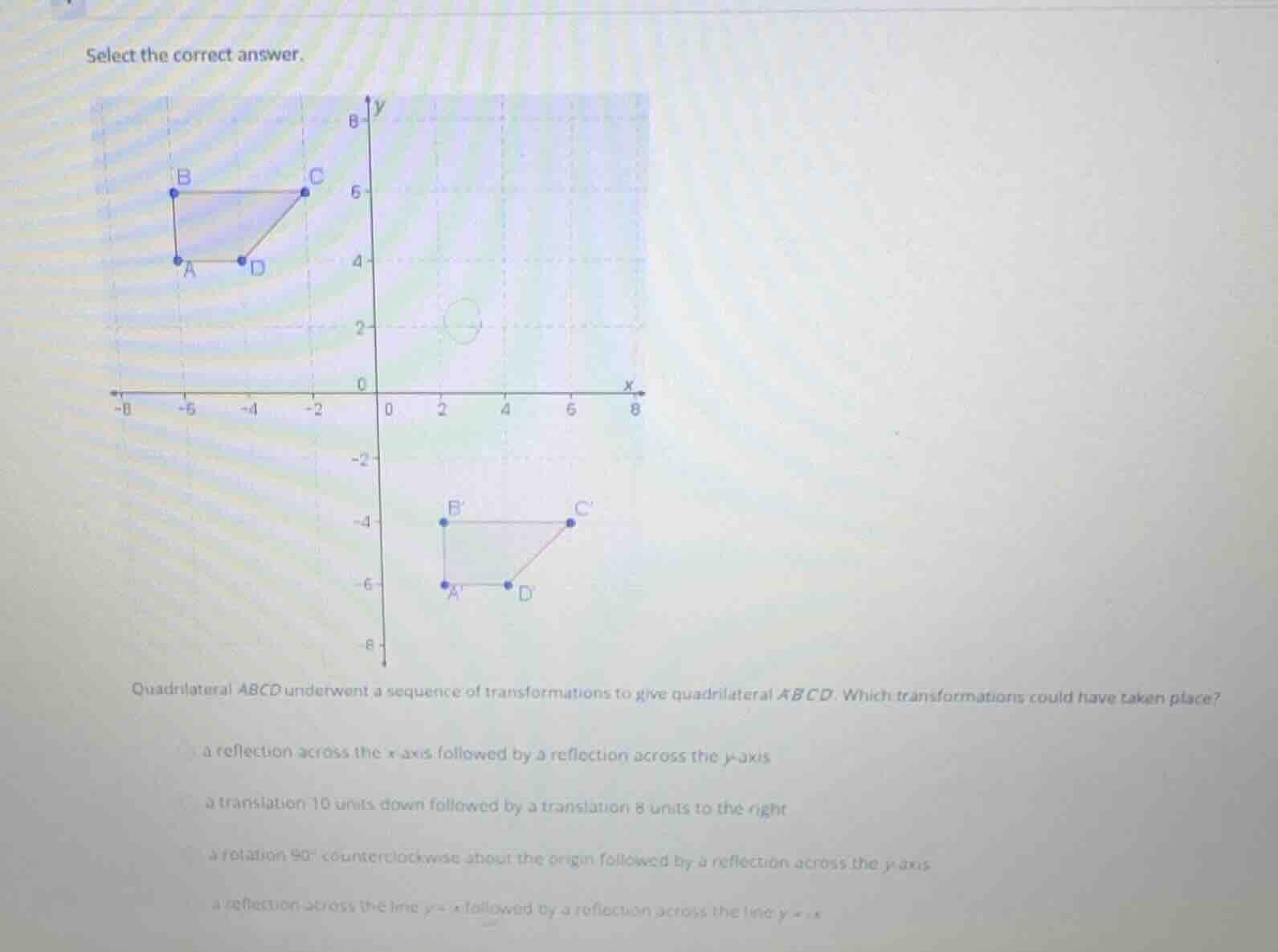
quadrilateral abcd underwent a sequence of transformations to give quadrilateral abcd. which transformations could have taken place?
a reflection across the x-axis followed by a reflection across the y-axis
a translation 10 units down followed by a translation 8 units to the right
a rotation 90° counterclockwise about the origin followed by a reflection across the y-axis
a reflection across the line y = x followed by a reflection across the line y = -x
Identify coordinates of the original and transformed vertices
The vertices of quadrilateral \(ABCD\) are:
The vertices of the transformed quadrilateral \(A'B'C'D'\) are:
Test the given transformation options
Let's evaluate the transformation options on a representative point, say \(B(-6, 6)\), which must map to \(B'(1, -4)\):
- Option 1: Reflection across the x-axis followed by a reflection across the y-axis
- Reflection across x-axis: \((x, y) \to (x, -y)\). For \(B(-6, 6) \to (-6, -6)\).
- Reflection across y-axis: \((x, -y) \to (-x, -y)\). For \((-6, -6) \to (6, -6)\).
- This does not match \(B'(1, -4)\).
- Option 2: Translation 10 units down followed by a translation 8 units to the right
- Translation 10 units down: \((x, y) \to (x, y - 10)\). For \(B(-6, 6) \to (-6, -4)\).
- Translation 8 units to the right: \((x, y - 10) \to (x + 8, y - 10)\). For \((-6, -4) \to (2, -4)\).
- This does not match \(B'(1, -4)\).
- Option 3: Rotation \(90^\circ\) counterclockwise about the origin followed by a reflection across the y-axis
- Rotation \(90^\circ\) counterclockwise: \((x, y) \to (-y, x)\). For \(B(-6, 6) \to (-6, -6)\).
- Reflection across y-axis: \((-y, x) \to (y, x)\). For \((-6, -6) \to (6, -6)\).
- This does not match \(B'(1, -4)\).
- Option 4: Reflection across the line \(y = -x\) followed by a reflection across the line \(y = x\)
- Let's check the standard coordinate rules:
- Reflection across \(y = -x\): \((x, y) \to (-y, -x)\).
For \(B(-6, 6) \to (-6, 6)\).
- Reflection across \(y = x\): \((-y, -x) \to (-x, -y)\).
For \((-6, 6) \to (-6, 6)\).
- This does not match \(B'(1, -4)\).
Let's re-examine the coordinates of \(A'B'C'D'\) from the graph:
- \(A'\) is at \((1, -6)\)
- \(B'\) is at \((1, -4)\)
- \(C'\) is at \((5, -4)\)
- \(D'\) is at \((3, -6)\)
Let's re-evaluate Option 3:
- Rotation \(90^\circ\) counterclockwise: \((x, y) \to (-y, x)\).
For \(B(-6, 6) \to (-6, -6)\).
Wait, let's test \(A(-6, 4)\):
- Rotation \(90^\circ\) counterclockwise: \((-4, -6)\).
- Reflection across the y-axis: \((4, -6)\). This does not match \(A'(1, -6)\).
Let's re-read Option 3: "a rotation 90° counterclockwise about the origin followed by a reflection across the y-axis".
Wait, let's look at the options again. Is there a translation option?
"a translation 10 units down followed by a translation 8 units to the right"
Wait, let's look at the coordinates of \(B'\) again.
The y-axis has grid lines. Let's count carefully:
The origin is \((0,0)\).
To the right: \(2, 4, 6, 8\).
The point \(B'\) is at \(x = 1\)? No, let's look at the grid.
The grid line for \(2\) is labeled. The line to the left of \(2\) is \(1\)? No, the grid lines are spaced by 1 unit.
Let's count from the y-axis (0) to the right:
1st grid line = 1
2nd grid line = 2 (labeled)
3rd grid line = 3
4th grid line = 4 (labeled)
So \(B'\) is on the grid line \(x = 2\).
Let's check the coordinates of \(B'\) with \(x = 2\):
If \(B'\)…

Snap & solve any problem in the app
Get step-by-step solutions on Sovi AI
Photo-based solutions with guided steps
Explore more problems and detailed explanations
- a reflection across the x-axis followed by a reflection across the y-axis
- a translation 10 units down followed by a translation 8 units to the right (Correct answer)
- a rotation 90° counterclockwise about the origin followed by a reflection across the y-axis
- a reflection across the line y = -x followed by a reflection across the line y = x