QUESTION IMAGE
Question
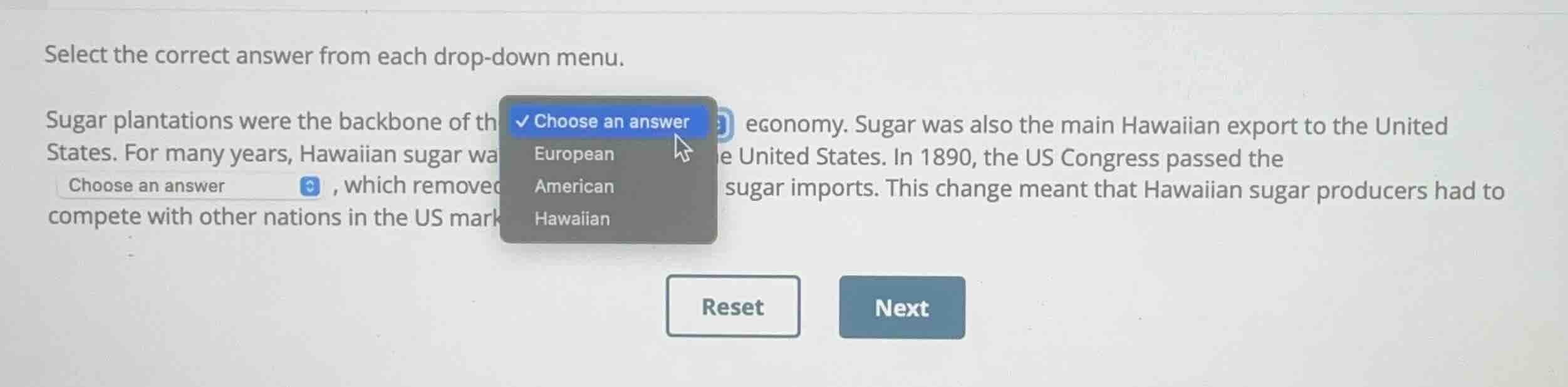
select the correct answer from each drop-down menu.
sugar plantations were the backbone of the choose an answer economy. sugar was also the main hawaiian export to the united states. for many years, hawaiian sugar was choose an answer, which removed choose an answer sugar imports. this change meant that hawaiian sugar producers had to compete with other nations in the us market.
<pre_analysis>
{
"quality": "clear",
"question_count": 1,
"skills_matched": [
"direct_cot",
"blank_filling_formatter",
"explain_then_answer",
"tutor"
],
"needs_drawing": false,
"concepts_used": [
"New Imperialism"
],
"new_concepts": [
"Annexation of Hawaii",
"McKinley Tariff"
],
"current_concepts": [
"New Imperialism",
"Annexation of Hawaii",
"McKinley Tariff"
]
}
</pre_analysis>
<reasoning>
Identify the historical context
The passage discusses the economic role of sugar plantations in Hawaii and their relationship with the United States during the late 19th century. This falls under the broader historical theme of New Imperialism and American expansionism.
Analyze the first drop-down menu
The sentence reads: "Sugar plantations were the backbone of the [first drop-down] economy." The options visible in the active drop-down menu are "European", "American", and "Hawaiian". Since the passage immediately follows with "Sugar was also the main Hawaiian export to the United States," the plantations were the backbone of the Hawaiian economy.
Analyze the second drop-down menu
The second sentence reads: "For many years, Hawaiian sugar was [second drop-down], which removed [tariffs/taxes] on sugar imports." Historically, the Reciprocity Treaty of 1875 allowed Hawaiian sugar to enter the United States duty-free (untaxed/tariff-free). In 1890, the US Congress passed the McKinley Tariff, which eliminated the duty-free status of Hawaiian sugar, forcing Hawaiian producers to compete with other nations. Therefore, the second blank describes Hawaiian sugar entering the US duty-free or untaxed.
</reasoning>
<answer>
Select the correct answer from each drop-down menu.
Sugar plantations were the backbone of the <blank>Hawaiian</blank> economy. Sugar was also the main Hawaiian export to the United States. For many years, Hawaiian sugar was <blank>imported duty-free</blank>, which removed tariffs on sugar imports. This change meant that Hawaiian sugar producers had to compete with other nations in the US market.
</answer>
<post_analysis>
{
"subject": "Social Science",
"question_type": "Fill-in-the-blank",
"knowledge_point": [
"Social Science",
"History",
"Annexation of Hawaii"
]
}
</post_analysis>
Snap & solve any problem in the app
Get step-by-step solutions on Sovi AI
Photo-based solutions with guided steps
Explore more problems and detailed explanations
<pre_analysis>
{
"quality": "clear",
"question_count": 1,
"skills_matched": [
"direct_cot",
"blank_filling_formatter",
"explain_then_answer",
"tutor"
],
"needs_drawing": false,
"concepts_used": [
"New Imperialism"
],
"new_concepts": [
"Annexation of Hawaii",
"McKinley Tariff"
],
"current_concepts": [
"New Imperialism",
"Annexation of Hawaii",
"McKinley Tariff"
]
}
</pre_analysis>
<reasoning>
Identify the historical context
The passage discusses the economic role of sugar plantations in Hawaii and their relationship with the United States during the late 19th century. This falls under the broader historical theme of New Imperialism and American expansionism.
Analyze the first drop-down menu
The sentence reads: "Sugar plantations were the backbone of the [first drop-down] economy." The options visible in the active drop-down menu are "European", "American", and "Hawaiian". Since the passage immediately follows with "Sugar was also the main Hawaiian export to the United States," the plantations were the backbone of the Hawaiian economy.
Analyze the second drop-down menu
The second sentence reads: "For many years, Hawaiian sugar was [second drop-down], which removed [tariffs/taxes] on sugar imports." Historically, the Reciprocity Treaty of 1875 allowed Hawaiian sugar to enter the United States duty-free (untaxed/tariff-free). In 1890, the US Congress passed the McKinley Tariff, which eliminated the duty-free status of Hawaiian sugar, forcing Hawaiian producers to compete with other nations. Therefore, the second blank describes Hawaiian sugar entering the US duty-free or untaxed.
</reasoning>
<answer>
Select the correct answer from each drop-down menu.
Sugar plantations were the backbone of the <blank>Hawaiian</blank> economy. Sugar was also the main Hawaiian export to the United States. For many years, Hawaiian sugar was <blank>imported duty-free</blank>, which removed tariffs on sugar imports. This change meant that Hawaiian sugar producers had to compete with other nations in the US market.
</answer>
<post_analysis>
{
"subject": "Social Science",
"question_type": "Fill-in-the-blank",
"knowledge_point": [
"Social Science",
"History",
"Annexation of Hawaii"
]
}
</post_analysis>