QUESTION IMAGE
Question
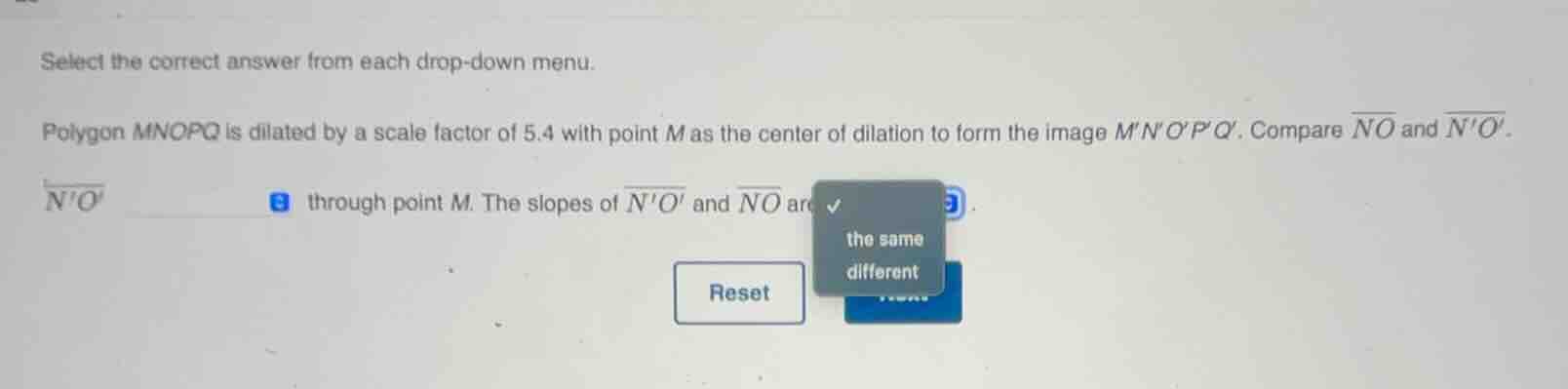
select the correct answer from each drop - down menu. polygon mnopq is dilated by a scale factor of 5.4 with point m as the center of dilation to form the image mnopq. compare \\( \overline { no } \\) and \\( \overline { n ^ { prime } o ^ { prime } } \\). \\( \overline { n ^ { prime } o ^ { prime } } \\) through point m. the slopes of \\( \overline { n ^ { prime } o ^ { prime } } \\) and \\( \overline { no } \\) are. reset next
Step1: Properties of dilation
When a figure is dilated with a center of dilation, the corresponding line segments of the original figure and its image are collinear with the center of dilation. So, \(\overline{N'O'}\) and \(\overline{NO}\) are collinear with the center of dilation \(M\). That is, \(\overline{N'O'}\) passes through point \(M\) (since dilation is a transformation that maps a line segment to a parallel (in the sense of direction) line segment passing through the center of dilation when the center is not on the original line segment. Here, the line segments \(\overline{NO}\) and \(\overline{N'O'}\) are related by dilation with center \(M\), so \(\overline{N'O'}\) passes through \(M\)).
Step2: Slope of line segments in dilation
Dilation is a similarity transformation. Similarity transformations preserve the slope of line segments. If we have two points \(N(x_1,y_1)\) and \(O(x_2,y_2)\) on \(\overline{NO}\), the slope \(m=\frac{y_2 - y_1}{x_2 - x_1}\). After dilation with a scale factor \(k\) and center \(M\), the points \(N'\) and \(O'\) are such that if \(M\) is the center of dilation, and we use the formula for dilation \((x,y)\to(x_0 + k(x - x_0),y_0 + k(y - y_0))\) (where \((x_0,y_0)\) is the center of dilation \(M\)). The slope of \(\overline{N'O'}\) with points \(N'(x_1',y_1')\) and \(O'(x_2',y_2')\) is \(m'=\frac{y_2' - y_1'}{x_2' - x_1'}=\frac{y_0 + k(y_2 - y_0)-(y_0 + k(y_1 - y_0))}{x_0 + k(x_2 - x_0)-(x_0 + k(x_1 - x_0))}=\frac{k(y_2 - y_1)}{k(x_2 - x_1)}=\frac{y_2 - y_1}{x_2 - x_1}\) (assuming \(k
eq0\)). So the slopes of \(\overline{N'O'}\) and \(\overline{NO}\) are equal.
Snap & solve any problem in the app
Get step-by-step solutions on Sovi AI
Photo-based solutions with guided steps
Explore more problems and detailed explanations
\(\overline{N'O'}\) passes through point \(M\). The slopes of \(\overline{N'O'}\) and \(\overline{NO}\) are equal.