QUESTION IMAGE
Question
select the correct answer from each drop - down menu.
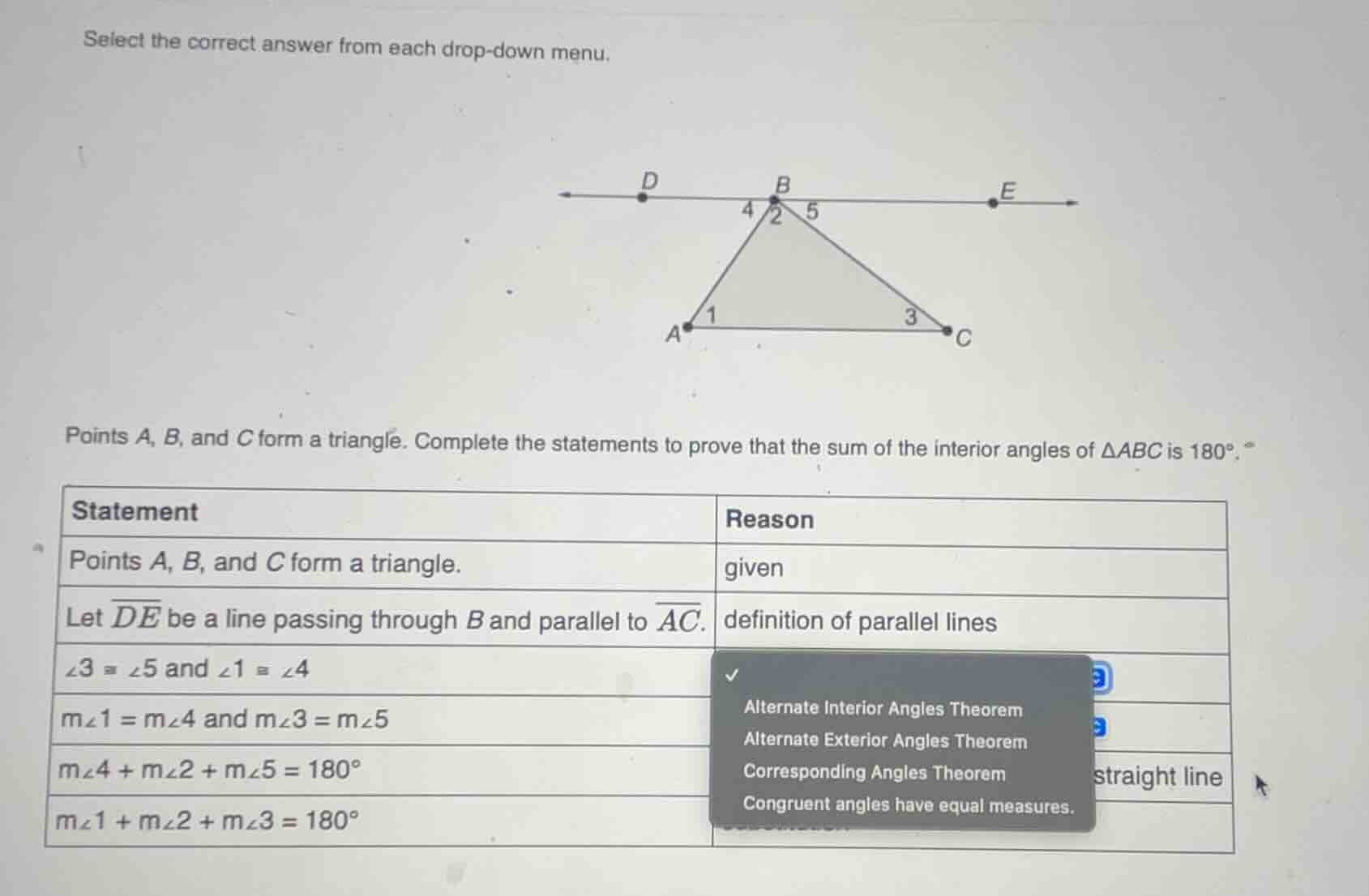
points a, b, and c form a triangle. complete the statements to prove that the sum of the interior angles of $\triangle abc$ is $180^{circ}$.
| statement | reason |
|---|---|
| let $overline{de}$ be a line passing through b and parallel to $overline{ac}$. | definition of parallel lines |
| $angle 3congangle 5$ and $angle 1congangle 4$ | |
| $mangle 1 = mangle 4$ and $mangle 3 = mangle 5$ | |
| $mangle 4 + mangle 2 + mangle 5 = 180^{circ}$ | straight line |
| $mangle 1 + mangle 2 + mangle 3 = 180^{circ}$ |
(the options for the reasons of some statements include: alternate interior angles theorem, alternate exterior angles theorem, corresponding angles theorem, congruent angles have equal measures.)
Brief Explanations
- For $\angle 3 \cong \angle 5$ and $\angle 1 \cong \angle 4$: When a transversal crosses parallel lines, alternate interior angles are congruent. Here, $\overline{DE} \parallel \overline{AC}$, so these pairs are alternate interior angles.
- For $m\angle 1 = m\angle 4$ and $m\angle 3 = m\angle 5$: Congruent angles are defined as angles that have equal measures.
- For $m\angle 4 + m\angle 2 + m\angle 5 = 180^\circ$: The angles along a straight line form a straight angle, which measures $180^\circ$.
- For $m\angle 1 + m\angle 2 + m\angle 3 = 180^\circ$: Substitute $m\angle 4$ with $m\angle 1$ and $m\angle 5$ with $m\angle 3$ using the earlier equal angle measures.

Snap & solve any problem in the app
Get step-by-step solutions on Sovi AI
Photo-based solutions with guided steps
Explore more problems and detailed explanations
| Statement | Reason |
|---|---|
| Let $\overline{DE}$ be a line passing through B and parallel to $\overline{AC}$. | definition of parallel lines |
| $\angle 3 \cong \angle 5$ and $\angle 1 \cong \angle 4$ | Alternate Interior Angles Theorem |
| $m\angle 1 = m\angle 4$ and $m\angle 3 = m\angle 5$ | Congruent angles have equal measures. |
| $m\angle 4 + m\angle 2 + m\angle 5 = 180^\circ$ | straight line (sum of angles on a straight line is $180^\circ$) |
| $m\angle 1 + m\angle 2 + m\angle 3 = 180^\circ$ | Substitution Property of Equality |