QUESTION IMAGE
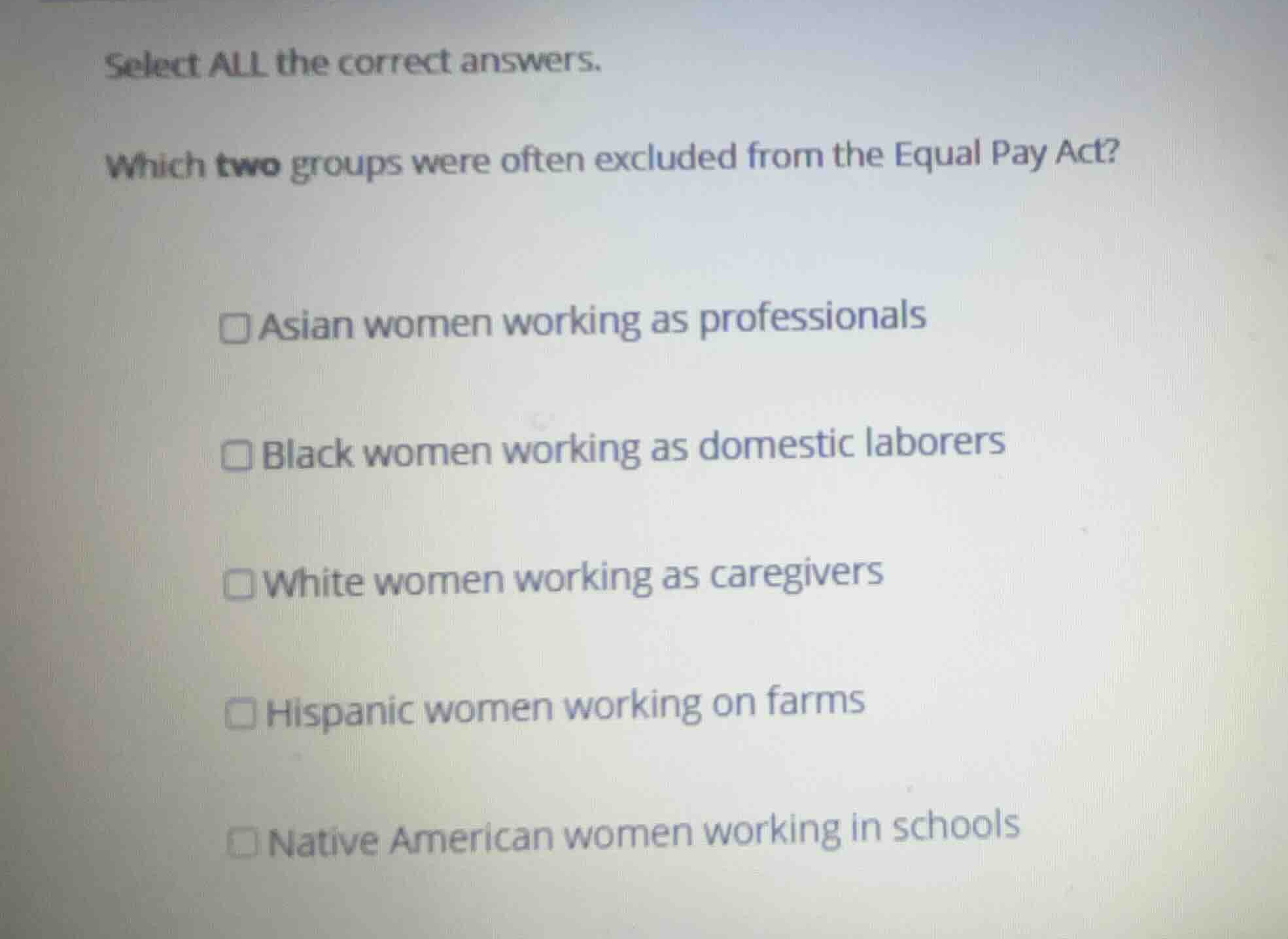
Question
select all the correct answers.
which two groups were often excluded from the equal pay act?
- asian women working as professionals
- black women working as domestic laborers
- white women working as caregivers
- hispanic women working on farms
- native american women working in schools
Analyze the Equal Pay Act of 1963
The Equal Pay Act of 1963 was a landmark federal law aimed at abolishing wage disparity based on sex. However, when it was passed, it did not cover all sectors of the workforce. It was passed as an amendment to the Fair Labor Standards Act (FLSA), meaning it inherited the FLSA's existing occupational exemptions.
Identify the occupational exemptions
Historically, the FLSA (and consequently the Equal Pay Act of 1963) excluded several major categories of workers from its minimum wage, overtime, and equal pay protections. The two largest excluded sectors that heavily employed minority women were:
- Domestic service workers (such as housekeepers, maids, and domestic laborers).
- Agricultural workers (such as farmworkers and agricultural laborers).
Match exemptions to the options
Let's evaluate the given choices based on these historical exemptions:
- Asian women working as professionals: Professional workers faced different barriers, but domestic and agricultural exclusions are the primary structural gaps of the early FLSA/EPA.
- Black women working as domestic laborers: This group was heavily excluded because domestic service was not covered by the FLSA at the time.
- White women working as caregivers: Caregivers in private homes fell under domestic service, but the options specifically highlight the racialized labor sectors of domestic and agricultural work.
- Hispanic women working on farms: This group was heavily excluded because agricultural labor was exempt from these protections.
- Native American women working in schools: School and educational employees were eventually integrated under different provisions, but did not represent the primary agricultural/domestic exclusions.
Therefore, the two groups most notably excluded due to these sector-based exemptions were Black women working as domestic laborers and Hispanic women working on farms.

Snap & solve any problem in the app
Get step-by-step solutions on Sovi AI
Photo-based solutions with guided steps
Explore more problems and detailed explanations
- Asian women working as professionals
- Black women working as domestic laborers (Correct answer)
- White women working as caregivers
- Hispanic women working on farms (Correct answer)
- Native American women working in schools