QUESTION IMAGE
Question
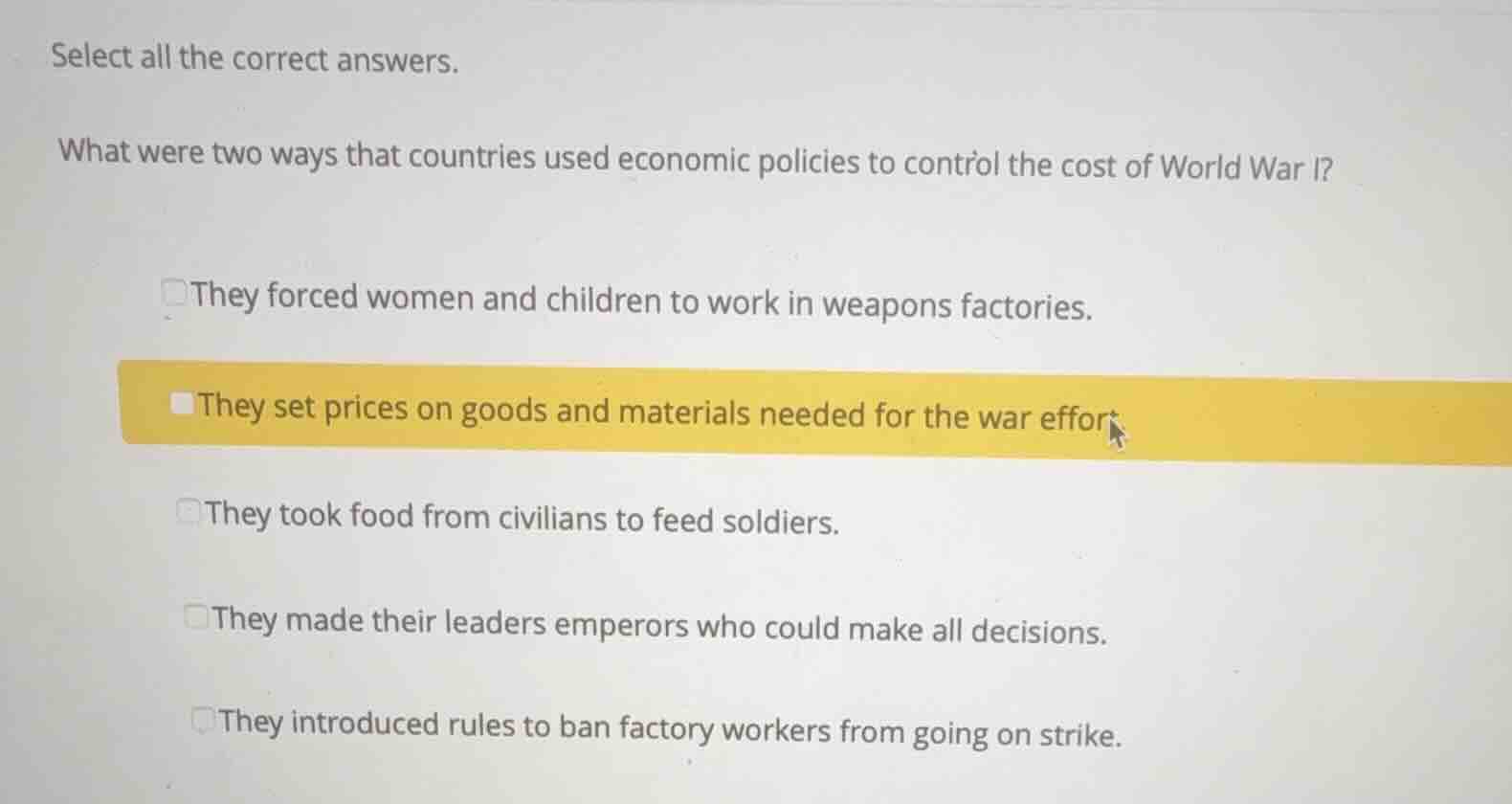
select all the correct answers.
what were two ways that countries used economic policies to control the cost of world war i?
they forced women and children to work in weapons factories.
they set prices on goods and materials needed for the war effort.
they took food from civilians to feed soldiers.
they made their leaders emperors who could make all decisions.
they introduced rules to ban factory workers from going on strike.
Analyze the question requirements
The question asks for two ways that countries used economic policies to control the cost of World War I. This relates directly to the concepts of Total War and Home Front Policies.
Evaluate the options based on historical evidence
- "They forced women and children to work in weapons factories."
While women and children did enter the workforce in large numbers, they were generally not legally "forced" or conscripted in a literal slave-labor sense to control costs. This was a labor mobilization policy rather than a direct cost-control economic policy.
- "They set prices on goods and materials needed for the war effort."
This is correct. Governments implemented price controls on essential goods, food, and raw materials to prevent inflation, stop war profiteering, and keep the financial cost of supplying the military manageable. This directly applies Home Front Policies.
- "They took food from civilians to feed soldiers."
While rationing occurred, simply seizing food from civilians is a description of requisitioning (often seen in extreme cases like War Communism in Russia), but it was not a standard, systematic economic policy used by most nations to control the financial "cost" of the war.
- "They made their leaders emperors who could make all decisions."
This is historically inaccurate. Democratic nations did not turn their leaders into emperors, and existing empires already had monarchs.
- "They introduced rules to ban factory workers from going on strike."
This is correct. To ensure uninterrupted production and prevent wage-push inflation or costly delays, governments in countries like Great Britain and Germany passed laws (such as the Munitions of War Act 1915 in Britain) that restricted or banned strikes in key war industries, helping control labor costs and maintain output. This is a classic example of Total War economic mobilization.

Snap & solve any problem in the app
Get step-by-step solutions on Sovi AI
Photo-based solutions with guided steps
Explore more problems and detailed explanations
- They forced women and children to work in weapons factories.
- They set prices on goods and materials needed for the war effort. (Correct answer)
- They took food from civilians to feed soldiers.
- They made their leaders emperors who could make all decisions.
- They introduced rules to ban factory workers from going on strike. (Correct answer)