QUESTION IMAGE
Question
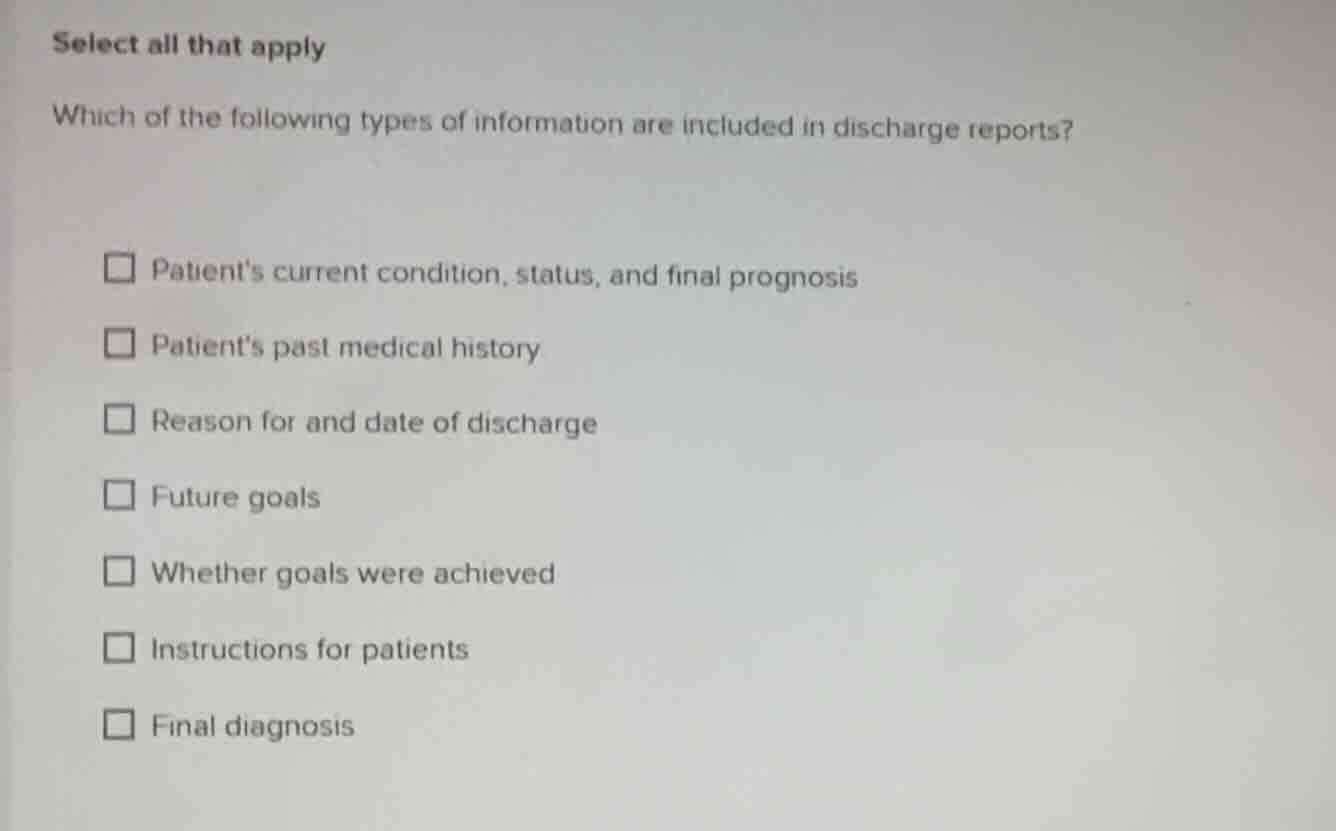
select all that apply
which of the following types of information are included in discharge reports?
patients current condition, status, and final prognosis
patients past medical history
reason for and date of discharge
future goals
whether goals were achieved
instructions for patients
final diagnosis
<pre_analysis>
{
"quality": "clear",
"question_count": 1,
"skills_matched": [
"direct_cot",
"multiple_choice_formatter",
"explain_then_answer",
"tutor",
"mastery_adaptive_brevity"
],
"needs_drawing": false,
"concepts_used": [
"Discharge Summaries"
],
"new_concepts": [],
"current_concepts": [
"Discharge Summaries",
"Medical Documentation"
]
}
</pre_analysis>
<reasoning>
Analyze the purpose of a discharge report
Using the Discharge Summaries knowledge point, a discharge report (or summary) is a clinical document prepared when a patient is released from a healthcare facility. Its primary purpose is to ensure continuity of care by documenting the patient's active hospital course, final status, and plans for post-discharge management.
Evaluate options related to patient status and history
- Patient's current condition, status, and final prognosis: Included. This provides the receiving provider with the patient's clinical state at discharge.
- Patient's past medical history: Included. Relevant background medical history is standard to provide context for the hospitalization.
- Final diagnosis: Included. The primary and secondary diagnoses established by the end of the stay must be documented.
Evaluate options related to the discharge event and instructions
- Reason for and date of discharge: Included. This documents why the patient is leaving (e.g., recovered, transferred) and exactly when.
- Instructions for patients: Included. This contains crucial patient-facing information such as medication changes, activity restrictions, and follow-up appointments.
Evaluate options related to goals
- Future goals: Included. Discharge planning, particularly in rehabilitative, physical therapy, or occupational therapy settings, outlines the ongoing functional or therapeutic goals for the patient.
- Whether goals were achieved: Included. The report must document the outcomes of the treatment plan and whether the established hospitalization or therapy goals were met prior to discharge.
</reasoning>
<answer>
<mcq-correct>Patient's current condition, status, and final prognosis</mcq-correct>
<mcq-correct>Patient's past medical history</mcq-correct>
<mcq-correct>Reason for and date of discharge</mcq-correct>
<mcq-correct>Future goals</mcq-correct>
<mcq-correct>Whether goals were achieved</mcq-correct>
<mcq-correct>Instructions for patients</mcq-correct>
<mcq-correct>Final diagnosis</mcq-correct>
</answer>
<post_analysis>
{
"subject": "Others",
"question_type": "Multiple Choice",
"knowledge_point": [
"Others",
"Healthcare Administration",
"Discharge Summaries"
]
}
</post_analysis>
Snap & solve any problem in the app
Get step-by-step solutions on Sovi AI
Photo-based solutions with guided steps
Explore more problems and detailed explanations
<pre_analysis>
{
"quality": "clear",
"question_count": 1,
"skills_matched": [
"direct_cot",
"multiple_choice_formatter",
"explain_then_answer",
"tutor",
"mastery_adaptive_brevity"
],
"needs_drawing": false,
"concepts_used": [
"Discharge Summaries"
],
"new_concepts": [],
"current_concepts": [
"Discharge Summaries",
"Medical Documentation"
]
}
</pre_analysis>
<reasoning>
Analyze the purpose of a discharge report
Using the Discharge Summaries knowledge point, a discharge report (or summary) is a clinical document prepared when a patient is released from a healthcare facility. Its primary purpose is to ensure continuity of care by documenting the patient's active hospital course, final status, and plans for post-discharge management.
Evaluate options related to patient status and history
- Patient's current condition, status, and final prognosis: Included. This provides the receiving provider with the patient's clinical state at discharge.
- Patient's past medical history: Included. Relevant background medical history is standard to provide context for the hospitalization.
- Final diagnosis: Included. The primary and secondary diagnoses established by the end of the stay must be documented.
Evaluate options related to the discharge event and instructions
- Reason for and date of discharge: Included. This documents why the patient is leaving (e.g., recovered, transferred) and exactly when.
- Instructions for patients: Included. This contains crucial patient-facing information such as medication changes, activity restrictions, and follow-up appointments.
Evaluate options related to goals
- Future goals: Included. Discharge planning, particularly in rehabilitative, physical therapy, or occupational therapy settings, outlines the ongoing functional or therapeutic goals for the patient.
- Whether goals were achieved: Included. The report must document the outcomes of the treatment plan and whether the established hospitalization or therapy goals were met prior to discharge.
</reasoning>
<answer>
<mcq-correct>Patient's current condition, status, and final prognosis</mcq-correct>
<mcq-correct>Patient's past medical history</mcq-correct>
<mcq-correct>Reason for and date of discharge</mcq-correct>
<mcq-correct>Future goals</mcq-correct>
<mcq-correct>Whether goals were achieved</mcq-correct>
<mcq-correct>Instructions for patients</mcq-correct>
<mcq-correct>Final diagnosis</mcq-correct>
</answer>
<post_analysis>
{
"subject": "Others",
"question_type": "Multiple Choice",
"knowledge_point": [
"Others",
"Healthcare Administration",
"Discharge Summaries"
]
}
</post_analysis>