QUESTION IMAGE
Question
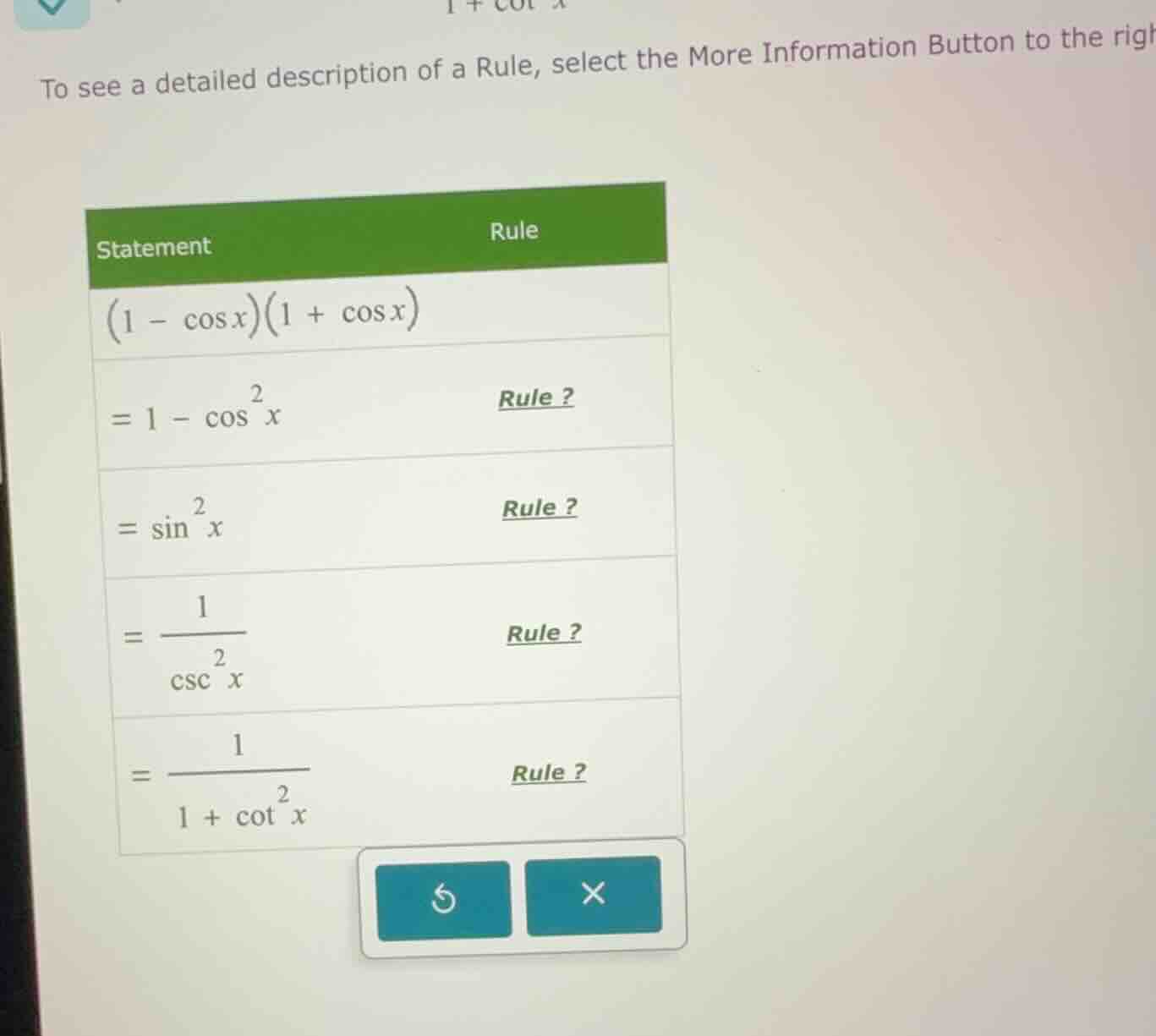
to see a detailed description of a rule, select the more information button to the right
\
$$\begin{tabular}{|l|l|}
\\hline
statement & rule \\\\
\\hline
\\((1 - \\cos x)(1 + \\cos x)\\) & \\\\
\\hline
\\(= 1 - \\cos^2 x\\) & rule? \\\\
\\hline
\\(= \\sin^2 x\\) & rule? \\\\
\\hline
\\(= \\frac{1}{\\csc^2 x}\\) & rule? \\\\
\\hline
\\(= \\frac{1}{1 + \\cot^2 x}\\) & rule? \\\\
\\hline
\\end{tabular}$$
Identify the algebraic expansion
Using the Trigonometric Identities knowledge point
$$
(1 - \cos x)(1 + \cos x) = 1^2 - \cos^2 x = 1 - \cos^2 x
$$
This step uses basic algebraic multiplication (difference of squares).
Apply the Pythagorean identity
Using the Pythagorean Identities knowledge point
$$
\sin^2 x + \cos^2 x = 1 \implies 1 - \cos^2 x = \sin^2 x
$$
Apply the reciprocal identity
Using the Reciprocal Identities knowledge point
$$
\sin x = \frac{1}{\csc x} \implies \sin^2 x = \frac{1}{\csc^2 x}
$$
Apply the cotangent Pythagorean identity
Using the Pythagorean Identities knowledge point
$$
1 + \cot^2 x = \csc^2 x \implies \frac{1}{\csc^2 x} = \frac{1}{1 + \cot^2 x}
$$

Snap & solve any problem in the app
Get step-by-step solutions on Sovi AI
Photo-based solutions with guided steps
Explore more problems and detailed explanations
Question 1
Algebra
Question 2
Pythagorean
Question 3
Reciprocal
Question 4
Pythagorean